
In the early morning of April 19th, sunlight pierced through the thin fog, spilling onto the straight asphalt road. With the sound of the starting gun, the 2026 Beijing Yizhuang Half Marathon & Humanoid Robot Half Marathon officially began.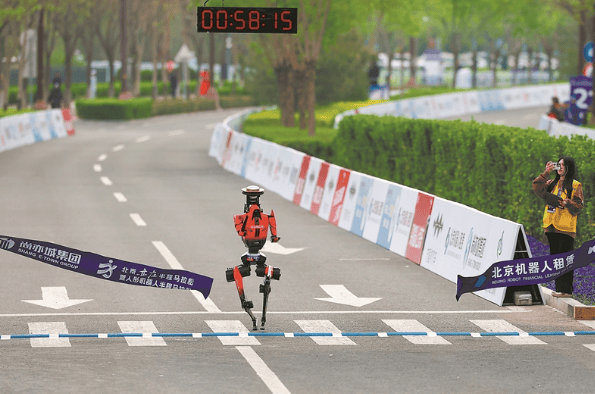
On the 21.0975-kilometer course, over 100 humanoid robots and more than 10,000 human runners dashed across the starting line together. Ultimately, a robot named "Flash" claimed the championship in the robot category with a net time of 50 minutes and 26 seconds, beating the world record for the men's half marathon by over 6 minutes.
Turning the clock back to a year ago, the inaugural Beijing Yizhuang Half Marathon & Humanoid Robot Half Marathon was also a hot topic on the internet. At that time, the completion rate was less than 30%, and mishaps such as falls and off-course deviations were frequent. Just one year later, as public attention focused on Yizhuang once again, the curiosity of netizens has been replaced by astonishment. The robust performance demonstrated by the robot participants provided an intuitive sense of the rapid advancements in technology and the industry.
Earlier this year, German Chancellor Merkel watched the Spring Festival Gala's popular robot program "Wu Bot" live during his visit to China, giving a "thumbs-up" for its outstanding performance. On an increasing number of occasions, Chinese humanoid robots are making observers both at home and abroad sit up and take notice.
Through this event, we can clearly see that Chinese humanoid robots are rapidly evolving in real-world applications. On the global robot industry's "racetrack," China is in a leading position. A system comprising policy, market, and supply chain provides strong momentum for the industry's continuous progress.
Chinese Humanoid Robots Accelerate Their Run
To gauge the maturity of a cutting-edge technology, the best testing ground is always scenarios filled with uncertainties in the real world. Unlike last year's relatively flat and controllable simulated road surface, this year's course was a complex real-world outdoor unstructured environment, featuring not only long, flat stretches but also challenges like slopes and sharp turns. Furthermore, the robots had to contend with drastically changing outdoor light and real-time road conditions.
Watching the robot participants run on the course, Zhao Mingguo, a member of the event's rules expert group and a researcher at the Department of Automation, Tsinghua University, highly praised the overall technical performance this year. Pointing to the robots' movements, he analyzed that the progress was comprehensive. Not only had hardware reliability improved significantly, but running speed and motion stability had also been markedly enhanced.
A direct indicator was the leap in battery life. "Last year, participating teams often needed to frequently swap batteries or recharge. But this year, the champion team only needed one battery swap for the entire 21-kilometer process," Zhao Mingguo emphasized. "This signifies a qualitative breakthrough in the efficiency of the energy management system and core motors."
The Honor Qitian Dasheng Team was the "dark horse" of this event. Using its self-developed motor, the robot with its 0.95-meter bionic long legs successfully won first place. Standing beside the robot adorned with the gold medal, the team's test development engineer, Du Xiaodi, explained to reporters that they had been making technical adaptations since last year, transferring mature technologies in energy efficiency management and precision control from the mobile phone field to the robots.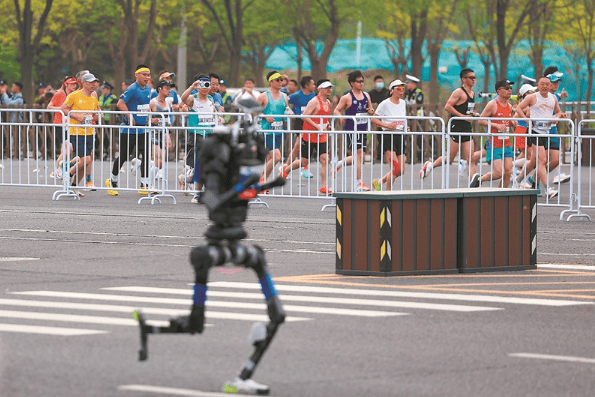
"Outdoor long-distance running generates a huge amount of heat. Our self-developed liquid cooling technology solved the heat dissipation challenges in high-temperature environments, ensuring the stable operation of the robot during high-speed running," Du Xiaodi said. In the future, these technologies validated on the track will be prioritized for application in the brand's retail business scenarios.
For humanoid robots, this race is essentially a "transition zone" between the laboratory and real-world application scenarios. The robots are not just sprinting towards the finish line; they are running into our living spaces. As Cai Jizheng, Director of the Robotics and Intelligent Manufacturing Industry Bureau of the Beijing Economic-Technological Development Area (Yizhuang), stated, the purpose of this event was to use real-world scenarios to drive technological innovation and provide an important validation platform for the implementation of the robot industry.
The Technological Leap of "Global Leadership"
The stunning performance on the track is essentially a vivid reflection of the substantive breakthroughs achieved by the Chinese humanoid robot industry across several core technologies.
The breakthrough was first evident in the robot's "brain"—its autonomous operation capability. In this event, fully autonomous navigation robots accounted for about 40% of the starting teams, a significant increase from last year. Some top-performing robots were already able to achieve body tilting and smooth cornering at high speeds.
Fu Yili, Deputy Director of the Robotics Institute at Harbin Institute of Technology, interpreted that the leap of humanoid robots from "remote-controlled staggering" to "autonomous running" is the result of collaborative efforts in domestic hardware production, algorithm optimization, and the industrial ecosystem. Looking at the global landscape, China leads in total unit shipments, mass production capability, supply chain completeness, and the speed of commercial deployment, making it the "mass production and application center" for humanoid robots. Data shows that in 2025, global humanoid robot shipments were approximately 17,000 units, of which Chinese enterprises contributed 14,400 units, accounting for over 84%.
The expansion of the industry's scale implies an increase in technological influence. Yang Zhen, Associate Researcher at the Institute of Industrial Economics, Chinese Academy of Social Sciences, pointed out that China is no longer just the world's largest robot producer but has also grown into an important source of technology supply. With patents and number of companies each accounting for over 60% of the global share, Chinese enterprises are nearly "dominating the charts" in the cutting-edge humanoid robot track.
"The scale advantage in the industry has been transformed into the power to set standards." Guo Jishun, General Manager of Wuhan Greenlan Intelligent Robot Co., Ltd., told reporters that Chinese enterprises have already taken the lead in formulating ISO international standards for humanoid robot datasets, achieving the simultaneous advancement of standard-setting and mass production.
Beyond breakthroughs in technology and standards, the progress of the Chinese humanoid robot industry towards the consumer market is also noteworthy. Guo Jishun stated that the localization rate of core components has already exceeded 90%, and the cost of the entire machine has dropped to the level of tens of thousands of yuan, only one-fifth to one-tenth of that of comparable foreign products. Commercialization for the mass market is no longer a distant prospect.
A System-Wide Explosion Long in the Making
The reason the Chinese humanoid robot industry can demonstrate such rapid progress lies behind a deep "resonance" among the policy environment, the industrial chain ecosystem, and market demand. This is not just an individual company's point breakthrough, but a system-wide explosion long in the making.
Wang Yaonan, an academician of the Chinese Academy of Engineering and a professor at the College of Electrical and Information Engineering, Hunan University, believes that forward-looking policy planning provides the strongest driving force for the industry.
The 15th Five-Year Plan outlines the forward-looking layout of future industries, promoting embodied intelligence as a new economic growth point, with humanoid robots being a key form of embodied intelligence. From the "14th Five-Year Plan for Robot Industry Development" to the "Guiding Opinions on the Innovative Development of Humanoid Robots," China has set clear goals for breaking through core technologies at the top design level.
Simultaneously, regions like Beijing, Shanghai, and Hubei have successively established hundred-billion-yuan-level industrial funds to proactively layout embodied intelligence and humanoid robots as new quality productive forces. This model of government-led initial investment followed by social capital has effectively filled the "valley of death" between the lab and the market.
Wang Yaonan also noted that China possesses the world's most complete supply chain for electronics and mechanical manufacturing, enabling rapid integration of various necessary components at relatively low production costs. Furthermore, China has made significant breakthroughs in control technology for humanoid robots in recent years, with particularly notable progress in autonomous motion control and stability.
Driven by policy support, technological development, and a vast domestic demand market, the Chinese humanoid robot industry has maintained a strong growth momentum. Yang Zhen analyzed that on the industrial chain side, relying on the "half-hour supply chain circle" in the Yangtze River Delta and Pearl River Delta regions, companies can achieve very high-frequency technological iterations. On the demand side, the large and diverse market scale provides ample room for profit and trial-and-error for technological iteration.
"The arrival of an aging society is one of the important driving forces for the humanoid robot industry to cross the commercialization chasm," Yang Zhen mentioned. China is already exploring robot application scenarios integrating "elderly care + childcare," continuously optimizing the robots' adaptive capabilities through feedback from real-world data.
Despite the strong momentum and promising future of the industry's development, we must still think calmly. "There is still a long way to go before they truly enter factories and homes," Fu Yili candidly acknowledged. Researchers still need to continuously push boundaries in underlying technologies such as high-performance joints, high-sensitivity force/tactile sensors, and embodied intelligence decision-making algorithms.
Although this race has concluded, the progress of the humanoid robot industry is far from crossing its finish line. The "China Development Report 2025" released by the Development Research Center of the State Council predicts that by 2030, the scale of China's embodied intelligence market could reach 400 billion yuan, potentially exceeding 1 trillion yuan by 2035. China's robot industry is steadily sprinting towards the global technological high ground.