
A research team led by Professor Shu Yang and Dr. Kun-Hao Yu from the University of Pennsylvania has published a study in the journal Advanced Materials, developing a diatomite-cement composite tile inspired by the skin of African elephants. This tile achieves efficient passive evaporative cooling through a programmable crack network. The first author of the paper is Qingya Huang, and it was published in 2026.
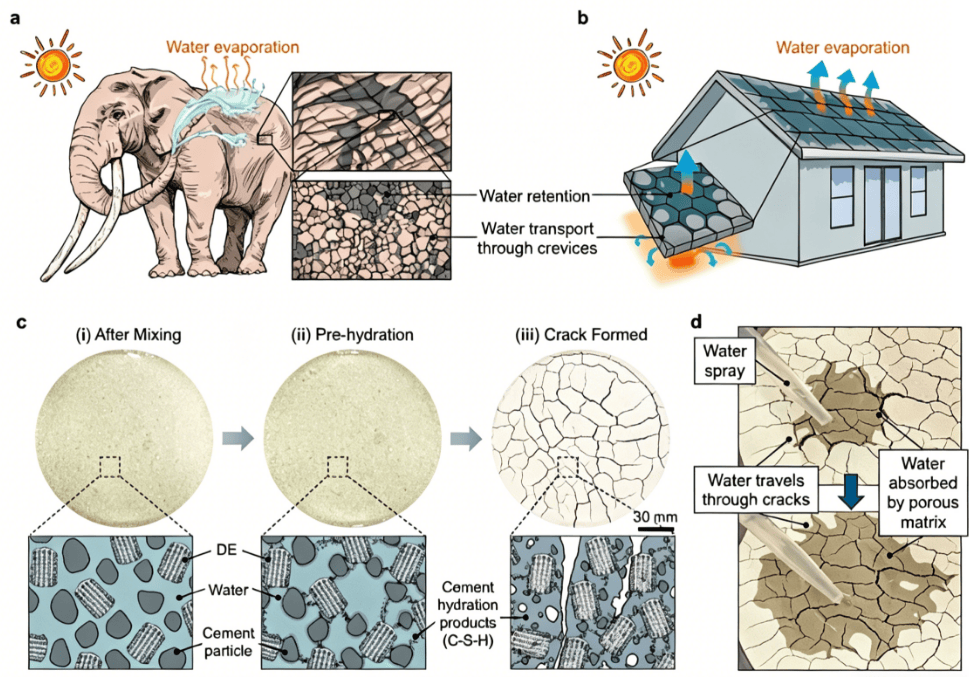
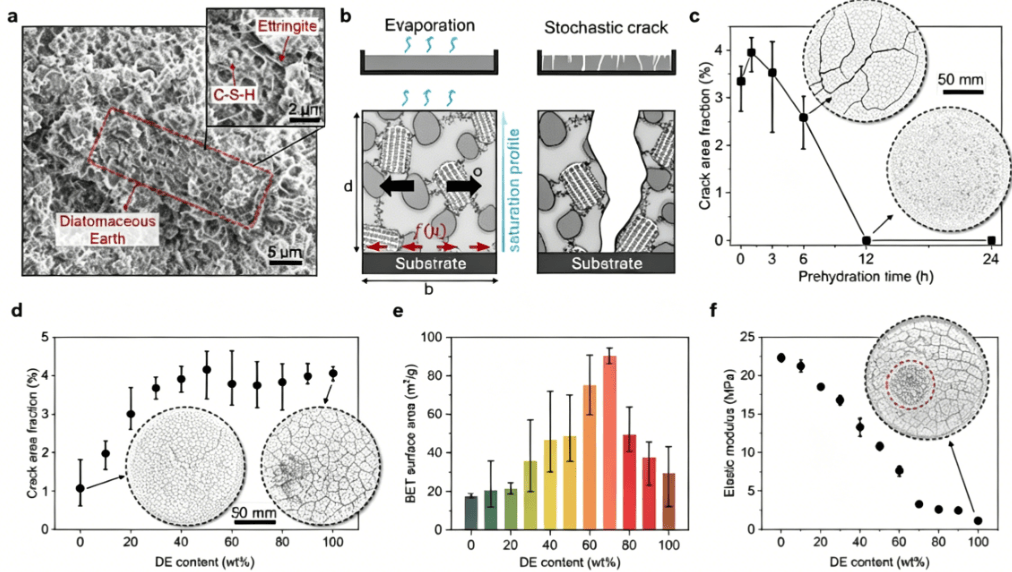
The research team cast a 3 mm thick sample from a 1:1 mass ratio of diatomite and cement slurry. After one hour of pre-hydration and drying at 60°C, cracks formed spontaneously in the material. The micro-nano porous structure of diatomite enables rapid water absorption within 50 milliseconds, while the crack network acts as capillary conduits to horizontally transport water across the entire surface. Calcium silicate hydrate gel and ettringite needle-like crystals, generated during pre-hydration, form bridging structures between diatomite particles, maintaining structural integrity through repeated wetting-drying cycles. The composite material with 50% diatomite content has an elastic modulus exceeding 10 MPa and a 3-day compressive strength of approximately 2.9MPa.
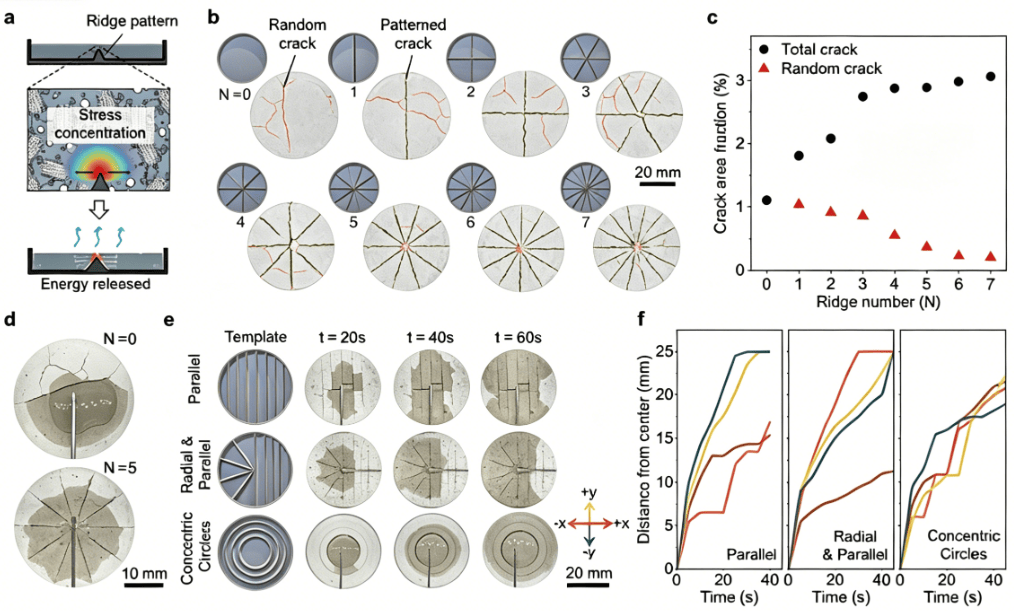
By designing triangular ridge protrusions on the mold base as stress concentrators, the team transformed random cracking into controllable, deterministic crack patterns. They further fabricated three types of space-filling periodic crack networks: triangular, square, and hexagonal. Testing under a 60° tilt with a fixed water volume showed that a medium-density hexagonal lattice network achieved the highest water retention, extending the effective cooling period to over 20 hours.
In a simulated residential roof model, the research team placed 50% diatomite hexagonal crack tiles, cracked commercial plaster tiles, and crack-free plaster tiles under infrared lamp heating conditions. The surface temperature of the heat source was maintained at 42±1°C, with 15.5 grams of water supplied at the roof ridge every 30 minutes. Results showed that the temperature below the diatomite-cement tiles remained stable at approximately 32°C, while it was about 42°C below the cracked plaster tiles and roughly 52°C below the crack-free plaster tiles.
This method transforms the random cracking defects resulting from drying shrinkage of cement-based materials into functional advantages for water conduction and retention, offering a technical solution for low-cost, scalable, and highly durable zero-energy passive cooling materials for buildings. The research team has filed a patent for this technology and is currently advancing toward larger-scale application testing.