
Today (23rd), the National Astronomical Observatories of the Chinese Academy of Sciences released the cosmological simulation project "Qianyan." An international team led by Chinese scientists has successfully constructed a digital virtual universe within a supercomputer, providing a high-precision digital guide map for humanity to explore the mysteries of the universe and study its historical evolution.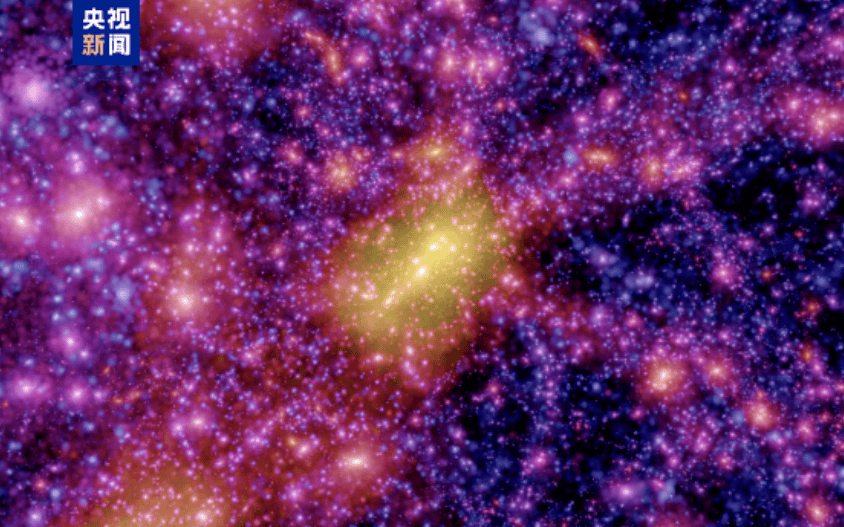
The so-called digital virtual universe refers to a digitalized universe very similar to the real one, built by researchers leveraging the powerful computing capabilities of supercomputers. This digital universe fully reproduces the evolution process of the universe over billions of years from its birth to the present, with the appearance of each stage completely recreated in the form of digital models.
Researcher Wang Qiao from the National Astronomical Observatories of the Chinese Academy of Sciences explained that since the Big Bang, the universe has evolved from a very uniform state to a web-like structure. In the "Qianyan" simulation, the research team used 4.2 trillion virtual particles to describe the entire process of the universe's structural formation and evolution over 13.8 billion years.
Leveraging physical models of galaxy formation, "Qianyan" can provide key information such as galaxy images and energy spectra. Comparing this high-precision virtual universe with actual observational data will help crack the essential mysteries of dark matter and dark energy, and deepen the understanding of galaxy evolution laws. Additionally, the simulation data will provide crucial scientific support for international flagship observation projects, including China's Space Station Telescope (CSST) and the European Space Agency's "Euclid."
It is understood that in this research effort spanning over a decade, the Chinese research team used independently developed software to optimize algorithms and programming for domestically produced supercomputers, ultimately generating massive scientific research data totaling 13 PB. This fully demonstrates China's innovative capabilities in the fields of computational cosmology and high-performance computing, helping the global cosmology research community enter an era of high precision.