
Nuclear fusion energy has been written into the national "15th Five-Year Plan" outline and listed as a key direction for future industries. Its basic principle is the same as the energy source of the sun, hence it is called the "artificial sun."
During the "15th Five-Year Plan" Period, China's "Artificial Sun"
Will Move from the Laboratory to Industrialization
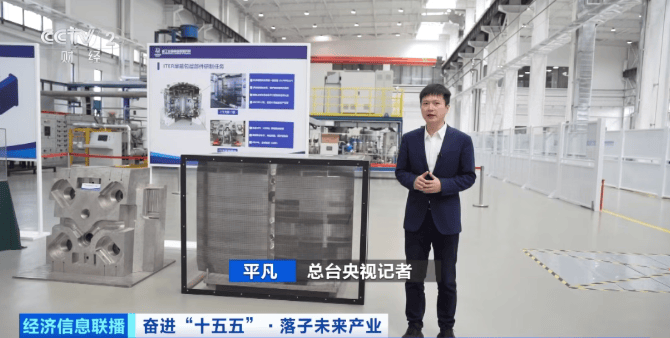
CCTV Reporter Ping Fan: At the National Fusion Industry Test Platform in Chengdu, Sichuan, the first wall, a core component of the "artificial sun," acts like armor directly facing the extreme high-temperature challenges and particle bombardment of the central plasma. Its core raw materials include three metals: tungsten, copper, and stainless steel.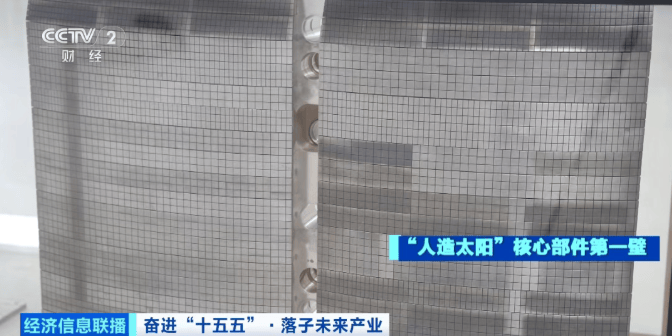
The first wall is located on the innermost side of the "artificial sun" vacuum vessel, serving as the first line of defense directly facing the high-temperature plasma, equivalent to the "close-fitting armor" of the fusion device. Currently, China has achieved fully independent research, development, manufacturing, and testing of the first wall, with materials, welding processes, and high-heat load tests all reaching internationally leading levels. This is also one of the core breakthroughs in the engineering implementation of controllable fusion in China.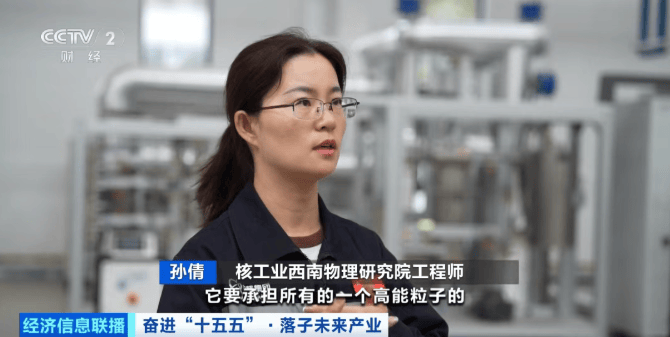
Sun Qian, Engineer at the Southwestern Institute of Physics: It directly protects the peripheral equipment and must withstand all the heat loads from high-energy particles and neutron bombardment. Currently, all materials are independently developed by us, and the entire process is also independently researched and explored, representing that our technology has entered a very leading position globally.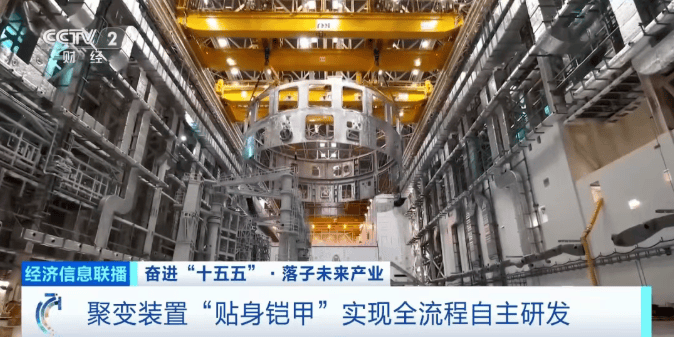
"Huanliu-3," as China's "new generation artificial sun" device, has achieved "double hundred million degrees" with an ion temperature of 120 million degrees Celsius and an electron temperature of 160 million degrees Celsius, with comprehensive fusion parameters reaching the order of 10 to the 20th power. Currently, "Huanliu-3" is advancing comprehensive upgrades as planned, aiming to achieve its first burning experiment in 2027.
Researchers told reporters that nuclear fusion power generation needs to achieve fusion burning and energy output, then solve the problems of stable operation and engineering reliability, and finally reduce costs through scaling and technological iteration.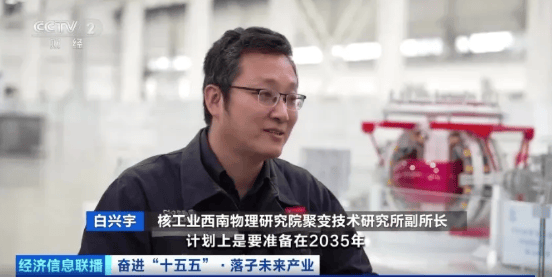
Bai Xingyu, Deputy Director of the Fusion Technology Research Institute at the Southwestern Institute of Physics: The plan is to build our fusion pilot experimental reactor around 2035, and a demonstration reactor around 2045, following the logic of experimental reactor - demonstration reactor - commercial reactor.
Fusion Industry Technology "Laying Golden Eggs Along the Way"
Surrounding Industries "Blossoming at Multiple Points"
During the interview, reporters learned that the research and development of nuclear fusion is a systematic innovation project covering over a hundred advanced and sophisticated technologies, including superconducting magnets, precision manufacturing, special materials, artificial intelligence, and measurement and control technology. How will the promotion and application of this series of cutting-edge technologies drive the development of surrounding industries? And how large a market space will it create?
At the Southwestern Institute of Physics in Chengdu, Sichuan, based on the advanced plasma surface engineering technology of the "artificial sun," researchers are preparing non-precious metal catalytic electrodes, which can significantly improve hydrogen production efficiency and reduce the cost of hydrogen production from electrolyzed water, playing a promoting role in the large-scale development of green hydrogen.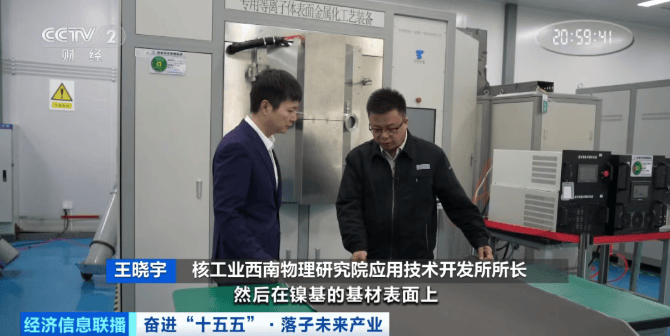
Wang Xiaoyu, Director of the Applied Technology Development Institute at the Southwestern Institute of Physics: We mainly utilize the high activity of plasma to coat a layer of hydrogen production electrode catalyst on the surface of a nickel-based substrate. This allows us to achieve the function of precious metal-based electrodes using non-precious metals, and its cost may only be one-tenth of that of precious metals.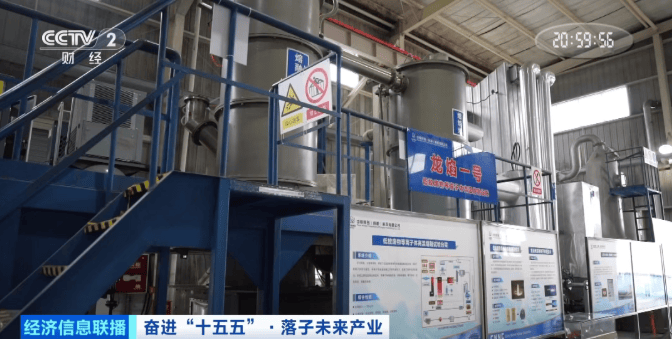
On the experimental device, researchers use plasma to reform carbon dioxide into syngas, which is then further synthesized to prepare fuel. Compared to traditional technologies, this technology can deeply couple with fluctuating renewable energy sources, providing a new path for the consumption of wind and solar power.
Currently, AI large models are triggering a surge in computing power demand. To enhance the powerful computing capabilities of graphics processors, global technology companies are rapidly deploying a new generation of glass substrate packaging materials. Fusion plasma technology can significantly improve the integration density of glass substrate packaging.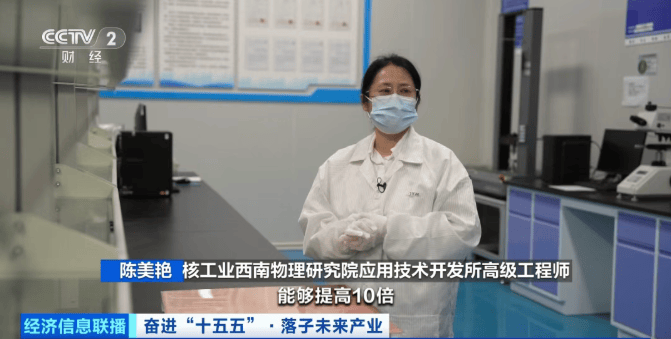
Chen Meiyan, Senior Engineer at the Applied Technology Development Institute of the Southwestern Institute of Physics: It can increase the chip packaging interconnection density, up to 10 times higher than conventional organic substrates, and its cost can be reduced to 80% of organic substrates. There may be a market scale of tens of billions of yuan in the next 3 to 5 years.
During the research and development process, fusion technology has precipitated a large number of transferable hardcore achievements. On one hand, this promotes the rapid formation of a complete fusion industry chain; on the other hand, core technologies such as superconducting magnets and plasma have already been applied in fields like hydrogen production, mineral sorting, medical equipment, and power transmission in China.
During the "15th Five-Year Plan" Period, China's Nuclear Fusion Industry
Is Expected to Reach a Scale of Hundreds of Billions
From top-level policy design to the efforts of market entities, the innovation ecosystem of China's fusion industry is accelerating its construction. Reporters learned that with the establishment of leading enterprises such as China Fusion Energy Corporation, China's nuclear fusion industry is expected to reach a scale of hundreds of billions of yuan by the end of the "15th Five-Year Plan" period.
China Fusion Energy Corporation, established in Shanghai, will promote the three-stage development of the "artificial sun" project from "experimental reactor to demonstration reactor to commercial reactor," expanding the fusion industry chain.
Liu Ye, Chairman of China Fusion Energy Corporation: Looking ahead to the next five years, it will be a period where various innovation entities such as research institutes, universities, and commercial companies actively participate, high-quality scientific and technological innovation achievements emerge rapidly, and the innovation ecosystem flourishes.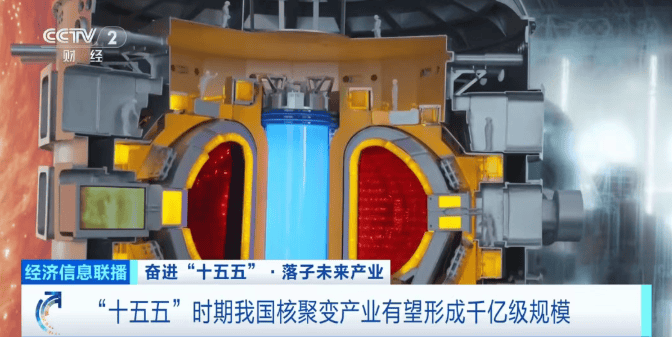
To accelerate the realization of the "artificial sun" dream, China has built an "ecosystem" supporting the engineering and industrialization development of fusion energy from multiple levels, including policy guidance, international cooperation, and mechanism innovation. By the end of the "15th Five-Year Plan" period, it is expected to form an industrial scale of hundreds of billions of yuan and cultivate a group of core enterprises with global competitiveness.