
Recently, the team led by Zhou Guangmin at Tsinghua Shenzhen International Graduate School in Shenzhen, Guangdong, China, achieved a breakthrough in the field of lithium-sulfur batteries, with the related results published online in Nature. The team adopted a "molecular building block" design approach, utilizing quantum chemistry and machine learning technologies to develop high-specific-energy lithium-sulfur batteries.
The energy density of conventional lithium-ion batteries is approaching its theoretical limit. Lithium-sulfur batteries, due to their theoretical energy density advantage, are regarded as a core candidate system for long-endurance drones and the development of the low-altitude economy. However, the industrialization of lithium-sulfur batteries is constrained by challenges such as the complex sulfur conversion pathway and slow reaction kinetics. Traditional molecular design relies on empirical trial-and-error, which is inefficient. Zhou Guangmin's team proposed a new concept of "pre-molecular mediator" for sulfur electrochemistry and established an intelligent molecular skeleton programming scheme driven by "quantum chemistry + machine learning."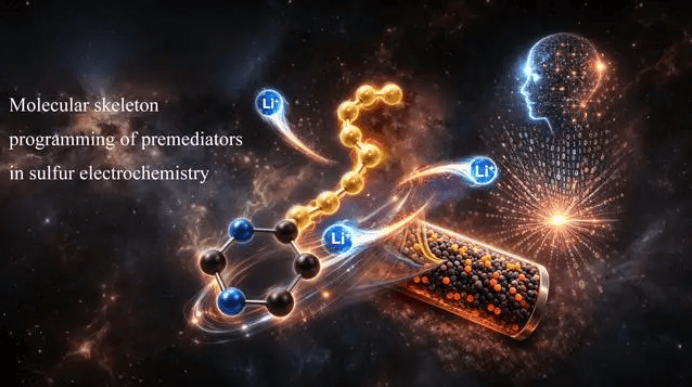
The research team clarified the physicochemical properties of molecules through quantum chemistry calculations and used machine learning to screen the optimal solution from 196 molecular combinations, ultimately identifying 4-trifluoromethyl-2-chloropyrimidine as a high-performance pre-molecular mediator. This material is a "to-be-activated" molecular precursor that can be awakened in situ by polysulfides at the battery reaction site, transforming into an active molecule, reshaping the sulfur conversion pathway, and accelerating reaction kinetics. Experimental data shows that this pre-molecular mediator can reduce the battery's charge transfer impedance by 75%. The energy density of lithium-sulfur batteries based on this is enhanced, effectively extending the endurance time of drones. This research overcomes the core technical bottleneck of lithium-sulfur batteries, providing a new concept and technical pathway for the design and development of next-generation high-specific-energy batteries in fields such as the low-altitude economy and new energy storage.