
Researchers from Worcester Polytechnic Institute and Argonne National Laboratory in the United States have jointly proposed a new battery recycling process that can convert low-value battery waste into next-generation cathode materials with higher energy density and stronger cycling stability. The related paper was recently published in the journal ChemCycling.
As demand for electric vehicles and energy storage systems continues to rise, lithium iron phosphate batteries have been widely adopted due to their safety and cost advantages. However, traditional recycling methods typically can only extract lithium and iron salts of relatively low value, providing weak economic drivers for recycling. To address this issue, the research team designed a "leaching-assisted upcycling" scheme. This process can preserve the original particle morphology of battery materials under atmospheric pressure conditions and convert mixed spent cathode materials—including lithium iron phosphate and lithium manganese oxide—into high-value lithium manganese iron phosphate, achieving an elemental reuse rate exceeding 95%. By avoiding high-pressure hydrothermal synthesis and being compatible with existing hydrometallurgical facilities, this technical pathway creates favorable conditions for large-scale deployment.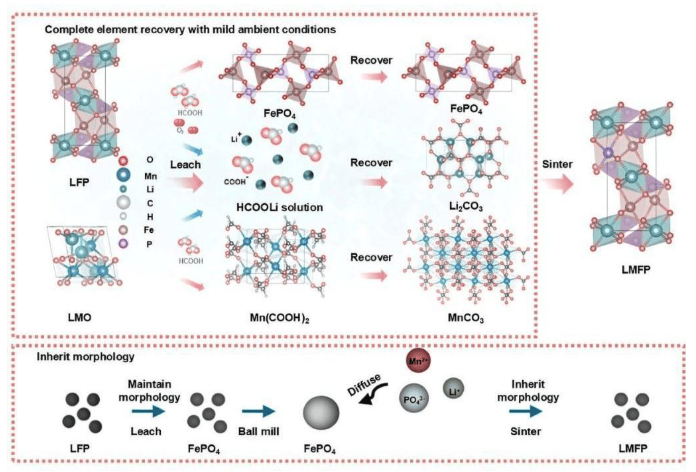
The resulting lithium manganese iron phosphate cathode material not only offers higher energy density but also demonstrates excellent cycling stability. Compared to traditional recycling schemes, the new process reduces raw material consumption, energy use, and wastewater discharge. The team stated that this work signifies a shift in mindset: from simply recovering raw materials to upgrading waste into higher-value next-generation products. Techno-economic analysis also indicates that the new process possesses positive profitability under various scenarios, potentially enabling recycling facilities to evolve into value-creation nodes within the circular battery supply chain.
The researchers also noted that several challenges must still be overcome before moving toward large-scale deployment. The composition of industrial spent batteries varies significantly, and future work needs to advance in areas such as impurity management, pilot demonstrations, and fostering collaboration among recyclers, manufacturers, and policymakers.