
A research team from the Harvard John A. Paulson School of Engineering and Applied Sciences, in collaboration with multiple international institutions, has successfully observed the acoustic Purcell effect in diamond nanostructures for the first time. Using a single silicon-vacancy center as a spin qubit, the study designed a microwave-frequency nanomechanical resonator, achieving an approximately tenfold enhancement of the spin relaxation rate, corresponding to a spin-phonon cooperativity of about 10, setting a new record.
According to the paper published in the journal *Nature* on May 6, the research team constructed a specially designed microwave-frequency nanomechanical resonator around a color center spin qubit in diamond and performed single-photon-level laser spectroscopy measurements at millikelvin temperatures. The experiment showed that when the spin qubit was tuned into resonance with a 12 GHz acoustic mode, its spin relaxation rate accelerated tenfold compared to free space, directly confirming the core prediction of the acoustic Purcell effect. Furthermore, the team used the color center as an atomic-scale probe to measure the broadband phonon spectrum of the nanostructure up to 28 GHz.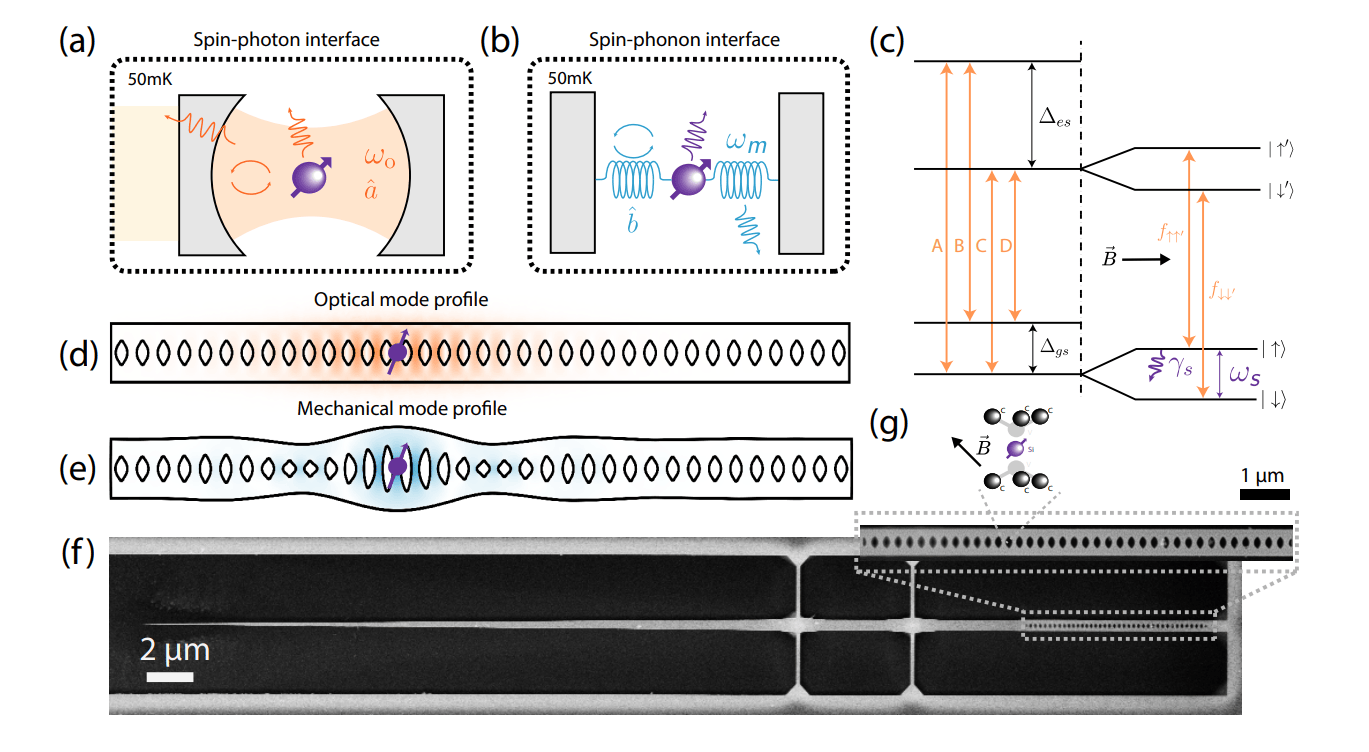
The Purcell effect, proposed by physicist Edward Purcell in 1946, describes how an electromagnetic resonant cavity can alter the spontaneous emission rate of a light emitter placed within it, and has since been widely applied in quantum computing and communication. The acoustic Purcell effect is the phononic counterpart of this effect, using sound waves instead of light waves to control quantum states. The Harvard team's successful replication of this mechanism in a solid-state artificial atom for the first time fills an experimental gap in solid-state acoustic systems that has existed for nearly 80 years since the theory was proposed.
The silicon-vacancy center is a point defect in diamond formed by a single silicon atom replacing two carbon atoms. Its ground state orbital doublet is highly sensitive to local strain, and its electron-phonon coupling strength is naturally superior to other color center systems. Leveraging this property, the team used the nanomechanical resonator to redistribute the phonon density of states, selectively accelerating the spin relaxation channel via phonon emission. Measurements indicate the system's spin-phonon cooperativity reaches approximately 10, marking that the system has crossed the critical threshold required for quantum coherent control, where phonons can efficiently extract information from the qubit without being overwhelmed by environmental noise.
This research was led by Harvard University and completed in collaboration with research teams from Japan, Europe, and other regions. The paper has a total of 12 co-authors, including Graham Joe, Michael Haas, Kazuhiro Kuruma, Chang Jin, Dongyeon Daniel Kang, Sophie Weiyi Ding, Cleaven Chia, Hana Warner, Benjamin Pingault, Bartholomeus Machielse, Srujan Meesala, and Marko Loncar. This transcontinental collaboration model encompassed the complete technical chain from diamond material preparation and nanostructure fabrication to cryogenic quantum measurement.
This achievement opens a direct channel for signal conversion between solid-state qubits and acoustic superconducting devices, potentially reshaping the interconnection methods for quantum network nodes. First, phonons can serve as a "universal quantum transducer" between different physical systems, enabling information transfer between superconducting qubits and solid-state color centers. Second, this technology can be directly translated into mechanical quantum memory, providing a physical foundation for information synchronization and caching in distributed quantum computing networks. Third, the acoustic Purcell effect can convert phonon noise into a resource for enhancing spin polarization, offering sensitivity beyond current limits for quantum sensing.
Against the backdrop of accelerating international competition in quantum computing, the Harvard team's achievement establishes an experimental foundation for the emerging field of "acoustic quantum interconnects." Currently, multiple national laboratories worldwide have successively launched research programs on solid-state acoustic quantum interfaces. It is anticipated that within the next two years, prototype devices for quantum transducers and repeaters based on the acoustic Purcell effect will successively enter the proof-of-principle verification stage.