
On May 27, the scientific and technological achievement "Key Technologies and Equipment Development for Non-Power-Off Ice-Melting on DC Transmission Lines," led by the CSG Electric Power Research Institute and jointly completed by six units including the Qujing Bureau of CSG EHV Power Transmission Company and Guilin Power Supply Bureau, successfully passed the appraisal organized by the China Electricity Council. The appraisal committee, composed of nine authoritative industry experts including Qiu Aici, an academician of the Chinese Academy of Engineering, unanimously agreed that the overall technology of the achievement has reached an internationally leading level.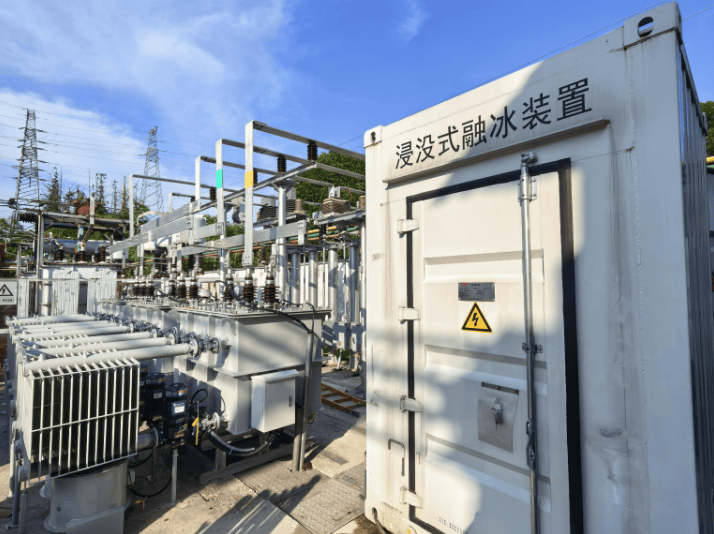
Currently, as China accelerates the construction of its new power system, the large-scale integration of a high proportion of new energy sources imposes unprecedentedly stringent requirements on the safe and stable operation of large power grids and the reliability of power supply under extreme weather conditions. Ice accretion disasters are among the most severe extreme meteorological events threatening the safe operation of power grids, easily leading to line tripping, wire breakage, tower collapse, and even large-scale power outages. This is a global challenge that has long plagued the power industry.
Traditional ice-melting technologies generally adopt a power-off ice-melting mode. Although this can ensure equipment safety, during critical power supply periods under extreme cold waves and widespread icing, power-off ice-melting can exacerbate the tension between regional power supply and demand.
Addressing the major needs of national energy security and the high-quality development of power grids, the project team from the CSG Electric Power Research Institute, relying on a series of scientific and technological projects, conducted theoretical analysis, modeling calculations, device research and development, and experimental verification. After eight years of dedicated research, they proposed methods and strategies for suppressing induced voltage during non-power-off ice-melting in DC transmission projects, overcoming technical challenges such as balancing ice-melting with induced voltage and ensuring system safety and stability during non-power-off conditions. They developed the first set of submerged ice-melting devices based on phase-change heat transfer technology and a mobile non-power-off DC ground wire ice-melting system. According to reports, the project's achievements have been promoted and applied in provinces such as Guangxi, Yunnan, Guizhou, and Hunan, achieving non-power-off ice-melting on DC transmission lines for the first time. This effectively ensures the continuous and reliable operation of transmission lines under extreme weather, properly balances the major demands of grid "ice disaster prevention" and "power supply assurance," comprehensively enhances the resilient defense capability of large power grids against extreme ice disasters, and yields significant economic, social, and ecological benefits.
In the next step, the team will continue to deeply cultivate technological innovation and equipment upgrades for non-power-off ice-melting, accelerate the iteration and widespread application of the achievements, improve the efficiency and economy of grid ice disaster prevention, and provide strong technical support for building the new power system.