
The global demand for strategic metals such as nickel, cobalt, and copper is surging, while terrestrial resources are increasingly depleted. However, thousands of meters beneath the ocean surface, the deep seabed harbors immense "treasures," including approximately 3 billion tons of cobalt and trillions of tons of manganese nodules. Whoever first unlocks this blue treasure trove will secure a commanding position in the international competition of the new energy era.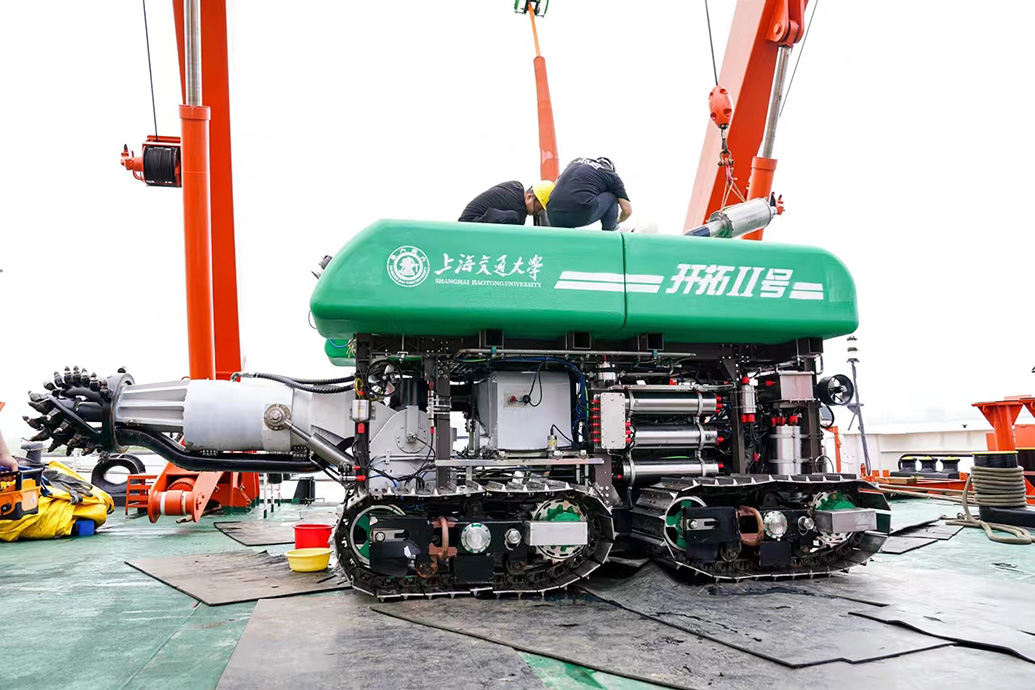
Recently, the "Pioneer" series deep-sea heavy-duty mining vehicle, developed by a team led by Professor Yang Jianmin of Shanghai Jiao Tong University, successfully completed trial mining of hard rock at a maximum depth of 4,102.8 meters, marking a milestone leap in China's deep-sea mining capabilities. This achievement not only makes China one of the few countries in the world capable of engineering-scale deep-sea hard rock mining but also opens a new pathway for cultivating future industries in deep-sea technology.
Two "Heavyweights" Lay the Foundation for Deep-Sea Mining
In 2013, when foreign deep-sea mining equipment had already reached a certain level, China's related research and development started almost from scratch. Under the leadership of Professor Yang Jianmin, Chief Scientist of the "Pioneer" series and Chair Professor at the School of Naval Architecture, Ocean & Civil Engineering of Shanghai Jiao Tong University, a team of naval architecture and ocean engineering experts embarked on a 13-year journey of independent research and development.
The team's achievements have been solid and progressive:
"Pioneer I," primarily targeting polymetallic nodules, measures 5.6 meters in length and weighs 9.0 tons. It successfully completed deep-sea trials in August 2021 in the Xisha waters of the South China Sea, reaching a maximum operating depth of 1,305 meters, a domestic leading level at the time, achieving a breakthrough from nothing.
"Pioneer II" focuses on more challenging hard rock ores such as polymetallic crusts and polymetallic sulfides. It measures 6.0 meters in length, weighs 14.5 tons (5.6 tons in water), and has a design operating depth of 6,000 meters, requiring greater R&D investment and posing more severe technical challenges.
In June 2024, "Pioneer II" traveled to the polymetallic crust and nodule areas of the Western Pacific Ocean. Over five consecutive days of continuous operation, facing Force 6 winds and Sea State 4 conditions, the mining vehicle successfully completed five seabed deployments, including four at depths of around 2,000 meters and one at a depth of around 4,000 meters, with the maximum diving depth firmly set at 4,102.8 meters. It brought back over 200 kilograms of deep-sea mineral samples, including polymetallic crusts, polymetallic nodules, and seabed bedrock.
With this, the Shanghai Jiao Tong University team conquered five major technological frontiers: high-mobility traversal of complex seabed terrain, composite drilling and mining for multiple ore types, intelligent fine control for deep-water heavy-duty operations, deployment and recovery of heavy loads using non-metallic cables, and monitoring and assessment of deep-sea environmental disturbances. Crucially, they broke the 4,000-meter depth barrier for the first time in deep-sea mining vehicle sea trials. In May 2026, this project was honored as one of the "Top Ten Scientific and Technological Advances" of Shanghai Jiao Tong University.
Five Pioneering Technologies Forge an "Undersea Vajra"
High-Mobility Traversal of Complex Seabed Terrain: Maneuvering Steep Slopes and Soft Mud with Ease
Polymetallic crusts often adhere to steep seamounts with slopes exceeding 30 degrees, while polymetallic nodules are often "half-buried" in viscous, soft seabed sediments.
"Pioneer II's" four independent tracks can autonomously adjust their direction and posture in real-time based on the actual seabed terrain, achieving centimeter-level precise positioning even in the pitch-black deep-sea environment. Whether traversing hard rock ridges or passing through soft sediments, the mining vehicle can smoothly move, climb slopes, and perform in-situ rotations, truly enabling it to navigate various complex seabed terrains as if on flat ground.
Composite Drilling and Mining for Multiple Ore Types: One Vehicle, Multiple Functions, Simultaneous Collection
Huang Wei, Deputy Director of the Deep-Sea Geology and Minerals Department at the Qingdao Institute of Marine Geology, who participated in the sea trials aboard the support vessel, marveled: "For polymetallic crusts attached to sloping bedrock, 'Pioneer II's' cutting capability can quickly separate the crust from the bedrock and efficiently suck the crust ore into the collection bin. For polymetallic nodules half-buried in soft seabed sediments, it can excavate them."
A single set of equipment capable of adapting to the collection of two different types of ores significantly enhances the engineering efficiency and equipment utilization level of deep-sea mining.
Intelligent Fine Control for Deep-Water Heavy-Duty Operations: Autonomous Perception, Autonomous Decision-Making
The extreme environment of deep-sea operations imposes the highest demands on artificial intelligence and automatic control. The intelligent control system equipped on "Pioneer II" possesses capabilities such as autonomous path planning, target tracking, and autonomous obstacle avoidance for its operations. It can complete seabed tasks without human intervention, even in dark, high-pressure, and adverse sea conditions. With the support of centimeter-level precise positioning, complex seabed mining operations resemble a choreographed, automated "underwater ballet."
Deployment and Recovery of Heavy Loads Using Non-Metallic Cables: First Domestic Large-Depth Winch System
The deployment and recovery of heavy-duty equipment in high sea states and deep-sea environments represent a "critical test" for deep-sea mining equipment. Non-metallic cables offer higher specific strength and superior signal transmission capabilities compared to metallic cables. However, technical challenges such as the swaying of large-tonnage deep-sea equipment in wind and waves, and sudden load changes, had long troubled the team. "Pioneer II" successfully validated the deep-sea heavy-load deployment and recovery system using non-metallic cables, providing key engineering capabilities for China's deep-sea entry and exit of large-depth heavy-duty equipment.
Deep-Sea Environmental Disturbance Monitoring: The Data Foundation for Green Mining
The deep-sea ecological environment is extremely fragile. The potential impacts of large-scale mining, such as seabed "plumes" and noise, are central to international debates on deep-sea mining. "Pioneer II" is equipped with a multi-parameter environmental monitoring system that comprehensively monitors and assesses the generation and diffusion of plumes and underwater operational noise caused by seabed operations, providing first-hand empirical data for future green deep-sea mining.
Seeking Resources from the Deep Blue, Securing Sovereignty through Technology
Breaking the "Bottleneck" of Strategic Mineral Supply
China faces a severe situation regarding its dependence on foreign sources for key metals: its dependence on foreign cobalt is nearly 99%, and on copper reaches 77%, with dependence on some strategic minerals even exceeding that on oil. The grade of mineral deposits in deep-sea mining areas is generally an order of magnitude higher than that of similar terrestrial deposits—the mineral value extractable from one ton of seabed nodules is approximately 6,000 to 7,000 RMB.
The breakthrough of the "Pioneer" series signifies a solid step for China in reducing its over-reliance on single terrestrial mineral sources and achieving self-control over the supply chain of strategic minerals. Professor Chen Xuguang from Ocean University of China pointed out: "Deep-sea mining is crucial for the self-control of the strategic mineral resource supply chain."
Seizing the First-Mover Advantage in Deep-Sea Development Commercialization
The International Energy Agency estimates that by 2030, the global demand for cobalt could be 10 times, or even up to 25 times, higher than current levels. The European Union, Japan, Canada, and other countries are already racing to develop key technologies and equipment for deep-sea mining. It is predicted that the development of deep-sea mineral resources could achieve commercial utilization within the next 10 to 15 years.
Canada's TMC company completed deep-sea mining collection and lifting tests in 2022. Academician Liu Dahai of the Chinese Academy of Engineering emphasized: "Mastering deep-sea mining technology means a country possesses long-term, systematic, and controllable operational and survival capabilities in the deep and distant oceans. This is a key indicator of transitioning from coastal waters to the deep blue and an indispensable technological cornerstone for a maritime power." The success of the "Pioneer" series has propelled China into the ranks of global leaders in this race for future resources.
Fostering a Deep-Sea Equipment Industrial Cluster
Deep-sea mining is an extremely complex system engineering project integrating deep-sea exploration, communication and navigation, intelligent robotics, surface support, and environmental monitoring. The technological achievements will systematically drive upgrades in multiple industrial sectors, including deep-sea robots, pressure-resistant materials, precision sensors, intelligent control, dynamic positioning, and special-purpose ship design, forging a new engine for China's high-end equipment manufacturing and marine information industries.
The successful sea trial of "Pioneer II" has been widely reported by over 300 domestic and international media outlets, including People's Daily, Xinhua News Agency, and the Chinese government website, becoming a landmark event for China's deep-sea mining. As global deep-sea resource development approaches the commercialization stage, the "Pioneer" series will undoubtedly serve as the pioneering envoy of China's deep-sea mining equipment, forging ahead through the ever-deeper blue territories.