
Among gravity separation equipment spanning a century, the shaking table, with its unique advantages of high enrichment ratio and no reagent pollution, still holds an "irreplaceable" position in the global recovery of fine-grained minerals of key metals such as tungsten, tin, tantalum, and niobium. However, the reliance on manual visual inspection for concentrate belt identification and manual adjustment of the concentrate launder—an operational mode used for decades—has become the "last barrier" hindering the intelligent upgrade of mineral processing plants. Recently, the team of Yang Wenlong and Qiu Mingguang from Jiangxi University of Science and Technology, in collaboration with Ganzhou Nonferrous Metallurgy Research Institute Co., Ltd. and Jiangxi Tungsten Industry Holding Group, published a groundbreaking achievement in the international journal Gold, Volume 47, Issue 5. They successfully developed an intelligent control system for shaking table concentrate collection based on machine vision and deep learning. Industrial trial data is encouraging: the grade of WO₃ (tungsten trioxide) in the concentrate increased by up to 2.9 times, and the grade of Sn (tin) in the concentrate more than doubled. This signifies that the long-standing problem of "human eye monitoring and unstable precision" in the gravity separation field has finally achieved a systematic technological breakthrough.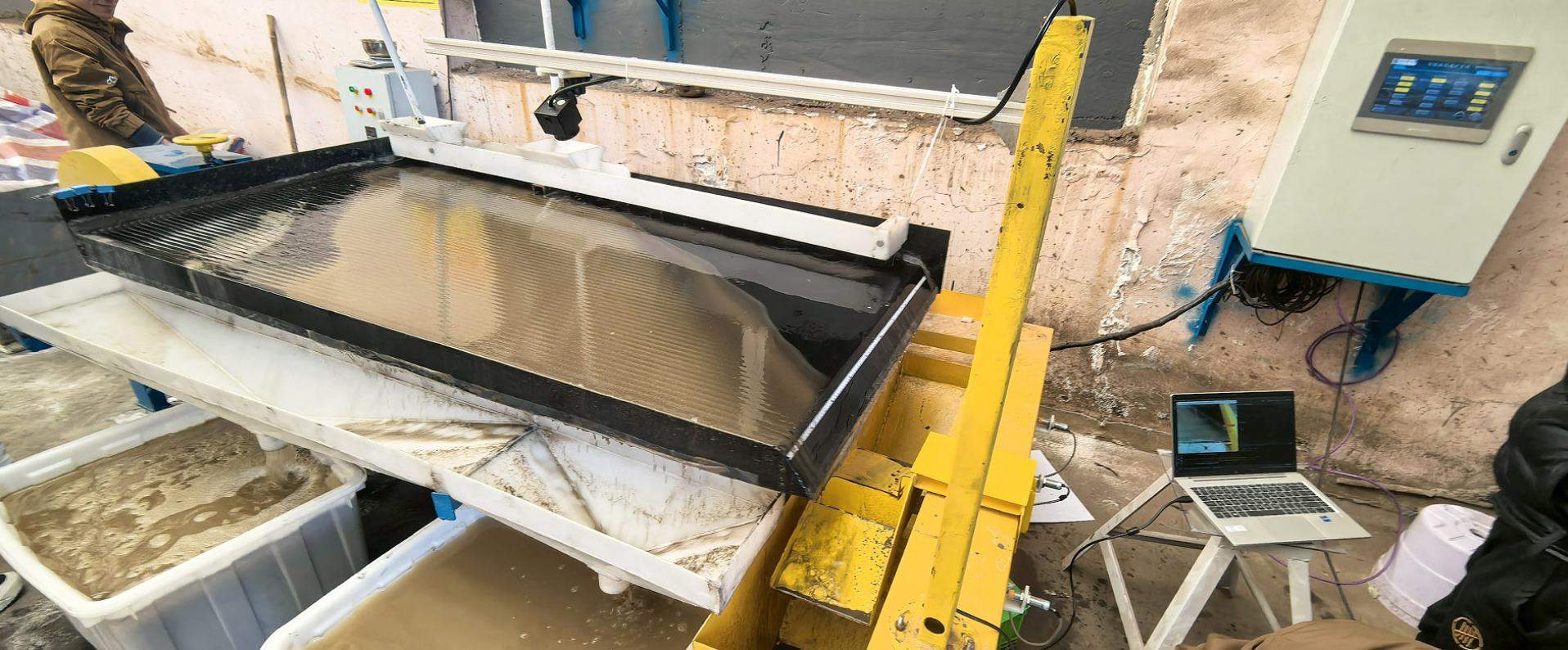
Manual visual belt identification leads to uncontrolled concentrate collection
The shaking table utilizes a combined force field of transverse water flow and longitudinal vibration on the deck surface to separate heavy and light minerals along specific trajectories. The enrichment ratio for fine-grained minerals can reach over 100:1, making it a recognized "high-precision separation tool" in the field of physical beneficiation. Hundreds of thousands of shaking tables operate year-round in various mineral processing plants, providing an indispensable raw material foundation for China's aerospace, new energy batteries, and semiconductor materials industries. However, in industrial environments, the mineral belt distribution on the shaking table exhibits dynamic blurring and complex boundaries with strong interference characteristics. Traditional manual observation methods heavily rely on worker experience and skill level. Factors such as fluctuations in pulp floatability, particle size variations, and on-site ambient lighting can easily lead to delayed or erroneous cutting, not only causing loss of concentrate but also directly affecting the stability and sustainable production of downstream smelting processes.
OreBound-YOLO reconstructs the "intelligent neural center" for mineral belt boundary perception
Facing the urgent need for visual perception of mineral belt boundaries and real-time control in harsh industrial environments, the research team systematically constructed a three-level closed-loop architecture of "preparation layer—control layer—application layer," introducing deep learning object detection technology into the full-process automation control of shaking table concentrate collection for the first time.
At the algorithm level, the research team proposed the OreBound-YOLO mineral belt boundary point identification algorithm. Based on the high-precision YOLOv7 network framework, this algorithm addresses key technical obstacles such as weak boundaries at the edges of the shaking table mineral belt and wide dynamic fluctuations of the belt, implementing four core improvements:
Feature extraction reconstruction: The backbone network is reconstructed using the C3k2 convolution module, significantly enhancing the feature expression capability for subtle mineral belt textures and spatial structures;
Bidirectional feature fusion: Introducing the FPN (Feature Pyramid Network) + PAN (Path Aggregation Network) structure achieves bidirectional multi-scale feature fusion of shallow positional information and deep semantic information, effectively capturing multi-level features of mineral distribution with different particle sizes;
Weak boundary perception enhancement: Embedding the C2PSA attention mechanism enables the model to focus on weak boundary areas at the edges of the mineral belt, accurately suppressing industrial noise interference such as deck water mist, shadow reflections, and floating slime;
Regression accuracy optimization: Innovatively adopting the EIoU loss function to replace traditional regression loss significantly improves bounding box regression accuracy, effectively solving the boundary point drift problem in blurred areas of the mineral belt edge.
After the intelligent upgrade, the control system, through industrial-grade image acquisition and a high-performance edge computing platform, can complete real-time detection of the mineral belt separation point on each shaking table deck and dynamic calibration of the servo-driven cutting plate within milliseconds, completely eliminating separation fluctuations caused by differences in manual experience.
A historic leap in tungsten and tin resource recovery
Large-scale industrial field trial data from the Jiangxi University of Science and Technology team shows that after equipping the OreBound-YOLO intelligent concentrate collection control system, the shaking table production indicators achieved a disruptive leap:
The grade of WO₃ (tungsten trioxide) in the concentrate increased by 2.4 to 2.9 times;
The grade of Sn (tin) in the concentrate increased by 1.4 to 2.1 times;
At the same time, the loss of valuable components in the tailings was significantly reduced, and the overall tailings grade decreased markedly, significantly improving ore resource utilization and greatly reducing manual dependency and operational costs.
In terms of promotion and application, this technological equipment has further demonstrated extremely high resource benefits and commercial transformation potential. Relevant data shows that after deploying the intelligent concentrate collection system for shaking tables at a large mine in Jiangxi Province, the WO₃ recovery rate increased by 14.11%, and the Sn recovery rate increased by 15.66%, far exceeding the economic and technical indicators of mineral processing under traditional manual operations, creating significant economic value for the mine.
Intelligent new infrastructure for mineral processing across all categories and industries
This systematic breakthrough not only brings industrial-level economic and emission reduction value to tungsten and tin separation but also provides China's modern mineral processing industry with an extremely clear strategic blueprint:
Reshaping strategic supply capacity for key metals: China is the world's major producer and consumer of tungsten and tin, with continuously growing demand in areas such as new energy batteries, advanced semiconductors, and special alloys. The high-identification-precision concentrate collection system can ensure the long-term stability of high-value-added mineral resource flows, effectively enhancing the country's control over strategic resources;
Empowering high-value narrow particle size recovery scenarios such as tantalum-niobium, ilmenite, and beach placer: The algorithm of this technical system has strong generalization ability and can be quickly adapted to different mineral types and deck configurations, potentially enabling large-scale replication and intelligent process reengineering in multi-metal complex associated mines;
Building a "unmanned processing plant" and integrated mine cluster collaboration base: Combined with 5G remote control and edge computing architecture, this system can support centralized management and control of multiple shaking tables, promoting the evolution of mineral processing operations from single-machine automation to full-process intelligence, providing key technical reserves for "dark factory production" in processing plants;
Promoting tailings resource re-processing and low-carbon operations: The system significantly reduces tailings losses, helping enterprises reduce carbon emissions and pressure for tailings pond expansion, providing sustainable process support for the mining industry's transition towards "resource-saving and environmentally friendly" operations.
From the birth of the first prototype shaking table in the United States in the late 19th century, to the Wilfley shaking table establishing the modern separation pattern in the 20th century, and now to the Jiangxi University of Science and Technology team implanting a deep learning "intelligent neural center" into this century-old equipment, the evolutionary history of the shaking table—a key piece of equipment—has turned a decisive page. The paradigm shift from "manual experience" to "data-driven" separation is bringing China's mines from "human eye monitoring" into a new era of full-time, full-domain, and full-process intelligent decision-making.