
June 15 news, the communication research team of the R&D Center of the First Academy of China Aerospace Science and Technology Corporation, in collaboration with Shanghai Aerospace Electronics Co., Ltd., has achieved a phased key breakthrough in the core technology of novel electromagnetic control, successfully completing the development of a functional sample for metasurface electromagnetic control core technology. This achievement targets directions such as 6G communication, low-orbit satellite interconnection, commercial satellite communication, millimeter-wave base stations, communication relays, and intelligent detection, marking a key verification step between core metasurface electromagnetic control devices and engineering applications in China.
The core of metasurface electromagnetic control technology lies in regulating the propagation direction, phase, amplitude, polarization, and other characteristics of electromagnetic waves through artificially designed two-dimensional microstructural units. Traditional communication coverage relies on numerous front-end devices, antenna arrays, and complex hardware stacking, resulting in high system volume, deployment costs, and maintenance difficulty. Metasurface technology attempts to use lighter, more controllable electromagnetic regulation units to alter the spatial propagation environment, enabling communication signals to be directionally enhanced, reflected, focused, or blind-spot compensated as needed. For millimeter-wave, low-orbit satellite interconnection, and high-frequency communication systems, such capabilities can alleviate issues like short coverage distance, weak diffraction ability, and numerous blind spots in high-frequency signals.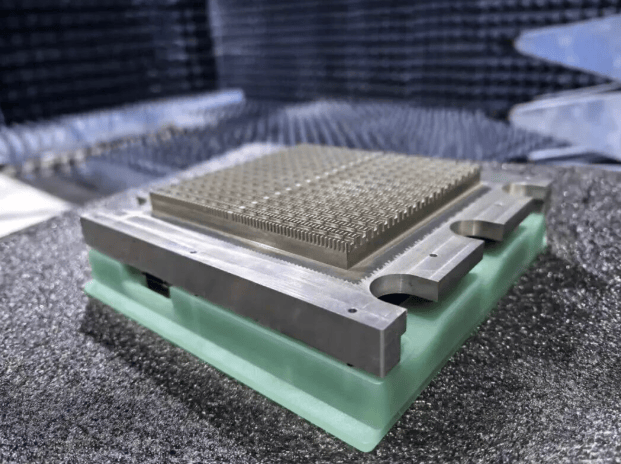
The scientific and innovative value of this functional sample development is concentrated in the simultaneous achievement of performance improvement and cost reduction. Public information shows that, under the same communication coverage effect, the new technology can significantly reduce the number of front-end communication devices deployed, improve communication area coverage performance by over 40%, and reduce single-scenario equipment investment costs by 500,000 yuan. This indicates that metasurface electromagnetic control is not just a material or structural verification in the laboratory but has begun to calculate coverage capabilities, equipment investment, and engineering deployment benefits for specific communication scenarios. For communication operators, satellite internet, and dedicated communication networks, coverage performance and equipment costs often constrain each other; this sample verification provides a new technical path.
More importantly, the R&D team, through underlying technological innovation, replaced traditional complex hardware stacking architectures with a simpler technical system, reducing the mass production cost of high-end satellite communication and millimeter-wave communication terminals from tens of thousands of yuan to thousands of yuan. High-end communication terminals have long been constrained by complex components, high system integration difficulty, and high small-batch manufacturing costs, making it difficult to quickly enter larger-scale commercial markets. If the metasurface electromagnetic control technology can subsequently complete environmental adaptation, reliability, batch manufacturing, and model verification, it will help lower the adoption threshold for satellite communication terminals, millimeter-wave communication equipment, and relay systems, enabling related equipment to more easily enter scenarios such as transportation, energy, emergency response, oceans, low-altitude economy, and remote area connectivity.
From the perspective of 6G and low-orbit satellite interconnection, metasurface electromagnetic control technology is a foundational capability for future network forms. Future communication networks will not only rely on ground base stations but will also integrate satellites, low-altitude platforms, ground relays, intelligent terminals, and edge nodes. High-frequency band communication imposes higher requirements on beam control, coverage compensation, spatial reconstruction, and low-cost terminals. The completion of this functional sample development provides a foundation for moving from sample verification to system integration, scenario testing, and industrial application, and also gives China a new technological fulcrum in key materials for next-generation communication, core structures, and electromagnetic control engineering capabilities.
Subsequent attention should still be paid to the continuous verification of this technology in complex environments. After metasurface devices enter actual communication systems, they need to address issues such as temperature, humidity, vibration, electromagnetic compatibility, long-term stability, batch consistency, and coordination with existing network equipment. The successful development of the functional sample is an important milestone for engineering implementation, but moving from sample to large-scale deployment still requires more testing and application adaptation. If the relevant teams can form stable solutions in commercial satellite communication, 5G/6G millimeter-wave base stations, and communication relay scenarios, metasurface electromagnetic control technology will provide key support for China's next-generation communication equipment with lower costs and higher coverage efficiency.