
Steel and alloy production contributes approximately 8% of global carbon dioxide emissions. Facing the urgent requirements of the "dual carbon" goals, replacing coal with green hydrogen to reduce metal oxides has long been an ideal pathway pursued in the metallurgical field. However, the slow reaction rate and low efficiency of hydrogen at medium and low temperatures have long constrained the industrial application of this technology.
Recently, a collaborative team from Xi'an Jiaotong University and the Max Planck Institute for Sustainable Materials in Germany published a breakthrough study in *Nature Synthesis*. They revealed for the first time a novel "solid-solid catalysis" mechanism. By introducing nickel oxide as a catalytic precursor into iron ore, they successfully enhanced the hydrogen-based reduction kinetics by approximately 2 times. This discovery opens a feasible path that balances efficiency and cost for the low-carbon transformation of steel and alloy production.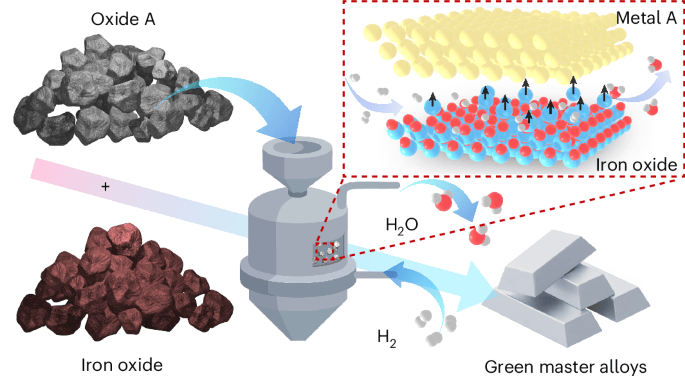
Hydrogen Metallurgy is "Green," but "Slow"
Traditional blast furnace ironmaking relies on coke, a process that is not only energy-intensive but also accompanied by significant carbon dioxide emissions. Hydrogen-based direct reduction technology uses green hydrogen as a reducing agent, theoretically achieving near-zero carbon emissions, and has the potential to simplify the traditional multi-step process of "ore reduction-smelting-alloying" into a one-step solid-state direct reduction.
However, there is a gap between ideal and reality, known as "reaction kinetics." Under medium and low-temperature conditions, the rate at which hydrogen reduces iron oxides is very slow, directly impacting production efficiency and economic viability. How to significantly enhance the reduction rate while maintaining the low-carbon advantage is a key challenge that the global metallurgical community urgently needs to overcome.
From "Passive Waiting" to "Active Catalysis"
The team of Professor Zhou Xuyang from the School of Materials Science and Engineering at Xi'an Jiaotong University, in collaboration with the Max Planck Institute in Germany, proposed a disruptive "solid-solid catalysis" strategy.
In-situ Generation of Catalyst: The research team mixed nickel oxide (NiO) into iron oxide (Fe₂O₃). Under a hydrogen atmosphere, nickel oxide is preferentially reduced, generating nanoporous metallic nickel *in situ*. This *in-situ* generated porous nickel possesses a larger specific surface area and higher catalytic activity compared to directly added nickel metal powder.
"Hydrogen Spillover" Effect Accelerates Reduction: The *in-situ* generated porous nickel forms a dynamic metal-oxide interface with the adjacent iron oxide. This interface acts like an efficient "catalytic factory." It promotes the dissociation of hydrogen molecules (H₂) and, through the "hydrogen spillover" effect, efficiently "transports" the dissociated active hydrogen atoms to the surface of the iron oxide, thereby greatly accelerating the removal of oxygen and the reduction of iron.
"Synchronous" Formation of Alloy: More surprisingly, this mechanism not only accelerates reduction but also bypasses the traditional alloy formation pathway. The study found that the iron-nickel alloy does not form slowly after the complete reduction of iron; instead, it is generated synchronously during the reduction process. The dynamic interface facilitates the direct entry of iron atoms into the lattice of face-centered cubic (fcc) nickel, bypassing the lengthy nucleation process of the conventional body-centered cubic (bcc) iron phase.
Data Speaks, Results are Significant
Using advanced techniques such as *in-situ* synchrotron radiation X-ray diffraction and four-dimensional scanning transmission electron microscopy, the study confirmed this mechanism at the atomic scale. Experimental data demonstrate its strong potential for industrial application:
Kinetics Enhanced by 2 Times: At 700°C, the introduction of nickel oxide reduced the reduction time of iron oxide by approximately half, enhancing the overall reduction kinetics by about 2 times.
Reduction Temperature Lowered by 100°C: Under simulated industrial continuous heating conditions, the addition of nickel or nickel oxide lowered the onset reduction temperature of iron oxide by at least approximately 100°C.
Paving a New Path for Green Steel and High-End Alloys
This research provides a novel perspective for hydrogen-based metallurgy: through the solid-solid catalysis effect, hydrogen-based alloy production can not only be more sustainable than traditional processes but also achieve dual advantages in kinetics and commercial viability.
From an application perspective, this strategy is expected to offer new ideas for the green manufacturing of a series of key alloy systems, including nickel-containing steels, stainless steels, low-expansion alloys, high-strength steels, and low-temperature engineering materials. By coupling oxide reduction with the alloying process, this method has the potential to reduce reliance on high-temperature smelting and prolonged homogenization treatments in traditional metallurgical processes.
This achievement, resulting from the collaboration between Xi'an Jiaotong University and the Max Planck Institute in Germany, breaks through the kinetic bottleneck of hydrogen metallurgy at medium and low temperatures, demonstrating the immense potential of interdisciplinary and international cooperation in driving the transformation of fundamental science into industrial applications.