
The Optical Materials Engineering Laboratory at ETH Zurich has developed a novel multifunctional image element called "Fourier pixels," capable of both emitting and measuring light within the same pixel structure. The research, led by Professor David J. Norris's team, was published in the journal *Nature* under the title "Fourier pixels for bidirectional light control." Unlike conventional pixels that either illuminate a display or capture light, Fourier pixels integrate light field generation and analysis into a single micro-nano structure, enabling control and detection of light's amplitude, phase, and polarization. This provides a new device foundation for bidirectional screens, holographic displays, optical communication, and quantum information processing. The core of a Fourier pixel is not about recording how bright a point in an image is, but rather processing the spatial frequency of light. It represents the distribution pattern of light waves in space, thus offering a more complete description of the light field.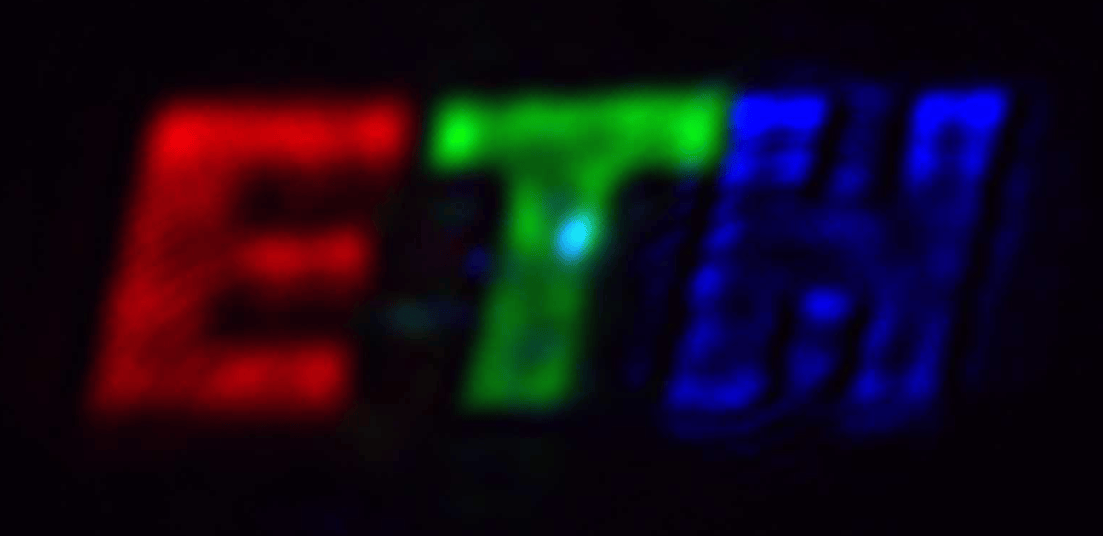
This colored logo was created using Fourier pixel technology developed by researchers at ETH Zurich. The letter "E" is only about 1 millimeter tall on the camera.
Conventional display pixels are primarily responsible for "emitting brightness," while camera sensor pixels are mainly responsible for "receiving brightness." This division of labor underpins the basic structure of current phone screens, televisions, cameras, and industrial cameras. However, most of them only process light intensity information and struggle to simultaneously control and read richer wave characteristics such as phase and polarization. Fourier pixels change this logic. They guide the propagation of surface waves through micro-nano contours on a metal surface, causing these surface waves to scatter into light waves at specific locations. The interference between multiple light waves then generates a preset light field pattern. Conversely, when external light illuminates the same structure, the pixel can also use the interference information to analyze the state of the light field entering the pixel.
The design foundation of this technology comes from Fourier analysis. The Fourier transform can decompose a complex waveform into a set of different frequency components. Sound waves, images, and light fields can all be described in a similar way. Fourier pixels apply this mathematical method to the design of micro-nano optical structures: first, determine the light field to be generated or detected, and then deduce the ripple profile that the pixel surface should have. In this way, a single pixel is no longer just a "bright spot" or "photosensitive point," but becomes a miniature optical system capable of processing light wave structures.
In terms of technical implementation, the research team used plasmonic surface waves on a metal surface to achieve light field control. When surface waves propagate along the metal surface, they interact with the designed corrugated microstructure and scatter into space in a predetermined direction. As long as the surface profile is sufficiently precise, the pixel can generate a specific light field in emission mode; in reception mode, it can deduce the amplitude, phase, and polarization of the incident light from the interference pattern it creates. This structure allows "emitting light" and "measuring light" to no longer rely on two completely separate devices, but instead achieves bidirectional light control on the same pixel platform.
This type of pixel could first change the boundary between screens and cameras. If future display devices adopt a matrix of Fourier pixels, the screen could potentially take on both display and imaging functions, forming a camera-display that can work bidirectionally.
Bidirectional screens are just one application. Fourier pixels can also provide more detailed light field control for holographic displays, as holographic displays require control not only of brightness but also phase information. Optical communication systems similarly need more complex light field encoding and decoding capabilities, especially in multi-channel, high-density, low-energy transmission scenarios where amplitude, phase, and polarization can all serve as information carriers. Quantum information processing demands even higher control over the state of photons. Miniaturized, programmable, and bidirectional optical components like Fourier pixels may offer new design directions for on-chip optical circuits, quantum state measurement, and precise light field manipulation.
This research is still in its early stages. Current Fourier pixels primarily demonstrate the ability for bidirectional light field control at the single-pixel level. Before they can truly enter mobile phone screens, consumer electronic cameras, or large-area display devices, issues such as pixel arraying, dynamic refresh, manufacturing consistency, system integration, and cost control need to be addressed. The Norris team's next step is to integrate Fourier pixels into a matrix structure to build more complex camera-displays. If arraying verification is successful, Fourier pixels will transition from individual optical units to scalable device stages.
For the optoelectronics industry, the significance of Fourier pixels lies in bringing image display, image acquisition, and light field processing to the same hardware level. In the past, displays, cameras, holographic elements, polarization analyzers, and phase modulators were typically separate components, leading to complex systems, increased volume, and high alignment requirements. If Fourier pixels can be arrayed and manufactured stably, future devices could accomplish display, imaging, recognition, and optical communication tasks in a smaller space. It also reminds the industry that the next generation of pixel competition may not only revolve around resolution, brightness, and refresh rate; the ability to fully control light field information could become a new technological direction.
Paper authors include Yannik M. Glauser, Sander J. W. Vonk, David B. Seda, Hannah Niese, Boris de Jong, Matthieu F. Bidaut, Daniel Petter, Erwan Bossavit, Gabriel Nagamine, Nolan Lassaline, and David J. Norris. As displays, cameras, holography, optical communication, and quantum optics continue to converge, Fourier pixels provide a path from "intensity pixels" to "light field pixels," opening new experimental directions for future camera-displays and on-chip optical systems.