
Coal gangue separation is the first gateway to clean coal utilization, but the working conditions at mine sites are constantly changing—coal quality fluctuations, lighting variations, dust interference... Traditional AI models often struggle to adapt, with separation accuracy significantly degrading as conditions drift. On June 19, 2026, Henan Zhongping Automation Co., Ltd.'s "AI-based Intelligent Gangue Selection Method" was officially granted a national invention patent (Patent Publication No. CN121103693B). This patent establishes a "working condition-sample" dynamic adaptation mechanism, enabling the AI separation model to remain stable and accurate under varying conditions, equipping intelligent dry separation equipment with an "adaptive brain."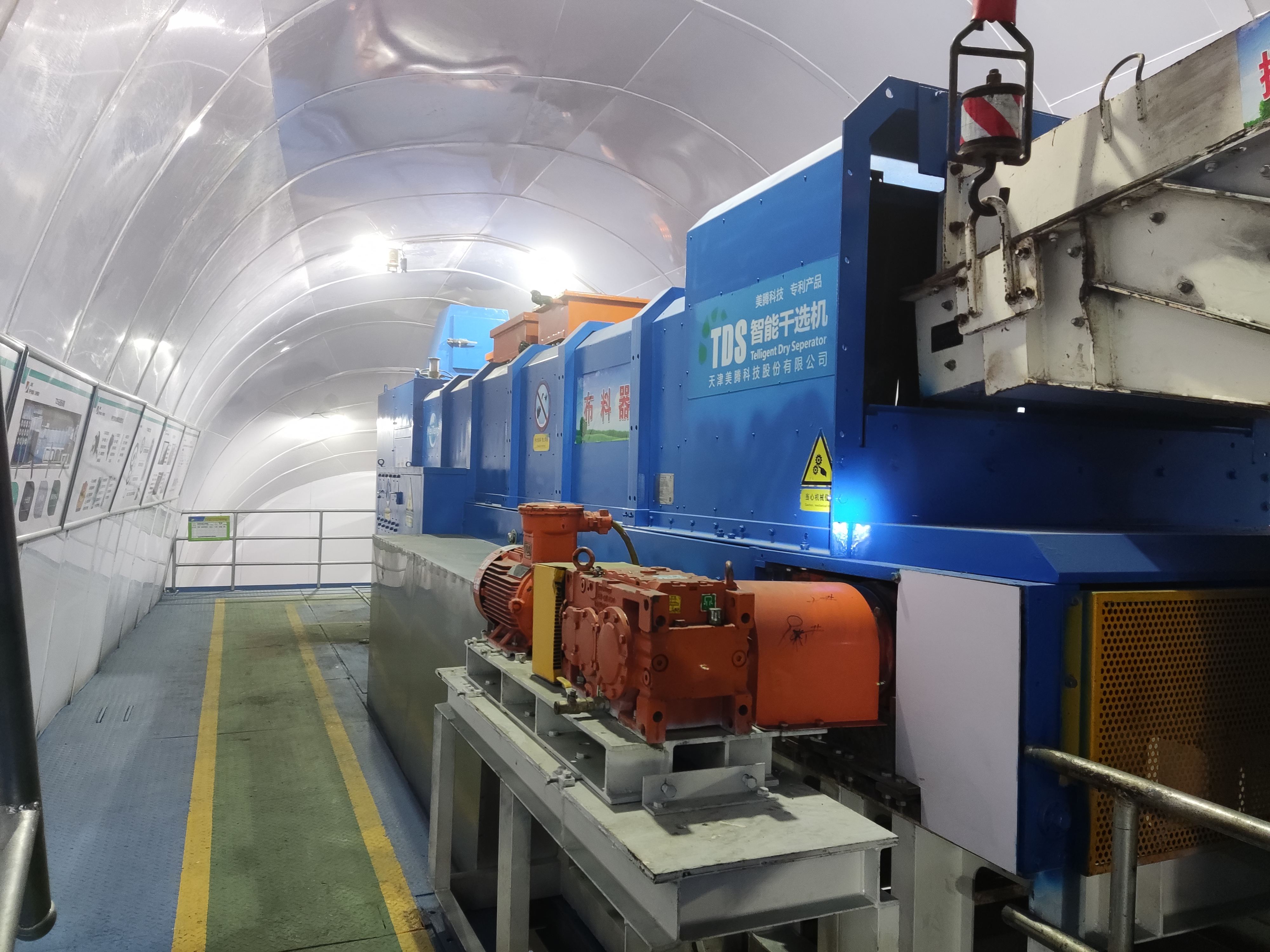
Why Does AI Frequently Struggle Underground?
Coal gangue separation is a critical step in coal washing and processing, directly impacting clean coal recovery rates, subsequent washing energy consumption, and the comprehensive utilization value of gangue. In recent years, intelligent gangue separation technology based on machine vision and deep learning has rapidly expanded, promising to replace traditional manual sorting and wet jigging.
However, while AI models perform excellently in the lab, their accuracy often drops significantly once deployed at mine sites. The core reason lies in the fact that coal-gangue separation is a typical "open environment" industrial vision task—changes in coal type, lighting variations, conveyor belt speed adjustments, dust concentration fluctuations... any alteration in working condition parameters can cause a shift in the distribution of image features.
More challenging is the difficulty in obtaining large quantities of labeled "ground truth" samples at mine sites (label scarcity), while sensor noise further contaminates the already limited data quality. Feature distribution drift + label scarcity + noise interference—these three major obstacles combine to make traditional AI gangue separation models highly unstable under varying conditions, severely limiting the large-scale application of intelligent dry separation technology.
A Paradigm Shift from "Static Models" to "Dynamic Adaptation"
The invention patent granted to Zhongping Automation provides a comprehensive solution. According to the patent abstract, the method enables the AI separation model to "adaptively evolve" with changing conditions through a complete technical chain of "acquisition—matrix construction—template generation—label calibration—segmented adjustment—incremental correction."
Step 1: Construct a "Working Condition-Sample" Correspondence Matrix to Extract Stable Feature Domains
The method first synchronously collects image signals and working condition parameters during conveyor belt operation, constructs a working condition-sample correspondence matrix, and extracts stable feature domains from it. The core value of this step is that it does not simply train the model with images but binds "what the working conditions were at the time" with "what images were captured," thereby distinguishing which features are the physical attributes of the coal and gangue themselves and which are "artifacts" caused by changing conditions.
Step 2: Generate Dynamic Feature Templates and Record Working Condition Threshold Conditions
Based on stable features, the system generates dynamic feature templates and records working condition threshold conditions. This template acts like a "variable ruler"—when conditions change, the ruler adjusts accordingly, ensuring the judgment criteria always match the current on-site environment.
Step 3: Purify the Label Set—Solving the "Boundary Ambiguity" Problem
Manually annotated samples are compared with dynamic templates, and consistency calibration is performed on samples with ambiguous boundaries to form a purified label set. The boundaries between coal and gangue are often unclear in images, and annotation standards vary among different workers. This method achieves "denoising" and "unification" of labels through template comparison, ensuring model training quality from the data source.
Step 4: Segmented Adjustment of Decision Boundaries—Refined Separation Decisions
Stable features and the purified label set are input into the separation decision model, and the decision boundaries are adjusted in segments based on template thresholds. Different particle sizes and coal types inherently require different criteria for judging "coal" versus "gangue." Segmented adjustment enables the model to make refined decisions tailored to different working conditions, rather than applying a "one-size-fits-all" approach.
Step 5: Closed-Loop Incremental Correction—Making the Model Smarter with Use
More critically, the final step involves monitoring working conditions and separation outputs during operation, and when distribution drift is detected, feeding it back to the label calibration step for incremental correction. This means the system is not a "one-time deal"—after deployment, it continues to "learn": once a change in conditions causes a fluctuation in separation accuracy, the system automatically triggers a new round of label calibration and model fine-tuning, forming an intelligent closed loop of "operation—monitoring—feedback—correction."
Equipping Intelligent Dry Separation with an "Adaptive Brain"
From "Static Deployment" to "Dynamic Evolution"
Traditional AI gangue separation models are "static"—once trained and deployed, model parameters remain fixed, and accuracy inevitably declines when conditions change. Zhongping Automation's patented technology endows the model with the ability for "dynamic evolution." This means intelligent gangue separation equipment can continuously self-optimize during long-term mine operation, becoming more accurate over time, completely escaping the dilemma of "degradation upon deployment."
Providing Core Algorithm Support for Full-Particle-Size Intelligent Dry Separation Systems
Zhongping Automation has previously launched the TDS intelligent dry separation system (effectively removing gangue above 50mm) and the TGS intelligent teetered bed dry separation system (more precise and intelligent). This patent grant for the AI intelligent gangue selection method provides core algorithm support for these hardware systems. From "hardware-based separation" to "algorithm-driven decision-making," Zhongping Automation is building an intelligent dry separation technology system covering the entire chain of "perception—decision—execution."
Accelerating the Evolution of Coal Washing Towards "Unmanned and Intelligent" Operations
This patented technology solves the stability challenge of intelligent gangue separation under varying conditions, promising to significantly improve the stability of clean coal ash content and clean coal recovery rates. Combined with Zhongping Automation's previously applied-for underground gangue intelligent sorting device (using vibration screening, collision conveying, air-blowing adsorption, precise detection and recognition, and air-jet separation for higher accuracy) and a belt-free coal gangue separation device, Zhongping Automation is comprehensively deploying from "algorithms" to "devices," driving the leap of coal washing from manual intervention to fully intelligent processes.
On June 19, 2026, at the moment the CN121103693B patent was officially granted, Zhongping Automation not only secured an invention patent but also established a technical paradigm in the field of intelligent dry separation: AI separation should not be a "set-and-forget" static deployment but a "condition-adaptive" dynamic evolution.
From Pingdingshan to major mining areas nationwide, from TDS to TGS to AI intelligent gangue selection algorithms, Zhongping Automation is redefining the intelligent boundaries of coal-gangue separation with its "adaptive" technical philosophy.