
A joint research team from the National Astronomical Observatories of the Chinese Academy of Sciences and Tsinghua University has detected radio pulses from a young neutron star that has long been "radio-quiet"—a central compact object. The findings have been published online in the international academic journal Nature Astronomy. The paper, titled "Pulsed radio emission from a central compact object," focuses on the typical young central compact object 1E 1207.4–5209. Located at the center of a supernova remnant, this object has been consistently bright in X-rays but had never been detected with pulsed signals in the radio band. This discovery breaks the long-standing observational status of central compact objects as "radio-quiet," providing new observational evidence for studying the magnetic fields, radiation mechanisms, and evolutionary paths of young neutron stars.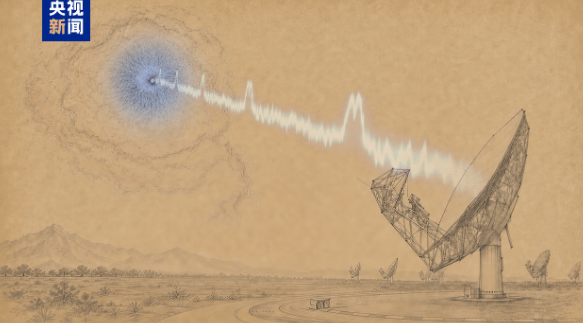
Central compact objects are a special type of neutron star. They are typically found at the centers of supernova remnants and exhibit characteristics of young neutron stars, yet they have long lacked confirmed radio pulse signals, making them a persistent puzzle in the study of neutron star evolution.
Neutron stars form when massive stars undergo gravitational collapse and supernova explosions at the end of their evolution. They are extremely dense, much smaller in scale than ordinary stars, and their physical state lies between that of white dwarfs and black holes. Since the discovery of pulsars in 1967, the scientific community has gradually established a basic picture in which young neutron stars produce radio pulses through strong magnetic fields and rapid rotation. Central compact objects, however, have long deviated from this picture: they are clearly visible in X-rays and are located at the centers of supernova remnants, matching the identity of young neutron stars, yet decades of radio telescope searches have failed to detect clear radio pulse signals. This contradiction has made it difficult for researchers to determine whether central compact objects lack the ability to emit radio waves or whether their radio signals are simply too weak to be captured by conventional observations.
This detection confirms that 1E 1207.4–5209 is actually a faint radio pulsar, with a radio pulse period consistent with its 0.4-second X-ray period. The paper also notes that polarization analysis indicates the radio beam passes through the line of sight near the magnetic pole direction, suggesting that the weakness of its radio emission has an intrinsic physical cause.
This result has direct implications for understanding the evolution of young neutron stars. Previously, central compact objects were often regarded as a class of young neutron stars that are radio-quiet and have weak magnetic fields, and their relationship with ordinary young radio pulsars was unclear. With the detection of radio pulses, the boundary between central compact objects and pulsars has been reopened: at least some central compact objects are capable of emitting radio pulses, but their signals are so faint that they require high-sensitivity observations and more refined data analysis to be identified. The paper also suggests that as supernova remnants gradually dissipate, such objects might be mistaken in the future for ordinary old pulsars, which could affect astronomers' assessments of neutron star ages, magnetic field strengths, and evolutionary stages.
The discovery of radio pulses also provides new clues about the evolution of neutron star magnetic fields. Young neutron stars are generally believed to have strong magnetic fields and rapid rotation, and the weak magnetic field characteristics of central compact objects have long challenged this understanding. This study links X-ray periods, radio pulses, and polarization information, allowing researchers to reassess the magnetic field geometry, radiation regions, and energy release mechanisms of these objects. For pulsar physics, such findings help explain why some young neutron stars emit bright radio pulses while others can only be identified in X-rays, and they also help fill in the early evolutionary picture of compact objects after supernova explosions.
This achievement also demonstrates that high-sensitivity radio observations are expanding the boundaries of neutron star research. The number of central compact objects is limited, and candidate sources are generally faint, making it difficult for past observational conditions to continuously lower the detection threshold. With improvements in radio telescope sensitivity, polarization observation capabilities, and data processing methods, more objects previously classified as "radio-quiet" can now be re-examined. If similar radio pulses are discovered in more central compact objects in the future, the scientific community will be able to build a more complete sample and further determine whether these young neutron stars generally emit faint signals or only a few individuals have the conditions for radio emission.
This detection of radio pulses from a central compact object by the Chinese research team marks a significant advance in the observational study of young neutron stars. It moves a problem that had long remained in theoretical speculation and non-detection results into a new phase where it can be measured, compared, and continuously tracked. For astronomy, this is not just the discovery of a radio signal but also the establishment of new connections among neutron star formation, magnetic field evolution, supernova remnant associations, and pulsar population classification. Subsequent deep radio searches targeting more central compact objects will determine whether this discovery can further rewrite the overall understanding of young neutron star evolution.