
QuTech, a quantum research institute jointly established by Delft University of Technology and the Netherlands Organization for Applied Scientific Research (TNO), has demonstrated an efficient, coherent light-matter interface that connects tin-vacancy color center quantum emitters in diamond with photons in a nanocavity. Led by Professor Ronald Hanson, this achievement has been published in the journal Physical Review X. The research team realized a coherent cooperativity exceeding 1 for tin-vacancy color centers in a diamond photonic crystal cavity. This metric indicates that useful coherent quantum interactions can overcome decoherence noise, providing an experimental foundation for establishing more reliable "handshakes" between solid-state qubits and flying photonic qubits.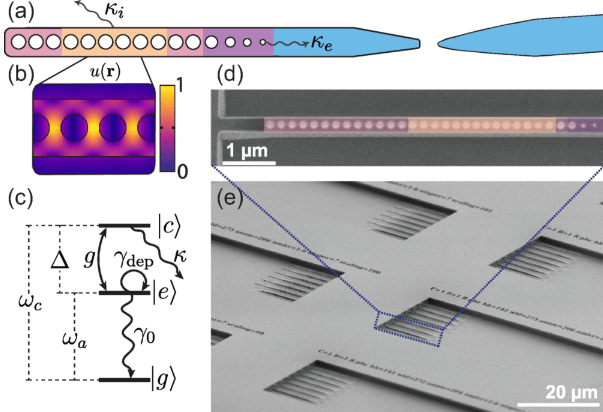
Tin-vacancy color centers are artificial defects in the diamond lattice, formed by a tin atom combined with a carbon vacancy. They behave like atom-like quantum systems embedded in a solid, capable of both storing quantum information and interacting with light.
Quantum internet and modular quantum computing both require connecting two types of quantum carriers: solid-state matter qubits on a chip for storing and processing information, and photonic qubits for transmitting quantum states between different nodes. The challenge lies in the fact that solid-state defects are affected by noise from the surrounding material, and photons must interact with the emitter with high fidelity within an extremely short time. Ordinary luminescence enhancement only indicates brighter emission and does not guarantee the coherence required for quantum protocols. In this work, QuTech embedded tin-vacancy color centers in a diamond photonic crystal cavity, allowing the nanocavity to concentrate the optical field in the defect region, enhancing the interaction between a single quantum emitter and photons. Through linewidth measurements, they confirmed a coherent cooperativity greater than 1.
"Greater than 1" corresponds to a significant experimental threshold. It indicates that the coherent coupling strength is sufficient to overcome environmental decoherence effects, and the system begins to enter an operational regime more suitable for quantum state transfer and remote entanglement generation.
The research team also demonstrated signs of scalability in device fabrication. They measured 327 diamond nanophotonic devices across two chips, achieving a high average quality factor and good device yield. In two key devices, cavity-coupled tin-vacancy color centers significantly enhanced photon emission in the target optical mode. According to QuTech's official website, when the optical cavity is tuned into resonance with the tin-vacancy color center, a single quantum emitter can strongly modulate the transmitted light within the cavity, nearly completely shutting off light transmission through the cavity. This demonstrates that a solid-state quantum emitter can exert strong control over an optical field at the single-photon level, providing a device foundation for future connections of multiple quantum nodes into a network.
The application direction of this achievement focuses on quantum networks. Future quantum nodes will need to perform local quantum storage and processing, then transmit quantum information to remote nodes via photons, enabling remote entanglement and distributed quantum computing connections.
The advantage of the diamond color center approach lies in its solid-state integration capability and optical interface potential. Compared to some other color center systems, tin-vacancy color centers possess favorable optical and spin properties, making them suitable for building chip-scale devices for quantum networks. The nanocavity plays the role of "amplifying interactions," compressing the inherently weak emitter-photon interaction into a smaller volume with a higher field strength optical mode. With coherent cooperativity exceeding 1, subsequent research can further target remote entanglement generation, quantum repeater nodes, modular quantum processor interconnects, and on-chip quantum photonic interfaces. In QuTech's published content, Ronald Hanson also noted that this result contributes to faster and more reliable generation of entanglement between remote nodes and holds significance for QuTech's collaboration with Fujitsu in advancing modular quantum computing.
Several engineering challenges remain to be addressed. Quantum networks require a large number of devices with consistent performance. The excellent metrics of individual samples must be translated into batch manufacturing, stable tuning, low-temperature operation, fiber coupling, long-term reliability, and system-level control capabilities. Frequency matching between tin-vacancy color centers and photonic crystal cavities, defect position control, material damage suppression, decoherence noise management, and multi-node interconnection will all impact the subsequent system scale. The measurement results of 327 devices demonstrated by QuTech provide a positive signal for scalable manufacturing. The coherent cooperativity exceeding 1 advances device capability from a "brighter luminescent interface" to an "interface capable of executing high-fidelity quantum protocols."
This research by QuTech in the Netherlands marks a step forward for diamond tin-vacancy color center quantum photonic interfaces toward practical quantum networks. It addresses not merely the issue of luminescence efficiency, but the question of whether reliable quantum interactions between solid-state qubits and flying photons can be achieved under low-noise conditions. As quantum computing evolves from single chips to modular architectures, and as the quantum internet progresses from experimental links to multi-node networks, such efficient, coherent, and scalable light-matter interfaces will become a key component of the underlying hardware.