
Recently, China's first 3D-printed landscape bridge was officially completed and opened to the public in Taopu Central Green Space, Putuo District, Shanghai. This S-shaped gold-plated metal bridge, measuring 15.25 meters in length, 3.8 meters in width, and 1.2 meters in height, lies like a soft ribbon over the winding water system. The design took over six months and underwent hundreds of revisions, while the actual 3D printing construction was completed in just 35 days in a single pass. This is not only a landscape bridge but also an innovative experiment in construction technology, marking a breakthrough in the field of architectural 3D printing in China.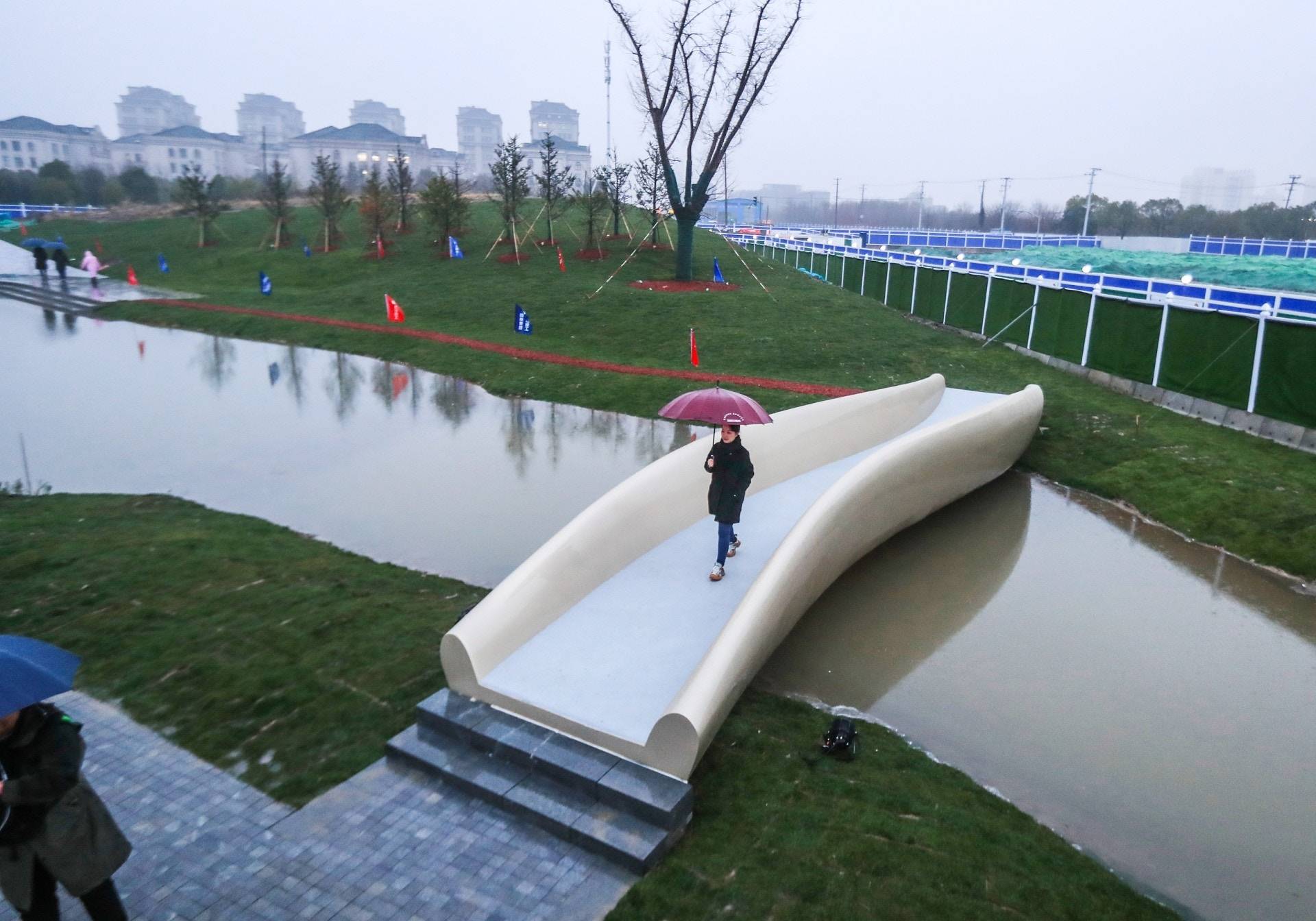
The "Three Major Hurdles" of Traditional Bridge Construction
As a core component of infrastructure, bridge construction has relied on formwork pouring and manual rebar tying for centuries. The traditional model has long faced three major bottlenecks:
Long Cycle Time: A 15-meter-level landscape bridge typically takes two to three months from design to construction, with cumbersome processes and significant weather constraints.
Limited Form: Traditional techniques depend on formwork, making complex three-dimensional curved surfaces and free-flowing shapes difficult to achieve. Architects' imaginative visions are often constrained by the "formwork."
High Material Waste: Formwork pouring generates a large amount of construction waste, with low material utilization and high carbon emissions, contradicting the direction of green development.
Chen Xiaoming, Deputy Chief Engineer of Shanghai Construction Group, pointed out, "Such three-dimensional curved surfaces cannot be achieved with traditional techniques. 3D printing technology has turned the once impossible into reality."
A Paradigm Shift from "Manual Labor" to "Robot Printing"
"Brain": Gantry Composite 3D Printing Robot System
The "unsung hero" behind this bridge is the gantry composite 3D printing robot system independently developed by Shanghai Construction Group's Machinery Construction Division. The system mainly consists of a three-axis gantry structure, a six-axis high-precision industrial robot, and a high-speed extrusion device (CNC nozzle), enabling higher precision, larger dimensions, and more spatial structures for 3D printing.
The printing process is like "layering" one layer at a time: printing one layer takes 8 hours and achieves a thickness of 4 millimeters. Since a single layer is up to 15 meters long, uneven cooling of the material can easily cause thermal cracks and warping. The construction team adopted processes such as "preheating before printing and heat preservation after printing" to increase the temperature of the printing workspace, ensuring that the interlayer bonding strength reaches 80%–85% of the material's own strength.
"Skeleton": Resin + Glass Fiber Composite Material Replaces Concrete
Unlike traditional concrete bridges, this bridge uses resin and glass fiber composite material instead of concrete and steel. After nearly a hundred printing tests and continuous optimization, the team ultimately selected ASA (a high-performance engineering plastic) mixed with a certain proportion of glass fiber and anti-aging materials.
This innovative material features high weather resistance, high elastic modulus, high yield strength, and high impact strength, capable of withstanding long-term sun and rain exposure while meeting the dual standards of 3D printing materials and construction materials. Tests show that the bridge can simultaneously support the normal passage of 20 adults, with a design service life of 30 years requiring no special maintenance during that period.
"Efficiency": 35 Days of Printing vs. Traditional Two to Three Months Construction Period
From design to printing completion, this bridge has set a new speed for large-scale landscape bridge construction. The design took over six months and hundreds of revisions, while the actual printing was completed in just 35 days in a single pass. In contrast, traditional techniques require two to three months to build a landscape bridge of the same scale.
During construction, two six-axis robotic arms worked collaboratively to print all major components. This robotic construction method not only saved about 50% in labor costs but also significantly improved construction efficiency. The 3D-printed product is formed in one piece, and after being transported to the destination via container, installation can be completed in just one or two days.
A Historic Leap from "Labor-Intensive" to "Technology-Intensive"
Addressing the Labor Shortage in the Construction Industry
As the demographic dividend gradually fades, the labor shortage in the construction industry is becoming increasingly prominent. With its automation and high efficiency, 3D printing technology is expected to save construction companies up to 50% in labor costs, becoming an important technological pathway to alleviate industry labor pressure.
Material Utilization Rate Close to 100%, Carbon Emissions Reduced by Over 60%
Traditional bridge construction consumes large amounts of steel and concrete, while the new composite materials used in the 3D-printed bridge can replace traditional building materials, reducing dependence on natural resources. The material utilization rate during construction is close to 100%, achieving near-zero waste, and carbon emissions are reduced by over 60% compared to traditional techniques, aligning with the national "dual carbon" strategic goals.
Unleashing Design Freedom, Reshaping Architectural Aesthetics
3D printing technology brings the free-form surfaces and complex shapes in architects' minds from blueprints to reality. This bridge presents a beautiful three-dimensional curved shape, creating a freely changing and dynamic bridge form. Chen Xiaoming believes that the advantage of 3D printing technology lies in architectural decoration, better showcasing the artistry of architecture.
From a "Single Case" to "Large-Scale Application"
Replicable and Scalable Technical Solutions
Xu Zheng, Party Secretary and Chairman of Shanghai Construction Group, stated at the completion ceremony that this 3D-printed bridge "provides replicable and scalable technical solutions for future infrastructure construction." It is reported that Shanghai Construction Group has accumulated extensive experience in the field of 3D-printed architecture, having previously completed projects such as the Quanzhou 3D-printed bridge and the world's longest 3D-printed bridge in Chengdu, promoting additive manufacturing technology from a "single case" to large-scale application.
Extension from Landscape Bridges to Municipal Engineering
Currently, the application of 3D printing in the bridge field is extending from landscape bridges to municipal engineering. At the same time, the Nangiao Source Public Green Space project in Fengxian District, Shanghai, is constructing a 3D-printed concrete formwork-free pedestrian bridge with a total length of 66.8 meters and a clear span of 34.0 meters. Upon completion, it will become the world's longest-span 3D-printed bridge.
Industrial Upgrade from "Printing Bridges" to "Printing Houses"
Industry experts point out that 3D printing technology is expected to save construction companies up to 50% in labor costs for house construction while reducing on-site dust and construction waste, aligning with the direction of green construction and sustainable development. From bridges to houses, from landscapes to residences, 3D printing construction technology is opening up a trillion-level incremental market.
From the debut of China's first 3D-printed resin bridge in Taopu Central Green Space in 2019 to the completion of the champagne-gold S-shaped metal bridge in the same green space in 2026, China's architectural 3D printing technology has completed a full cycle from "laboratory verification" to "engineering application." Formed in one go in 35 days, saving 50% in labor costs, reducing carbon emissions by over 60%, and achieving a 30-year service life—behind these figures lies a microcosm of the era of China's construction industry transitioning from "labor-intensive" to "technology-intensive."
As Shanghai Construction Group stated, this 3D-printed bridge is not only a landscape bridge but also an innovative experiment in construction technology, providing replicable and scalable technical solutions for future infrastructure construction. When robotic arms replace rebar workers, when composite materials replace reinforced concrete, and when 35 days replace two to three months, China's construction industry is writing its own new paradigm of "intelligent manufacturing."