
In July 2026, the Luoyang Ship Material Research Institute (hereinafter referred to as "LSMRI"), under China State Shipbuilding Corporation Limited, announced the successful completion of certification testing for China's thickest (63.5mm) high-manganese austenitic steel, alongside the simultaneous execution of China's first ammonia compatibility corrosion test for this material. This milestone signifies that LSMRI has established a comprehensive, full-chain technical service capability covering material R&D, process application, and performance evaluation for high-manganese steel, providing critical material support for China's self-reliant LNG and liquid ammonia storage and transportation equipment.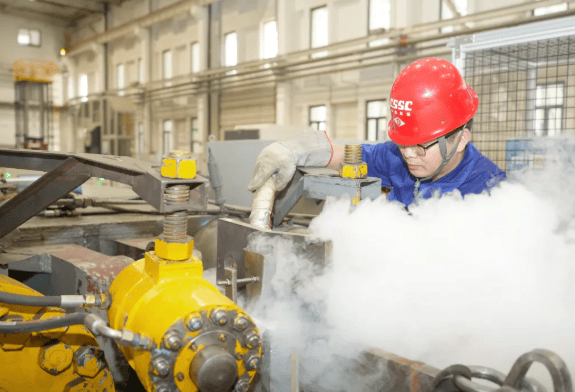
High-Manganese Steel Faces Dual Challenges of "Thickness" and "Medium"
High-manganese austenitic steel is widely recognized as an ideal material for LNG (Liquefied Natural Gas) storage tanks and cargo tanks of transport vessels due to its excellent low-temperature toughness and cost-effectiveness. However, as the global shipping industry accelerates its transition towards zero-carbon fuels like ammonia, traditional high-manganese steel faces two major challenges:
Thickness Bottleneck: The current guidelines of the International Maritime Organization (IMO) only cover certification systems for high-manganese steel with a maximum thickness of 40mm. As large LNG carriers and liquid ammonia carriers trend towards ultra-large sizes, the demand for thicker steel plates (≥50mm) is increasingly urgent, yet lacks corresponding certification standards and test data support.
Unknown Medium Compatibility: Ammonia (NH₃), as an emerging zero-carbon marine fuel, is highly corrosive. Key data on the long-term service performance, stress corrosion cracking susceptibility, and low-temperature toughness evolution of high-manganese steel in liquid ammonia environments are globally absent. Whether it can be safely used for liquid ammonia storage and transportation is a critical determinant for extending high-manganese steel's application from the LNG sector to the future zero-carbon fuel transport market.
63.5mm Ultra-Thick Plate + Corrosion Data from Six Ammonia Environments, Achieving Multiple Chinese Firsts
The certification test completed by LSMRI utilized a plate thickness of 63.5mm, exceeding the 40mm upper limit of the IMO guidelines. Concurrently, the client explicitly required simultaneous ammonia compatibility corrosion testing per the latest specifications. Facing the dual challenge of "ultra-thick plates" and "new medium," LSMRI technical personnel systematically studied various specification requirements, proactively engaged in in-depth communication with multiple classification societies, and leveraged the institute's accumulated practical experience in material testing. They independently designed and formulated a comprehensive test plan covering welding processes, low-temperature performance, crack arrest tests, and corrosion tests, which was successfully approved by all relevant classification societies.
Ultra-Thick Plate Certification: Breaking the IMO Guideline Limit
The successful certification of the 63.5mm thick plate signifies that LSMRI has mastered a full-process evaluation technical system for ultra-thick high-manganese steel:
Welding Process Evaluation: Established welding process specifications and evaluation methods suitable for ultra-thick plates;
Low-Temperature Performance Verification: Completed a full set of mechanical property tests, including impact and tensile tests, in the liquid nitrogen temperature range of minus 196 degrees Celsius;
Crack Arrest Test Breakthrough: Completed a low-temperature crack arrest test at minus 165 degrees Celsius, a key indicator for evaluating the crack arrest capability of ultra-thick plates under extreme low temperatures, directly impacting the structural safety of large storage tanks.
Ammonia Compatibility Corrosion Test: China's First, Filling Data Gaps
The core highlight of this test—China's first ammonia compatibility corrosion test for high-manganese austenitic steel—involved two rounds, five batches, and corrosion tests in six different ammonia environments conducted according to new regulations, ultimately yielding China's first set of ammonia compatibility corrosion data for high-manganese austenitic steel.
The strategic value of this data lies in:
Providing direct experimental evidence for the application of high-manganese steel in liquid ammonia storage tanks and ammonia fuel tanks;
Offering critical data support for classification society certification and IMO code revisions;
Propelling China to the forefront globally in the research field of high-manganese steel suitability for ammonia fuel.
Full-Chain Capability from "Follower" to "Leader"
The success of this certification test represents the culmination of LSMRI's intensive efforts in the high-manganese steel field over the past five years.
As early as April 2022, LSMRI initiated the R&D and application of high-manganese austenitic steel, collaborating with the China Classification Society and Chinese steel enterprises to establish a collaborative R&D platform for the high-manganese steel industry chain, systematically advancing core technology breakthroughs from continuous casting processes and welding material matching to storage tank forming.
Through multi-party efforts, LSMRI successfully completed the first factory certification for high-manganese steel products in China and the second worldwide, breaking foreign technological monopolies. It also led the development of group standards and application guidelines, achieving full-chain original innovation from materials to engineering applications.
The success of this certification test marks LSMRI's extension of this full-chain capability from "material manufacturing" to "extreme condition verification," forming a complete closed loop covering material R&D → process application → performance evaluation → standard development.
From LNG to Liquid Ammonia: Opening the "Material Door" for Zero-Carbon Fuel Storage and Transport
Large LNG Storage Tanks: Ultra-Thick Plate Certification Opens Market Space
The successful certification of the 63.5mm thick plate provides the material foundation for domestic high-manganese steel to be applied in ultra-large LNG storage tanks (single tank capacity of 270,000 cubic meters or more). With the continuous growth of global LNG trade, the domestic substitution of ultra-thick high-manganese steel plates will significantly reduce storage tank construction costs and enhance China's self-reliance capability in the entire LNG industry chain.
Liquid Ammonia Carriers and Storage Tanks: Seizing the Zero-Carbon Fuel Opportunity
The shipping industry is accelerating its transition to ammonia fuel, with global orders for ammonia-fueled vessels expected to grow rapidly by 2030. Whether high-manganese steel can be safely used in liquid ammonia environments is the key to extending its application from the LNG sector to the ammonia fuel transport market. The first Chinese ammonia compatibility corrosion data obtained by LSMRI has cleared the most critical technical obstacle for the application of Chinese high-manganese steel in liquid ammonia storage and transportation equipment.
Standards and Influence: From "Follower" to "Setter"
LSMRI has previously led the development of group standards and application guidelines for high-manganese steel. The success of this ultra-thick plate certification and ammonia compatibility test will provide strong support for its participation in IMO code revisions and the formulation of unified requirements by international classification societies, promoting Chinese high-manganese steel technical standards onto the world stage.
Breaking Monopolies, Filling Gaps, Leading Standards
From initiating collaborative R&D on the high-manganese steel industry chain in 2022, to completing China's first factory certification in 2024, and then achieving the 63.5mm ultra-thick plate certification and China's first ammonia compatibility test in 2026—LSMRI has accomplished a three-step leap for high-manganese steel from "material localization" to "extreme condition verification" and then to "standard leadership" in just four years.
LSMRI's successful completion of certification testing for China's thickest high-manganese austenitic steel, along with the simultaneous acquisition of China's first ammonia compatibility corrosion data, has overcome the dual application challenges of high-manganese steel in ultra-thick specifications and new zero-carbon fuel environments. This signifies that China has established a full-chain original innovation capability in the high-manganese steel field, covering material R&D, process application, performance evaluation, and standard development, providing a solid guarantee for the self-reliance of LNG and liquid ammonia storage and transportation equipment.