
In July 2026, good news came from the banks of the Yangtze River in China. The deck paving construction of the Hubei Yanji Yangtze River Bridge is entering its final stage—this world's first four-main-cable double-deck suspension bridge with varying sag is about to usher in the historic moment of full-line opening to traffic.
Behind this super project, an innovative process that fills a gap in the industry is particularly noteworthy: an asymmetric catwalk spanning 12 kilometers across the river, built within an aerial working space less than 60% of that of conventional bridges, creating a dedicated "aerial corridor" and providing a replicable and referable new paradigm for the construction of catwalks for long-span suspension bridges worldwide.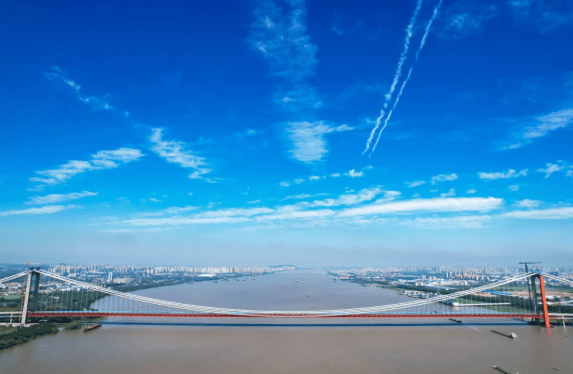
Aviation Height Restrictions "Force" Extreme Construction Challenges
The Yanji Yangtze River Bridge, with a total length of approximately 26.3 kilometers and a main span of 1,860 meters, is a core supporting project for Ezhou Huahu Airport. After the bridge opens, travel time between Ezhou and Huanggang will be reduced from 2 hours to 15 minutes, effectively breaking through transportation barriers in eastern Hubei and promoting regional coordinated development.
However, this bridge, of great significance to regional development, faces an "inherent constraint" due to its proximity to the core airspace of Huahu Airport—strict adherence to aviation height limits. The main tower height is only 184 meters, and the double-deck main cable arrangement of the bridge is extremely compact.
This height restriction directly led to a thorny problem: the effective aerial working space is less than 60% of that of conventional bridges. Combined with adverse conditions such as the complex hydrology of the Yangtze River and frequent wind and waves on the river surface, this has given rise to multiple world-class construction challenges.
Disruptive Breakthrough from "Symmetry" to "Asymmetry"
Defying Tradition: Boldly Proposing an Asymmetric Catwalk Solution
Previously, long-span suspension bridges both domestically and internationally have used symmetric catwalk construction techniques. However, after preliminary calculations and verification, the project's technical team found that traditional techniques are only suitable for conventional large-space bridges. Blindly applying them would prevent core equipment such as wrapping and tensioning devices from being positioned, making the project difficult to advance.
Luo Hang, then the project's Chief Engineer, combined engineering data with on-site measurement results and boldly proposed an innovative solution: using an asymmetric catwalk to fully utilize the limited aerial space and adapt to the special tower-cable structure.
Breaking Doubts with Data: 3.45-meter Offset Plan Passes Review
During the preliminary review of the plan, industry experts expressed concerns about potential safety hazards such as center-of-gravity shift and aerial overturning due to the asymmetric structure. The team repeatedly calculated parameters, optimized models, and conducted load tests, using detailed data to confirm the safety of the plan. Ultimately, the 3.45-meter offset asymmetric catwalk plan successfully passed the review, filling a technical gap in bridge construction within specially confined spaces.
Innovation in Tower-Passing Technique: From "Wrapping Around" to "Passing Through"
After the plan was implemented, new construction bottlenecks emerged. During the load-bearing cable passing through the tower, the traditional "wrapping around" technique required guiding the steel cables to bypass both sides of the cable saddle. In the confined space, this was prone to cable bending and uneven stress distribution, posing high safety risks.
Wu Di, Head of the Project's Technical Department, led the team to tackle this challenge, innovatively developing a technique for passing cables through pre-reserved holes in the main tower. By precisely embedding dedicated through-pipes in the tower body and using cable deflection equipment to guide the cables in a straight line, millimeter-level precise alignment was achieved.
"The 'passing through' construction method fundamentally eliminates the safety hazards of cable bending and uneven stress, and can also shorten the construction period by 20 days, achieving a triple benefit in safety, quality, and efficiency," Wu Di explained.
Millimeter-Level Control: Overcoming the 15% Cable Force Deviation Challenge
Catwalk erection was the core difficulty of the entire line construction. "With strong winds and waves on the river surface, coupled with the overall asymmetric structure, the cable force difference between the wide and narrow sides of the catwalk reaches 15%, making stability control extremely difficult," explained Chen Hanlong, the project's Principal Engineer.
The project team implemented millimeter-level control, executing measures of "speed locking, strict spacing control, and dual-instrument monitoring":
The traction speed of the cable strands was stabilized at 3 meters per minute
The error in cable spacing was strictly controlled within 5 millimeters
Protective measures such as reflective positioning and tire buffers were employed
On December 30, 2024, the four asymmetric catwalks of the bridge were fully connected. In 2025, relying on the unique catwalk platform, the team overcame challenges such as uneven stress on multi-sag main cables and high-altitude wind disturbances, achieving full-line connection of the bridge by the end of 2025.
Core Innovation Achievements
| Innovation Point | Traditional Solution | Yanji Bridge Innovative Solution |
|---|---|---|
| Catwalk Structure | Symmetric Catwalk | 3.45m Offset Asymmetric Catwalk |
| Tower-Passing Technique | Traditional "Wrapping Around" Technique | Main Tower Pre-reserved Hole Passing Technique |
| Cable Strand Traction Speed | — | 3 m/min |
| Cable Spacing Error | — | ≤5 mm |
| Construction Period | — | Shortened by 20 Days |
| Safety Control | Conventional | Millimeter-Level Control, Dual-Instrument Monitoring |
With its excellent quality and independent innovation technology, the project has won the Hubei Province Green Construction Engineering Award and 9 provincial-level QC achievement awards, and two teams were rated as first-prize winners for Hubei Province Engineering Construction Trustworthy Teams.
Providing a "Chinese Solution" for World's Long-Span Suspension Bridges
Filling a Technical Gap in Bridge Construction within Specially Confined Spaces
The asymmetric catwalk solution for the Yanji Yangtze River Bridge fills a technical gap in bridge construction within specially confined spaces. This innovation provides a replicable technical pathway for future construction of long-span suspension bridges in confined spaces such as dense urban areas, airport height-restricted zones, and narrow canyon areas.
Advancing Suspension Bridge Catwalk Construction from "Experience" to "Data"
Through repeated parameter calculations, model optimization, and load tests, the project team used detailed data to confirm the safety of the asymmetric structure. This "data-driven decision-making" methodology marks a new stage where suspension bridge catwalk construction moves from relying on experience to relying on scientific calculation.
Providing a "Chinese Model" for Similar Projects Worldwide
"Over the Yangtze River, the 12-kilometer 'aerial corridor' spanning the waves is a vivid testament to the builders of China Communications Construction Company Second Harbor Engineering Company Ltd. crafting excellence with ingenuity and bridging smooth paths with hard work, providing a replicable and referable new idea for the construction of catwalks for world's long-span suspension bridges."
As global infrastructure construction continues to advance, the demand for bridge construction in confined spaces will increase. The asymmetric catwalk technology of the Yanji Yangtze River Bridge is expected to become a "Chinese calling card" in the field of world bridge construction.
Using "Asymmetry" to Solve the "Impossible"
The successful practice of the asymmetric catwalk on the Yanji Yangtze River Bridge has industry significance far beyond the completion of a single bridge. It proves a key proposition: when conventional solutions cannot adapt to extreme conditions, disruptive innovation often lies in "counter-intuitive" thinking.
From symmetry to asymmetry, from wrapping around to passing through, from empirical judgment to data-driven decision-making—the builders of the Yanji Yangtze River Bridge, with their 12-kilometer "aerial corridor," have not only broken through transportation barriers in eastern Hubei but also written a vivid footnote about courage, wisdom, and innovation for world bridge construction.