Multiple World Records Set! China's Self-Developed New Shield Tool Changing Equipment Successfully Applied
On July 23, the world's first set of "ternary mixed gas" shield pressurized operation equipment, independently developed by China Railway 11th Bureau, completed its first large-scale ultra-high pressure pressurized chamber tool change operation in the world's longest underwater high-speed railway tunnel—the Jintang Subsea Tunnel of the Ningbo-Zhoushan Railway. This achievement set multiple world records in the shield tunneling field, including the highest operating pressure, the highest frequency of ultra-high pressure tool changes, and the longest continuous operation cycle. It has formed a full-chain technology covering equipment manufacturing, operation control, and personnel training, breaking the long-term technological monopoly of foreign countries.
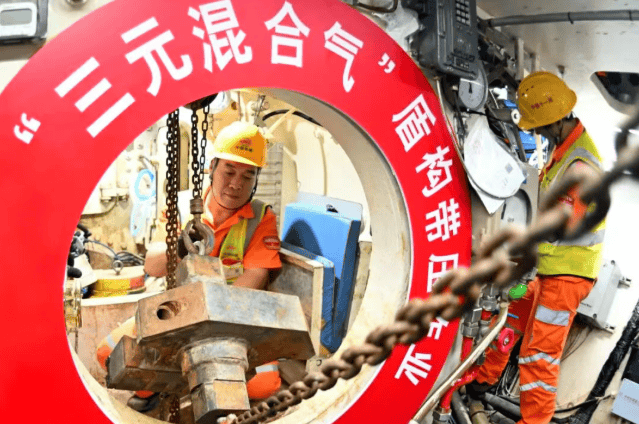
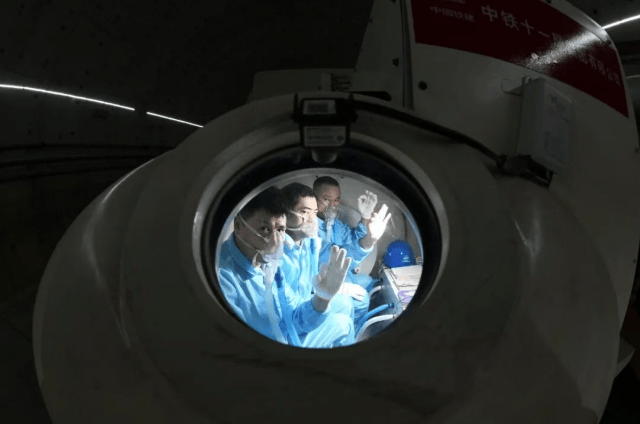
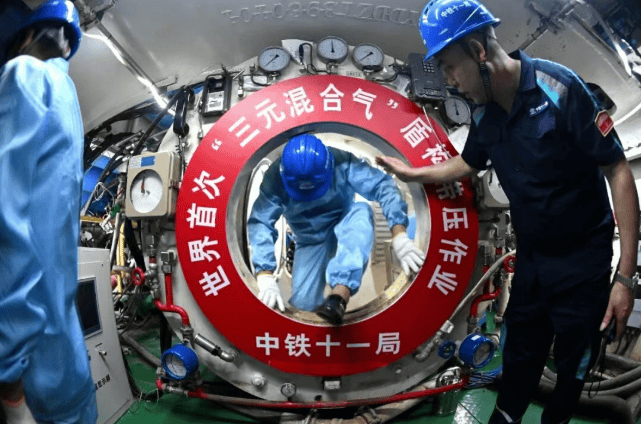
The last tool being transferred out of the manlock
This tool change operation lasted 75 days. The construction team worked at six locations 64 meters below sea level, completing a total of 313 pressurized chamber operations and 936 safe entries, successfully replacing 67 tools of various types. This fully verified the reliability of the "ternary mixed gas" in practical application.
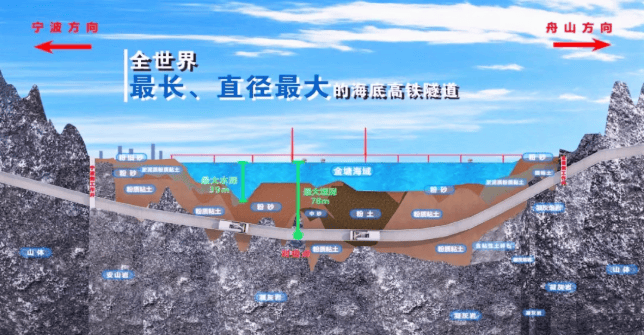
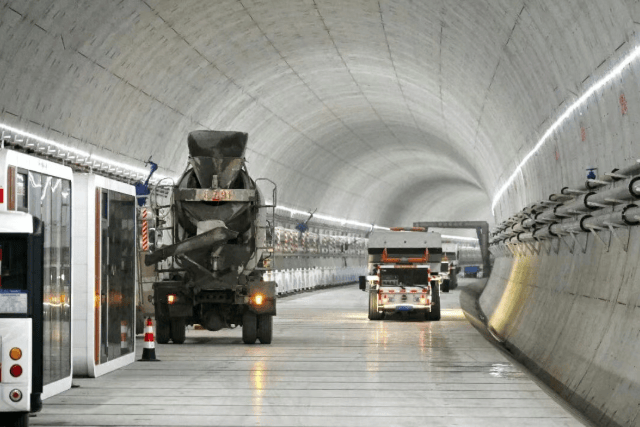
The Jintang Subsea Tunnel is a key control project of the entire Ningbo-Zhoushan Railway. Spanning the Jintang Waterway between Ningbo and Zhoushan in Zhejiang Province, it has a total length of 16.18 kilometers, with a shield section of 11.21 kilometers, making it the world's longest underwater high-speed railway tunnel.
The project construction uses two super-large diameter shield machines, which started simultaneously from the Ningbo and Zhoushan sides and advanced towards each other. After traversing high water pressure and various complex strata, they will achieve high-precision connection under the seabed. The maximum burial depth of the tunnel is 78 meters below sea level, with a maximum water and soil pressure of 8.5 bar, equivalent to a load of nearly 40 kilograms on an area the size of a one-yuan coin.
The geological conditions of the subsea tunnel are complex and variable. When the shield machine transitions from soft soil strata to hard rock strata, the soft soil tearing tools must be replaced with hard rock disc cutters. However, working in the chamber under ultra-high pressure has long been a thorny problem plaguing global subsea tunnel shield construction. China Railway 11th Bureau, responsible for the 6,270-meter shield construction on the Zhoushan side, innovatively proposed the concept of shield helium-nitrogen-oxygen "ternary mixed gas" pressurized operation. They invited academicians and industry expert teams for repeated demonstration and guidance, ultimately establishing the technical path.
In the "ternary mixed gas," helium has low density, fast diffusion, and high safety. It effectively prevents risks such as "nitrogen narcosis" and "oxygen toxicity" for personnel working under ultra-high pressure, building a safe breathing barrier for operations in deep-sea ultra-high pressure environments.
On May 8, 2026, the world's first set of "ternary mixed gas" shield pressurized operation equipment was officially applied to the construction of the Jintang Subsea Tunnel. The R&D team conducted thousands of pressure simulation tests and on-site condition verifications, overcoming a series of technical challenges including precise mixing ratio of gases, automatic gas supply regulation, graded safe decompression, and exhaled gas recovery.
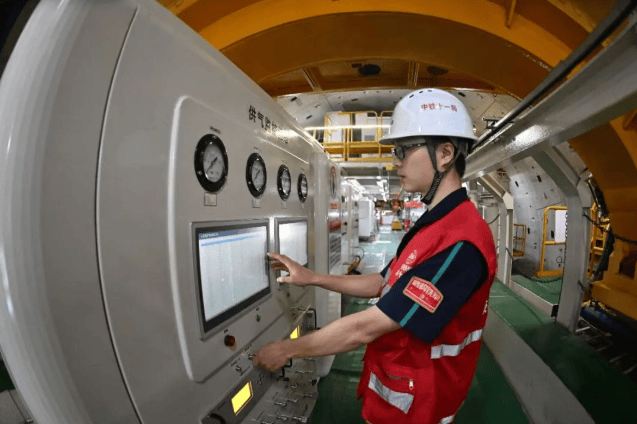
This equipment comprises 113 sub-modules, including a gas mixing hub, gas supply hub, specialized respirators, deck decompression chamber, and pressure flow intelligent control system. It can dynamically adjust the gas mixing ratio according to different water pressure environments, precisely adapting to the ultra-high pressure operation range of 5 bar to 12 bar, achieving a technological equipment breakthrough for pressurized chamber operations at depths of up to 100 meters.
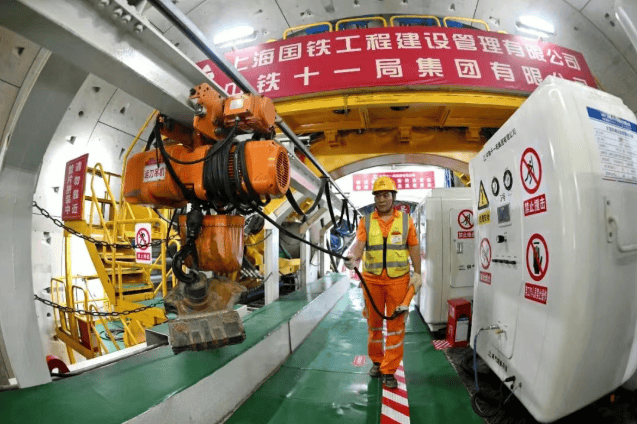 Relying on this innovative technology, the "ternary mixed gas" equipment abandons the bulky pre-chamber system of traditional helium-oxygen saturation pressurized operation equipment, achieving lightweight and modular layout for quick on-site deployment. Operators can start work after professional training, assessment, and certification. The equipment supports simultaneous entry of three personnel per session, with an effective working time of 60 minutes per person per session. Two sets of manlocks operate alternately, enabling 24-hour uninterrupted construction.
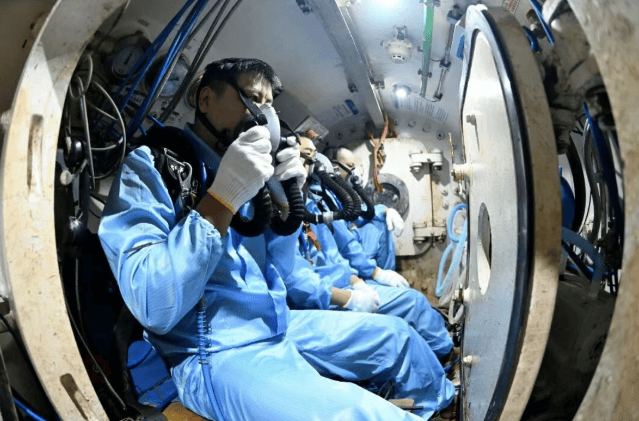 During operation, personnel entering the chamber wear specialized mixed gas respirators, supplied with gas through external pipelines, while exhaled gas is actively recovered inside the chamber. Operators first pressurize in the compression chamber to the design pressure, then sequentially pass through the shield machine's manlock, air cushion chamber, and slurry chamber to reach the back of the cutterhead, facing the tunnel face. After completing the task, they undergo scientific decompression before exiting the chamber and then enter the deck decompression chamber for secondary decompression recuperation.
 Currently, this equipment has formed standardized and systematic construction processes and safety control systems, establishing a replicable and scalable "Chinese solution" for ultra-high pressure tunnel construction. It has accumulated valuable practical experience and technological achievements for domestic and international deep-sea tunnels and major cross-sea projects.
As of now, the shield section of the Jintang Subsea Tunnel has advanced 10,005 meters, completing approximately 89.3%. According to the construction plan, subsequent work will continue to rely on this equipment system to ensure the safety of pressurized operations and guarantee the tunnel's timely completion.
Currently, this equipment has formed standardized and systematic construction processes and safety control systems, establishing a replicable and scalable "Chinese solution" for ultra-high pressure tunnel construction. It has accumulated valuable practical experience and technological achievements for domestic and international deep-sea tunnels and major cross-sea projects.
As of now, the shield section of the Jintang Subsea Tunnel has advanced 10,005 meters, completing approximately 89.3%. According to the construction plan, subsequent work will continue to rely on this equipment system to ensure the safety of pressurized operations and guarantee the tunnel's timely completion.
This bulletin is compiled and reposted from information of global Internet and strategic partners, aiming to provide communication for readers. If there is any infringement or other issues, please inform us in time. We will make modifications or deletions accordingly. Unauthorized reproduction of this article is strictly prohibited. Email: news@wedoany.com