
On July 30, as the cutterhead of Fujian Province's first combined pipe jacking and shield tunneling machine, the "Qingyuan", precisely ground through the left-line tunnel portal of the receiving shaft, the double-line breakthrough was achieved in the pipe jacking and shield tunneling section of the N1 Bid Section of the Southern Main Canal Water Supply Replacement Project for Kinmen Water Supply Source Guarantee. This marks the first application of the combined pipe jacking and shield tunneling method in China's water conservancy industry, clearing a key bottleneck for the full-line water delivery of the project.
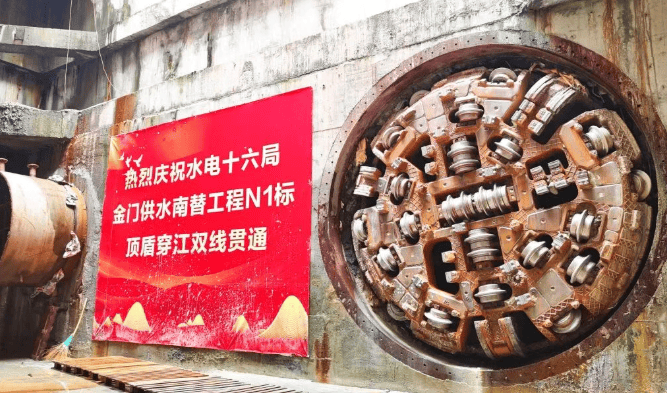
The single-line length of the pipe jacking and shield tunneling section of the N1 Bid Section of the Kinmen Water Supply Replacement Project is 1.4 kilometers, requiring four crossings beneath the Jinjiang River channel while avoiding multiple cultural relics and historic sites. The geology along the route is complex, predominantly consisting of highly permeable sandy cobble strata, with locally soft upper and hard lower layers. The clear distance between the double-line pipes is only 4.6 meters, and the thinnest riverbed overburden is merely 6 meters, with significant influence from groundwater and tidal effects. The successful double-line breakthrough of this pipe jacking and shield tunneling section signifies the first successful application of the combined pipe jacking and shield tunneling technology in small-spacing, complex-strata river-crossing projects in China's water conservancy and hydropower sector. It fully validates the stability and superiority of the slurry balance combined pipe jacking and shield tunneling machine in long-distance river-crossing construction under complex geological conditions, filling a technical gap in construction for both Fujian Province and China's water conservancy industry, and providing a replicable and promotable practical solution for similar construction projects.
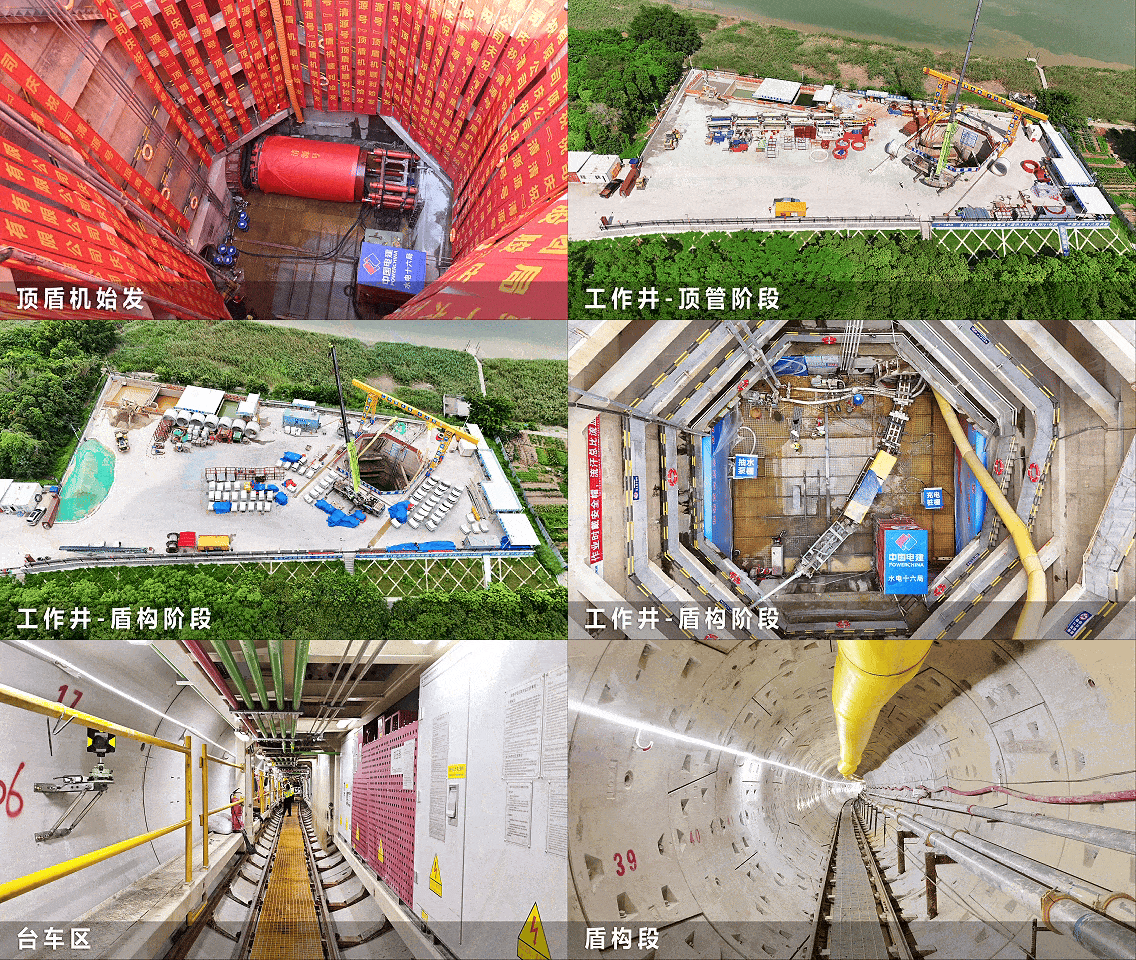
Facing these challenges, the project team adhered to technology-driven innovation, pioneering the combined pipe jacking and shield tunneling construction method with jacking first and shielding second. Leveraging the core advantages of one machine, two modes, and flexible adaptation, the maximum daily advance reached 25 meters, with the shield mode achieving a maximum daily advance of 26.4 meters. To address the complex working conditions, the project team conducted systematic research and developed a complete set of construction technology systems: First, the adoption of launching sealing technology, innovating a short-sleeve sealing combined with heavy dewatering process to eliminate the risk of water gushing and seepage at the tunnel portal; Second, the use of salt-resistant composite bentonite friction reduction and thick slurry grouting technology, employing salt-resistant composite bentonite to resist the erosion of slurry performance by salts in groundwater, and innovating a thick slurry grouting process to effectively isolate the influence of flowing water and significantly reduce jacking friction; Third, the adoption of a composite cutterhead with disc cutters and tearing cutters, effectively preventing cutter breakage and cutterhead eccentric loading or jamming, and avoiding frequent chamber opening for cutter changes. A secondary crushing chamber was configured to effectively address challenges such as cutting through pile foundation concrete and crushing large cobbles, while preventing cutter wrapping and chamber blockage. Additionally, the team overcame core technologies including online mode conversion of the combined pipe jacking and shield tunneling equipment, efficient muck discharge in water-rich sandy cobble strata, and high-precision guidance and deviation correction, accumulating valuable experience for the construction of similar projects.