
Researchers at the Chinese Academy of Sciences (CAS) have developed a four-terminal tandem solar cell featuring a wide-bandgap perovskite top cell and a copper indium gallium selenide (CIGS) bottom cell, addressing the stability challenges of wide-bandgap perovskite materials through coordination engineering technology. The tandem device retains over 91% of its initial efficiency after 2,000 hours of continuous operation, achieving an overall efficiency of 29.71%.
Wide-bandgap perovskite absorber layers have long faced performance degradation caused by light-induced phase segregation and halide ion migration. The research team noted that undercoordinated lead defects and associated halide vacancies are key factors triggering instability—these defects not only act as recombination centers, disrupting the local lattice environment, but also provide pathways for halide ion migration. Although traditional post-treatment passivation strategies can reduce some defects after crystallization, their control over defect formation during film growth is limited, and light-induced halide segregation remains difficult to suppress during long-term operation.
To address this, the researchers employed a sulfur-containing organic compound, bis(2-pyridylmethyl) sulfide (2PyS), to finely regulate the local coordination environment of lead (Pb) ions in the perovskite layer. The binding strength of 2PyS with lead iodide (PbI₂) is higher than that of commonly used solvents such as dimethylformamide (DMF) and dimethyl sulfoxide (DMSO), enabling more effective modulation of the lead ion coordination environment during perovskite formation, thereby influencing the crystallization process. In-situ photoluminescence measurements revealed that 2PyS modulates crystallization kinetics, suppresses rapid nucleation, and promotes more uniform film growth, ultimately reducing non-radiative recombination and enhancing structural integrity and phase stability.
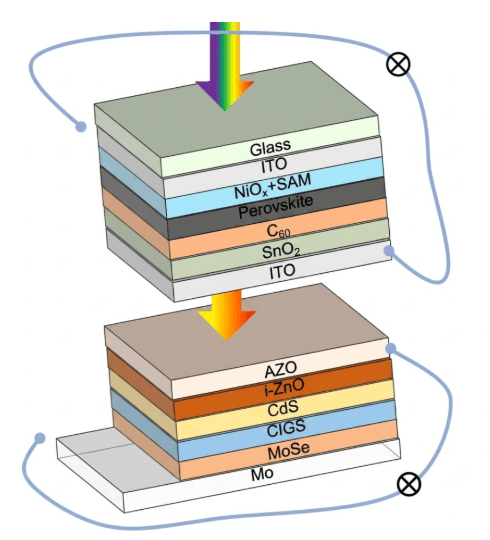
The top perovskite cell comprises an indium tin oxide (ITO) front electrode, a nickel oxide (NiOx) hole transport layer, a self-assembled monolayer (SAM) interface layer, a perovskite light-absorbing layer, a C60 fullerene electron transport layer, a tin oxide (SnO₂) buffer layer, an ITO transparent electrode, and a silver (Ag) metal contact. The bottom CIGS sub-cell consists of a molybdenum (Mo) back electrode, a CIGS absorber layer, a cadmium sulfide (CdS) buffer layer, and a zinc oxide-based window layer (intrinsic zinc oxide i-ZnO and aluminum-doped zinc oxide Al:ZnO).
Test results show that the standalone CIGS bottom cell achieves a power conversion efficiency of 19.65% under full-spectrum illumination; when operating beneath the semi-transparent perovskite top cell, the sub-cell efficiency drops to 7.5% due to reduced available incident light from spectral filtering. The top cell achieves an efficiency of 22.21%, and the integrated four-terminal (4T) tandem device reaches a total efficiency of 29.71%. The research team states that this is among the highest efficiencies reported to date for perovskite/CIGS four-terminal tandem solar cells.
The findings were published in IPOScience under the title "Coordination-regulated defect suppression enables stable wide-bandgap perovskites for efficient perovskite/CIGS tandem solar cells."