
Since the beginning of this year, driven by both policy empowerment and technological iteration breakthroughs, China's aerospace industry has accelerated its transition from concept cultivation to a new stage of implementation, with emerging tracks such as commercial space and aviation equipment continuing to unleash their momentum.
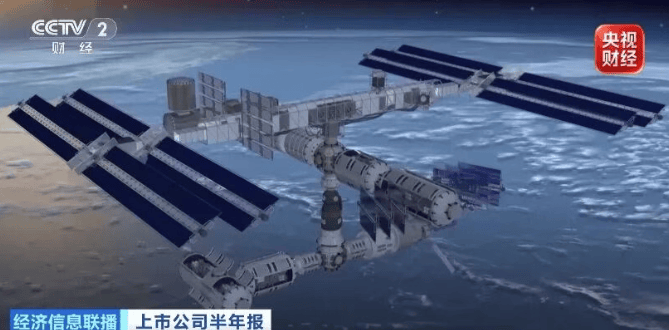
As of July 30, 18 companies in the high-end aerospace sector on the A-share market have disclosed their 2026 interim earnings forecasts, of which 12 are expected to report positive results, with the proportion of positive forecasts exceeding 60%.
Breaking the monopoly! Prices cut by 70%!
Domestic aviation brake materials achieve a "corner overtaking"
The braking system is the core key to the safe takeoff and landing of aircraft. In the past, the production and sales of high-performance brake discs were long monopolized by overseas companies. Today, with continuous breakthroughs in domestic new material technologies, China's civil aviation braking sector has fully entered a new stage of independent localization.
Liu Jinsong, chief technical expert of the Aviation Industry Corporation of China, explained that in the past, aircraft, automobiles, and trains all used powder metallurgy brake discs, commonly referred to as "steel brakes." As aircraft speeds increase and energy levels grow, brake disc temperatures can reach over a thousand degrees Celsius, causing steel to melt into molten metal. Under such conditions, international research on carbon/carbon brake discs was initiated.
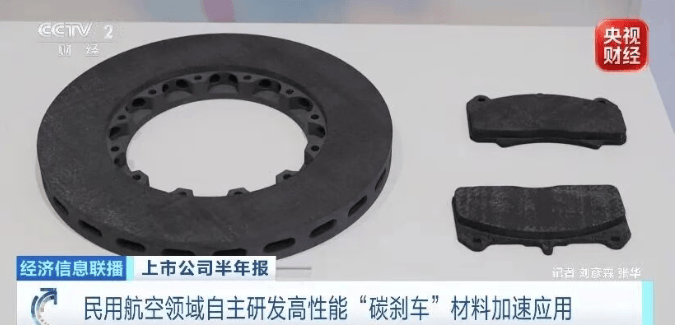
Compared with metal brake materials, carbon materials offer irreplaceable advantages including light weight, high-temperature resistance, and long service life. Currently, all mainstream civil aviation airliners worldwide use carbon brake materials on a large scale. However, civil aviation carbon brakes have long been high-priced consumables, with the unit price of complete spare parts being extremely high, earning them the industry nickname "black gold." Relying on breakthroughs in the domestic materials industry, China has independently developed carbon/ceramic brake materials on the basis of traditional carbon/carbon brakes, which are moisture-resistant, high-temperature resistant, and more stable in braking across the full temperature range, achieving a corner overtaking in key brake material technology.
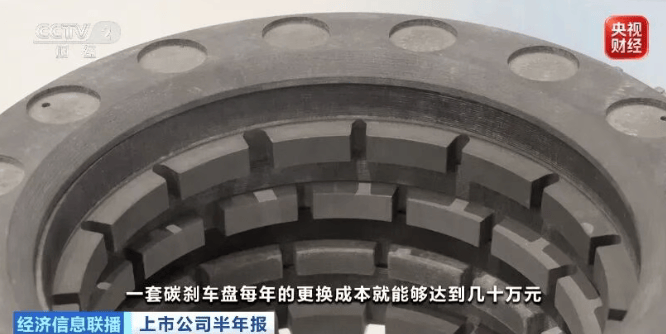
Liu Jinsong stated that carbon brake discs had long been monopolized by three to four foreign companies, with the annual replacement cost of a single set of carbon brake discs reaching hundreds of thousands of yuan, and an aircraft requiring one to two million yuan in replacement costs per year. After they and domestic peers entered this field, foreign suppliers significantly reduced their prices, with a reduction exceeding 70%.
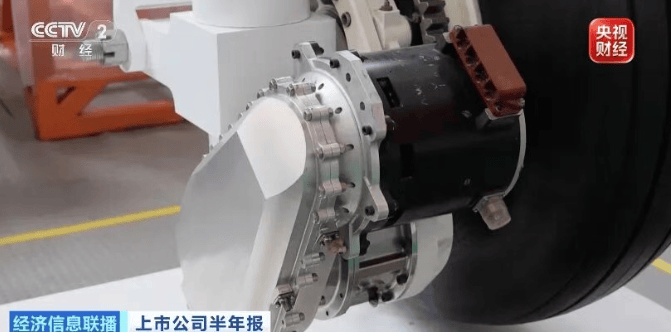
Industry insiders point out that the application boundaries of domestic civil high-performance brake materials are continuously expanding, now extending comprehensively into emerging aviation sectors. The entire industrial chain—from research on high-performance carbon-based composite brake materials and brake disc manufacturing to the application of anti-skid electronic brake control systems—has achieved full localized mass production.
Protected by the "Chinese chip"!
Consolidating the digital foundation of aerospace equipment
Aerospace equipment is the crown of high-end manufacturing, and onboard chips serve as the foundation for the safe operation of such equipment. In recent years, with continuous breakthroughs in domestic chip technology, China's core aerospace chips are entering a new stage of independent innovation.
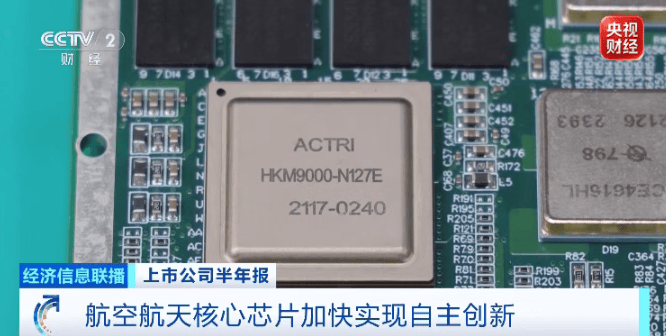
This domestically produced GPU chip is named HKM9000. In November 2025, the chip was carried into space aboard the Shenzhou-22 spacecraft to perform missions, undertaking key tasks such as cockpit display and navigation data visualization. What makes chips used in aerospace scenarios different from those used in our everyday phones and computers?
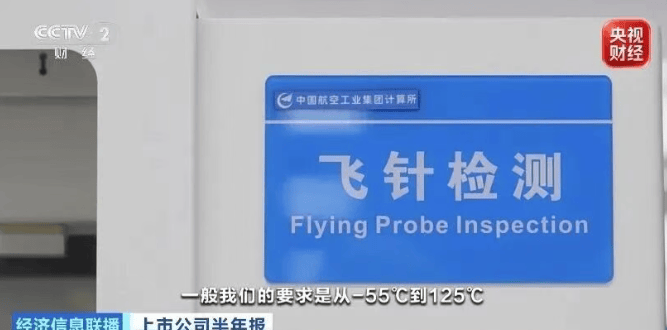
Guo Meng, senior engineer at the AVIC Computing Technology Research Institute, explained that this chip possesses extremely strong environmental adaptability, typically required to operate from -55°C to 125°C, while also facing radiation from high-energy particles. In a binary system, it operates on "0101" logic; once a high-energy particle strikes the chip, it may cause a bit to flip from 0 to 1 or from 1 to 0, directly leading to functional anomalies.
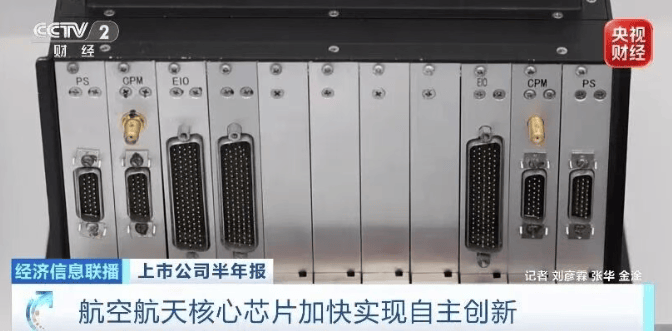
Aviation-specific chips feature high technical barriers and immense R&D difficulty. In the past, leading foreign companies started earlier and held a large number of mature technologies. To address this shortcoming, in recent years, relevant domestic institutions have persisted in independent R&D and concentrated efforts on tackling key challenges, developing a large batch of aviation-specific chips, thereby consolidating the core foundation for the independent and safe operation of China's aviation equipment.
Xie Wentao, head of the business division at AVIC Civil Aircraft Airborne Systems Co., Ltd., stated that the operating systems paired with these chips, as well as the ecosystem and tools required for their development, were previously extremely difficult to develop. However, in recent years, China has made significant progress in all these areas.