
According to Wedoany.com, the chip was jointly developed by the team of Professor Yang Yuchao from the School of Integrated Circuits at Peking University and the Chinese Academy of Sciences, marking the first time that the single-step computation time of a neuromorphic dynamics hardware system has been compressed to the millisecond level.
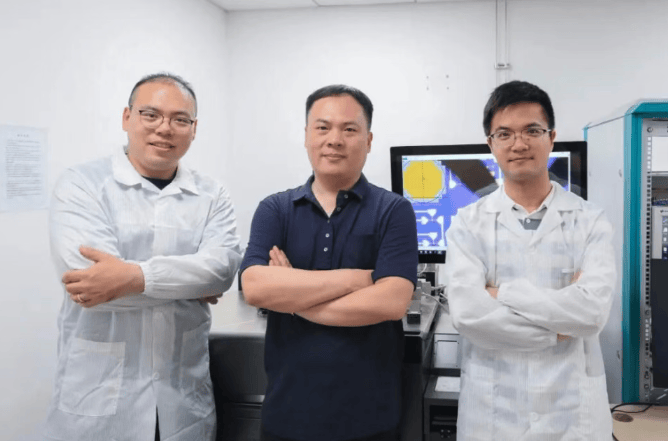
Professor Yang Yuchao (center) from the School of Integrated Circuits at Peking University poses with collaborators in the laboratory (Photo courtesy of Peking University)
The brain is one of the most complex dynamical systems. Whether it is real-time neural state decoding in brain-computer interfaces or high-precision reconstruction of the cerebral cortex in medical imaging, rapid modeling of continuous neuromorphic and dynamic processes is essential. "The neuromorphic dynamics system was thus born, where researchers combine neural networks with differential equations to reconstruct precise three-dimensional brain structures," Yang Yuchao explained. The system holds broad application prospects but also has notable shortcomings: the massive data generated by computation must be frequently shuttled between memory and processors, resulting in long processing times and persistently high energy consumption.
To address this challenge, Yang Yuchao's team developed the world's first millisecond-level neuromorphic dynamics system chip based on phase-change memristors, dramatically compressing the single-step computation time of the neuromorphic dynamics system to 2.12 milliseconds for the first time, achieving brain-like high-speed, high-precision computation.
"We proposed a new paradigm of 'controllable in-memory computing' based on phase-change memristors, allowing data to be processed efficiently in place without being shuttled back and forth," Yang Yuchao said. Compared with current mainstream advanced chips in the industry, the chip developed by the team delivers a significant leap in computational performance with substantially reduced power consumption, meeting the requirements for high-fidelity brain structure modeling.
"In the future, brain-computer interfaces will not only need to read neural signals but also understand brain states in real time, predict the evolutionary trends of neural dynamics, and perform closed-loop regulation based on feedback," Yang Yuchao noted. High-fidelity brain modeling, capable of running at millisecond speeds, is expected to provide brain-computer interfaces with individualized, dynamic, and interpretable brain state models, enabling brain state modeling and intelligent interaction. In the medical field, this achievement also holds promise for opening new technological pathways for early screening of brain diseases, disease progression monitoring, and personalized diagnostic and therapeutic interventions.