
A joint research team from Origin Quantum and the University of Science and Technology of China has innovatively proposed the "Parameter Space Expansion Controlled-Phase Gate (PSE-CZ)" scheme, successfully resolving the long-standing trade-off between speed and fidelity in superconducting quantum computing. This breakthrough enables two-qubit quantum gates to achieve significantly improved precision while maintaining high speed. The findings have been published in the top international physics journal Physical Review Letters, with experimental verification conducted on China's self-developed superconducting quantum computer, "Origin Wukong."
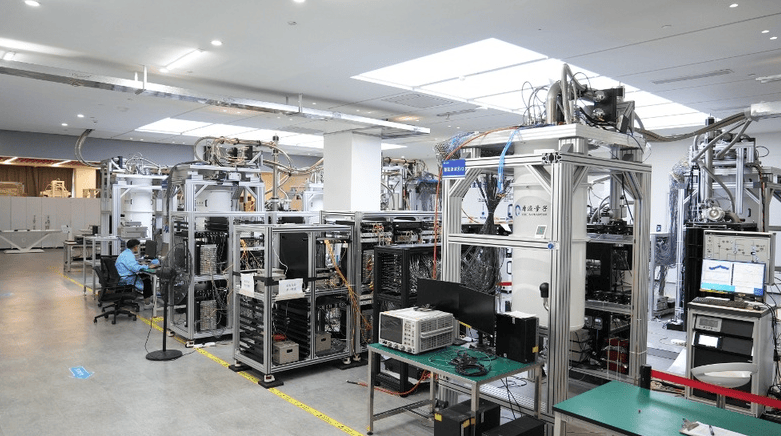
Quantum computers rely on fundamental operations called "quantum gates" to perform complex computations. Stable and reliable quantum computing requires quantum gates to possess both ultra-fast operation speed and ultra-high computational fidelity. However, these two requirements have long presented an irreconcilable contradiction: the faster a quantum gate operates, the more pronounced issues such as hardware waveform distortion and timing deviations become, leading to a significant drop in precision; conversely, slowing down to ensure accuracy compromises the overall operational efficiency of the quantum computer. This has been a critical bottleneck constraining the development of quantum computers.
To address this issue, the research team innovatively proposed the "Parameter Space Expansion Controlled-Phase Gate (PSE-CZ)" scheme. Dr. Yang Xiaoyan, a measurement and control scientist at Origin Quantum, explained: "Without extending pulse duration, this scheme splits the detuning in the middle region of the pulse into two independently adjustable parameters, adding a 'tuning knob' to the system. Through this innovative mechanism, the system can simultaneously correct both leakage and phase errors, achieving both speed and high fidelity."
Leveraging the "Origin Wukong" superconducting quantum computer, the team selected 20 pairs of two-qubit quantum gates for testing. The results show that the PSE-CZ scheme effectively reduces coherent errors caused by short-duration distortions, bringing quantum gate performance closer to the decoherence limit. Even under extremely short gate durations of 30–40 nanoseconds, PSE-CZ maintains stable performance superior to that of conventional CZ gates.
It is reported that this scheme is not only compatible with superconducting quantum computing systems but can also be extended to various other quantum computing platforms, including ion traps and solid-state spins, offering a promising new approach for achieving faster and higher-fidelity quantum logic operations.
Origin Quantum is China's first quantum computing company, focused on full-stack quantum computer development. It has preliminarily established a "three hardware, three software" quantum computing technology system, centered on quantum chip systems, quantum measurement and control systems, environmental support systems, quantum operating systems and software, quantum computing cloud platforms, and quantum computing application software. Its self-developed "Origin Wukong" series superconducting quantum computers have provided stable quantum computing services to 192 countries and regions worldwide, with cumulative remote access exceeding 52 million visits and over 1 million computational tasks completed.