
The Dark Energy Spectroscopic Instrument (DESI) Legacy Imaging Survey team in the United States has released the largest two-dimensional color map of the universe to date. This vast 5.6-trillion-pixel panorama encompasses nearly 4 billion celestial objects, mostly stars and galaxies.
Both professional astronomers and amateur enthusiasts can explore this map independently or cross-reference it with their own observations, gaining a deeper understanding of our universe. Scientists can use it to search for rare phenomena such as gravitational lensing, capture fleeting events like supernova explosions, and delve into two of physics' most profound mysteries: dark matter and dark energy.
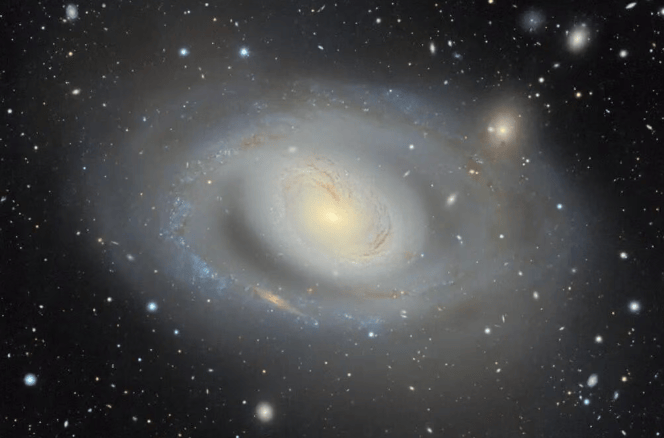
The newly released map covers approximately 75% of the sky in visible and near-infrared wavelengths. It meticulously records the positions and brightness of galaxies and stars, enabling DESI to select targets and measure light at different wavelengths to determine distances, thereby constructing the highest-resolution three-dimensional map of the universe to date. By studying how galaxies cluster at different cosmic epochs, scientists can trace the evolution of dark energy over time. The team expects that this map will remain the most comprehensive two-dimensional view of the universe for years to come.
This spectacular "star map" was assembled from hundreds of thousands of images captured over 2,285 nights. Each image bears the unique imprint of atmospheric and telescope conditions at the time, behind which lies a massive computational endeavor. Scientists at the National Energy Research Scientific Computing Center at Berkeley Lab used the Perlmutter supercomputer, spending about a year developing the code and then running it continuously for eight weeks, day and night, to process all the images.
In April 2026, DESI completed its originally planned five-year survey ahead of schedule, observing far more objects than anticipated. Early research results suggest that the influence of dark energy may weaken over time. DESI is expected to release more refined results based on the first five years of data in 2027, and will continue observing through 2028.
In addition to supporting DESI, the Legacy Imaging Survey will serve as a reference benchmark for next-generation telescopes. The data provided by this project will also be used to train artificial intelligence tools, helping them analyze vast astronomical datasets and accelerate the discovery of new phenomena.