
A research team led by Professor Zeng Changgan and Distinguished Professor Cheng Guanghui at the University of Science and Technology of China (USTC), in collaboration with partners, has for the first time utilized a "dark cavity" to achieve vacuum fluctuation-enhanced superconductivity. The findings were published in Nature on August 19.
In the world of quantum electrodynamics, a vacuum is not empty but accompanied by the continuous creation and annihilation of virtual particles, resembling a dynamic "ocean" filled with vacuum fluctuations. However, vacuum fluctuations in free space are typically weak and difficult to exert observable effects on macroscopic condensed matter systems. How to transform them into resources for manipulating quantum states of matter is a significant topic at the intersection of condensed matter physics and cavity quantum electrodynamics.
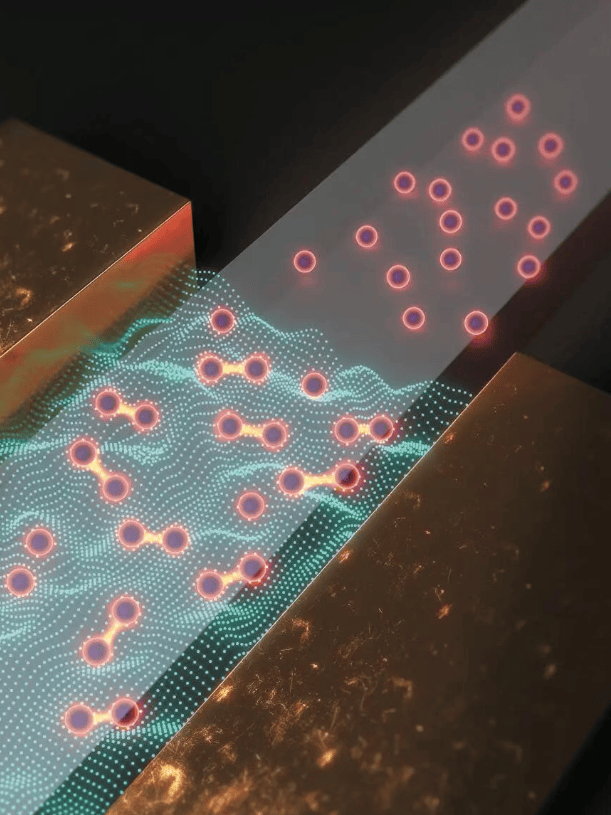
Previously, the Zeng Changgan team conducted research on manipulating the effects of vacuum fluctuations themselves, achieving a reversible transition of the Casimir force from attraction to repulsion. This inspired the team to further consider: can vacuum fluctuations be used to achieve controllable regulation of macroscopic quantum states of matter? To this end, the research team introduced a "dark cavity" composed of terahertz split-ring resonators, significantly enhancing vacuum fluctuations by reshaping the electromagnetic environment. The team embedded the superconductor niobium diselenide into the dark cavity and found that the superconducting critical temperature of niobium diselenide in the dark cavity was substantially increased. In six-layer niobium diselenide devices, the critical temperature was enhanced by up to 5.4%. Additionally, the critical current and critical magnetic field of the superconductor were also significantly enhanced near the superconducting transition. This marks the first experimental observation worldwide of vacuum fluctuation-enhanced superconductivity.
Through rigorous control experiments, the team ruled out conventional factors such as strain, degradation, and inhomogeneity. In particular, the experiments revealed that the superconducting enhancement effect exhibits a resonant peak dependence on the characteristic frequency of the dark cavity, providing key evidence for the coupling between the superconducting state and the dark cavity.
The researchers stated that this study, by engineering vacuum fluctuations through the cavity, achieved non-contact enhancement of the superconducting steady state without external driving, offering new insights for exploring superconducting mechanisms and designing novel superconducting devices. This innovative "non-contact knob" is expected to find broad applications in the manipulation of quantum states of matter.