
Chinese scientists have, for the first time, broken the micron-level length barrier in synthesizing "metallic wires" with a single-atom diameter. Scaled proportionally by diameter and length, this is equivalent to a 4-meter household copper wire.
The team led by Li Kuo at the Center for High Pressure Science and Technology Advanced Research (HPSTAR) innovatively applied a new strategy of high-pressure solid-state topochemical polymerization, achieving for the first time internationally the synthesis of carbon-wrapped single-metal-atom chains with micron-level length, atomic-level thickness, and structural stability. This achievement was published in the international academic journal Science on August 21.
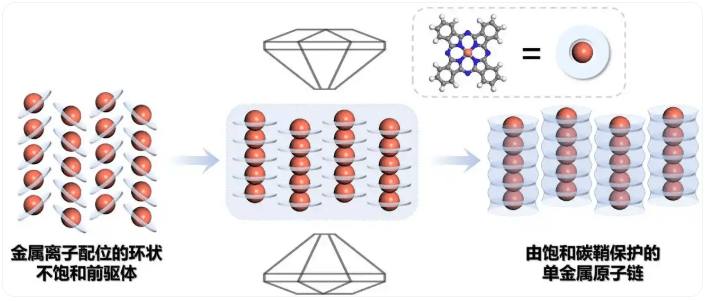
The image shows a schematic diagram of the synthesis process of micron-length carbon-wrapped single-metal-atom chains. (Image by the research team) A single-metal-atom chain can be understood as the world's "thinnest one-dimensional metallic wire," so thin that it has a diameter of only a single atom, making it an ideal research subject for scientists exploring low-dimensional physical laws in the microscopic world. "However, the development of such materials has long suffered from shortcomings: some preparation methods can only be achieved under ultra-high vacuum conditions and are easily damaged once removed from that environment; other methods can yield stable, batch-producible samples, but the atomic chain length is limited. The difficulty in simultaneously achieving chain length, stability, and batch production has constrained the potential for related fundamental research and applications," Li Kuo said.
The greatest breakthrough of this achievement lies in advancing the preparation limit of single-metal-atom chains to the micron level. Using the Paris-Edinburgh press, the team batch-produced large-sized carbon-coated copper single-atom chain single crystals, with individual stripped atomic chains exceeding 1 micron in length, capable of continuously connecting more than 4,000 copper atoms in series—an improvement of more than two orders of magnitude over previously prepared sample chain lengths internationally. This preparation method can also be extended to various metals such as cobalt, nickel, and zinc.
To stabilize this extremely thin atomic-level "metallic wire," the research team proposed a new approach. "Just like fitting a fragile filament with a sturdy 'protective sleeve,' we selected β-copper phthalocyanine crystals as the raw material. By precisely compressing the intermolecular spacing under high pressure, upon reaching critical conditions, the peripheral molecular rings of the raw material interconnect and polymerize, forming a dense and robust carbonaceous 'protective sheath' that firmly encapsulates and locks in the neatly arranged copper atoms inside," Li Kuo explained.
This research was completed by HPSTAR in collaboration with Nankai University, Peking University, and other institutions. "Atomic-scale ultra-fine metallic wires are expected to provide entirely new material options for next-generation nanoelectronics circuits and flexible wearable electronic devices, opening new pathways for the development of novel low-dimensional functional materials in China," said Mao Ho-Kwang, a world-renowned high-pressure scientist and academician of the Chinese Academy of Sciences.