
On August 21, WeDoAny learned from the Institute of Coal Chemistry, Chinese Academy of Sciences that the team led by Yin Xi has recently overcome a series of core key technologies, including the structural design of the 200 kW 40 Nm³/h AEM water electrolysis stack, modular integration of the stack, construction of the entire system architecture, and supporting intelligent control. They have also coordinated the completion of core implementation stages such as overall equipment assembly, system commissioning, and multi-dimensional performance verification testing.
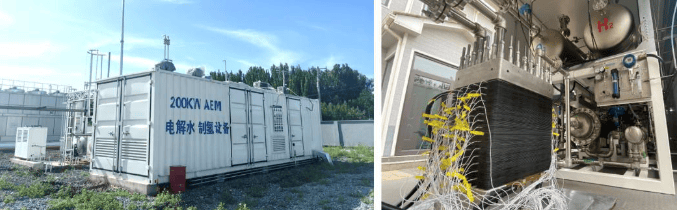
Driven by the "dual carbon" strategy, green hydrogen application scenarios in China continue to expand, and equipment demand is growing steadily. AEM water electrolysis hydrogen production technology (AEM: Anion Exchange Membrane) offers advantages of low cost and high flexibility, and is considered one of the next-generation mainstream hydrogen production technologies.
However, the current domestic technology system for complete AEM hydrogen production equipment is not yet fully developed, and numerous technical bottlenecks remain in the engineering of high-power equipment. Under high-power operating conditions, the internal flow field of the stack and the distribution control of gas-liquid two-phase flow are highly challenging. The stacking of multiple single cells presents sealing and pressure equalization difficulties, while electrode materials struggle to adapt to alternating operating conditions, limiting stability. Moreover, there is a scarcity of reference high-power engineering cases domestically, and mature experience is lacking in equipment integration, commissioning, and reliability verification, which constrains the industry's large-scale advancement.
Yin Xi stated that this research has achieved three major breakthroughs: First, optimizing the electrode material structure has significantly enhanced the electrode's tolerance performance in strong alkaline and alternating load environments, enabling the use of non-precious metal material systems that balance equipment performance and cost advantages. Second, completing the optimized flow field design for the high-power stack has resolved the issue of uneven gas-liquid two-phase flow distribution under high-power conditions, ensuring uniform distribution of current and media within the stack, thereby improving overall operating efficiency and service life. Third, achieving highly stable operation under wind-solar renewable energy conditions. Relying on a modular architecture and a self-developed intelligent control system, the equipment can rapidly adjust load in response to photovoltaic and wind power output, supports flexible expansion to megawatt-level and thousand-Nm³/h scale, and is adapted to the engineering requirements of on-site hydrogen production with fluctuating renewable energy.
Yin Xi noted that this system not only effectively addresses the pain points of industry development, but also lays a solid technical foundation for the autonomous controllability, industrial implementation, and large-scale high-quality development of China's hydrogen energy equipment. Recently, following expert review organized by the Beijing Guoke Yuce High-Tech Industry Development Center, the overall technology of this equipment has reached the internationally advanced level, and it has also obtained Beijing's first (set) major technical equipment certification.