
Recently, the research team led by Professor Liu Hongjun from the State Key Laboratory of Transient Optics and Photonics at the Xi'an Institute of Optics and Precision Mechanics, Chinese Academy of Sciences, has made significant progress in the field of metasurface mid-infrared nonlinear frequency upconversion imaging. The related research findings have been published in Laser & Photonics Reviews. The first author of the paper is Zhang Congfu, a doctoral student at the institute, and the corresponding author is Liu Hongjun.
The mid-infrared band (3–5 μm), as an important atmospheric transmission window, plays a critical role in fields such as biomedicine and environmental monitoring. Nonlinear frequency upconversion technology can convert mid-infrared signal light, which is difficult to detect directly with high sensitivity, into the near-infrared or visible band, enabling high-performance detection using compact, high-quantum-efficiency silicon-based detectors. This represents one of the core technological approaches in the field of mid-infrared detection. Compared with traditional nonlinear optical devices, nonlinear metasurfaces can significantly enhance light-matter interactions at the subwavelength scale, thereby overcoming the constraints of stringent phase-matching conditions. In recent years, although high-quality-factor nonlocal metasurfaces have been applied to enhance nonlinear effects, achieving efficient continuous-wave frequency upconversion under low-threshold, weak-light conditions while simultaneously maintaining flexible spectral tuning capabilities has remained challenging, directly limiting the practical advancement of high-performance metasurface-based mid-infrared detection technologies.
To address these issues, the research team, using thin-film lithium niobate as the nonlinear optical platform, proposed a nonlinear frequency upconversion method based on quasi-guided mode (QGM) engineering (Figure 1). This method introduces quasi-guided mode resonances through Brillouin zone folding, establishing stable high-quality-factor resonant modes across a wide wavevector range. Furthermore, by leveraging the strong coupling effect between quasi-guided modes and guided-mode resonances (GMR), the mode-matching range within a single guided-mode resonance system is expanded, allowing different resonant modes to effectively enhance nonlinear effects. Combined with the resonance tuning capability across a wide wavevector range, this method significantly broadens the tuning range of frequency conversion, achieving simultaneous improvements in conversion efficiency and spectral tunability.
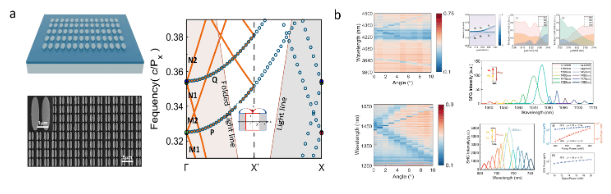
Figure 1 Schematic of metasurface frequency upconversion (a) Schematic of the metasurface structure and QGM principle; (b) Linear and nonlinear spectral characteristics of the metasurface
Based on the aforementioned method, the research team constructed a thin-film lithium niobate mid-infrared frequency upconversion imaging system. In the experiments, sum-frequency upconversion imaging of a low-intensity continuous-wave 4.33 μm mid-infrared signal was successfully achieved (Figure 2). By tuning the near-infrared pump wavelength, the team verified the pump-side resonance tuning capability and its influence on the nonlinear conversion process. Combined with dispersion analysis, the potential for broadband tunable mid-infrared frequency conversion imaging was further demonstrated.
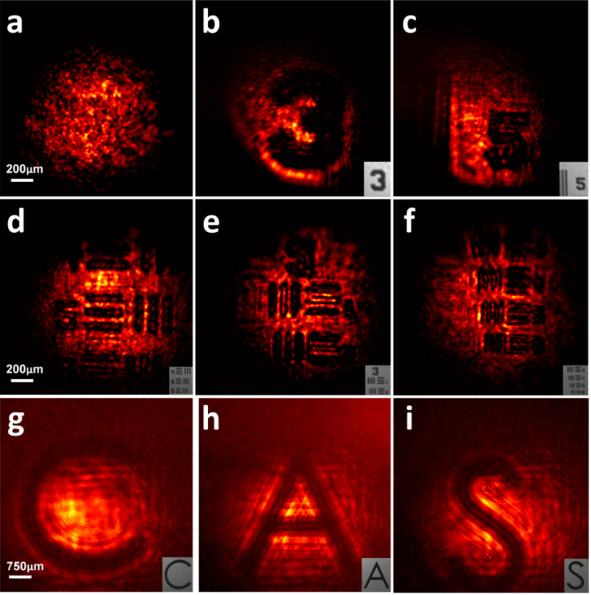
Figure 2 Metasurface frequency upconversion imaging results
Zhang Congfu explained: "The nonlinear metasurface is only one-hundredth the thickness of a human hair, with tens of thousands of nanostructures integrated onto an area the size of a sesame seed. Using the quasi-guided mode resonance effect, we first make the structure selectively receive light at specific wavelengths, like tuning a radio to a station, continuously accumulating weak light energy; then, like a signal amplification tower, we concentrate this energy into an extremely thin film to amplify the light's effect. As a result, frequency conversion that previously required high-power intense lasers can now be accomplished with ordinary weak light. This resolves a major challenge for compact device applications such as mid-infrared weak-light detection and non-invasive biological imaging."
This research extends the tuning capabilities of nonlocal metasurfaces into the realm of continuous-wave nonlinear frequency conversion, not only providing a new technological pathway for compact, low-cost, and highly sensitive mid-infrared detection technologies, but also, owing to the technology's on-chip integration potential, demonstrating broad application prospects in scenarios such as gas detection, environmental monitoring, biomedical imaging, and integrated photonic sensing.
The research team led by Professor Liu Hongjun has conducted systematic studies in recent years on nonlinear metasurface optical field manipulation and enhancement mechanisms, with related findings published in journals such as Laser & Photonics Reviews and Nanoscale Horizons.