
Significant progress has been made in the development of new thin-film photovoltaic technology. A research team led by Researcher Meng Qingbo from the Institute of Physics, Chinese Academy of Sciences, has successfully fabricated large-area copper-zinc-tin-sulfur-selenium thin-film photovoltaic modules, achieving a power conversion efficiency of 13.0%—setting a new world record for this type of module and laying a solid foundation for the industrialization of next-generation low-cost, environmentally friendly solar cells. The related findings were published online in the international academic journal Nature Materials.
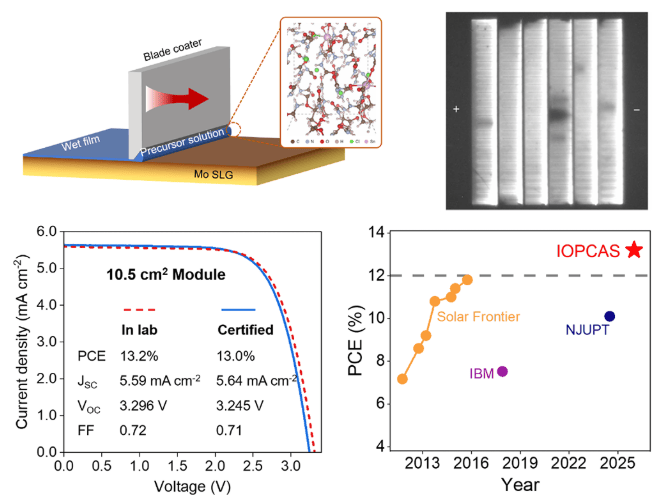
Copper-zinc-tin-sulfur-selenium is a new thin-film photovoltaic material composed of earth-abundant, low-cost, and environmentally friendly elements such as copper, zinc, and tin, and is considered an important direction for next-generation sustainable solar cells. In recent years, Meng Qingbo's team has set the world record for the efficiency of this type of cell 10 times. However, to bring this "laboratory star" into practical application, a key challenge remains: once the device size is scaled up, the uniformity of the thin film deteriorates sharply, and the efficiency correspondingly "shrinks."
"The problem lies in the solution process," Meng Qingbo explained. In conventional methods, metal ions and organic molecules form complex cross-linked networks, leading to uneven solvent evaporation, elemental distribution, and crystallization—much like having too many lumps in dough, resulting in a rolled-out "film" of inconsistent thickness. To address this, they started at the molecular scale, introducing formamide as a "coordinator" to precisely regulate the coordination structure between metal ions and organic molecules, successfully breaking this cross-linking "chaos."
Based on this molecular coordination regulation strategy, the team developed a solution-coating process suitable for large-area continuous production, producing highly uniform copper-zinc-tin-sulfur-selenium thin films on a 10 cm² substrate. A small-area cell of 1 cm² made from this film achieved a certified efficiency of 14.2%; meanwhile, a module with 6 sub-cells connected in series via laser scribing, with a total area of 10.5 cm², still achieved a certified efficiency of 13.0%.
"This fully demonstrates that copper-zinc-tin-sulfur-selenium thin-film technology not only performs well at small laboratory scales but also holds potential for scale-up production and industrialization," Meng Qingbo stated. This research provides a new approach for the large-scale manufacturing of low-cost, green thin-film photovoltaic modules.