
A study led by Professor Qian Shengbang from the School of Physics and Astronomy at Yunnan University has demonstrated that planetary systems in regular orbits around B-type massive stars, which have long been overlooked in observations, do indeed exist. The research was published in the academic journal Nature Communications.
B-type stars are massive stars in the universe, with surface temperatures exceeding 10,000 kelvin. Planets around this type of star serve as important observational samples for studying planet formation and evolution under extreme radiation environments. However, B-type main-sequence stars rotate rapidly, and their spectral signals have low discernibility, making it difficult for traditional observational methods to capture planetary signals within their intermediate orbital ranges. This field has long suffered from observational gaps, and the scientific community has been unable to determine whether such planetary systems truly exist.

To overcome this observational challenge, the research team adopted a different approach: instead of directly observing B-type main-sequence stars in their prime, they turned to observing their "retired" late-stage evolutionary form—the red clump giant. Once a star evolves to this stage, its spectral conditions are more favorable for extracting planetary signals. However, distinguishing red clump giants from ordinary red giants and determining the true evolutionary stage of the star posed another technical hurdle.
The research team employed asteroseismology, akin to performing an ultrasound CT scan on stars, utilizing high-precision photometric data from the Transiting Exoplanet Survey Satellite to capture subtle brightness oscillations. By analyzing oscillation frequencies to decipher the internal structure of stars, they precisely identified the evolutionary stages of the stars. Through analysis, the study confirmed that four planet-hosting stars, including HD 2952, are red clump giants.
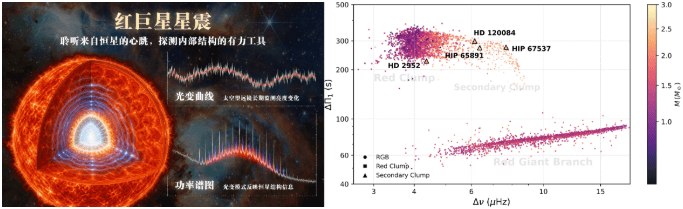
By combining stellar evolution models for retrospective inference, the study found that these four stars were all B-type massive stars in their youth, with their orbiting planets falling precisely within the previously unobserved orbital range. Orbital calculations confirmed that these planets survived the host stars' expansion phase without being engulfed, persisting to the present day.
Qian Shengbang, the corresponding author of the paper, noted that planetary systems in regular orbits around B-type stars may not be rare but have long been hidden in the blind spots of traditional detection methods. By studying evolved host stars, it is possible to trace back the planetary systems of massive stars in their youth and further examine how planet formation efficiency, orbital evolution, and long-term survival mechanisms vary with host star mass. This research connects multiple fields—exoplanet detection, stellar evolution, and asteroseismology—and proposes a new pathway for finding planets around massive stars.