
Over the Hongshui River in the Longtan Gorge of Tian'e County, Guangxi Zhuang Autonomous Region, a concrete arch bridge with a main span of 600 meters stretches across the river like a rainbow lying on the waves. This is the Tian'e Longtan Extra-Large Bridge, which has elevated the world record for concrete arch bridge span from 445 meters to 600 meters in a single leap, breaking through the industry-recognized 600-meter technical barrier.
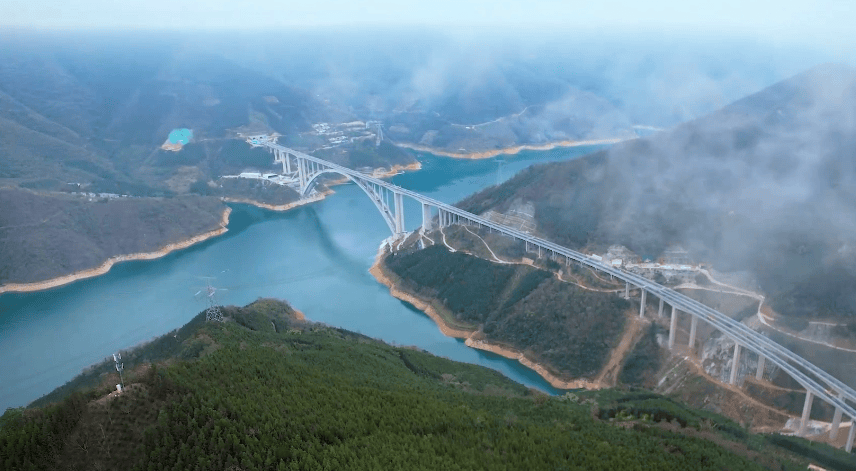
On August 24, at the 2026 Guangxi Science and Technology Awards Conference, the "Key Technologies for Construction of 600m-Class Concrete Arch Bridges," led by Zheng Jielian, academician of the Chinese Academy of Engineering and professor at Guangxi University, was awarded the Grand Prize of the Guangxi Science and Technology Progress Award. Previously, the Tian'e Longtan Extra-Large Bridge had already won the highest award for large highway and railway bridges from the International Association for Bridge and Structural Engineering.
Arch bridges are an important type of modern bridge. The industry once believed that the span of ordinary concrete arch bridges could hardly exceed 400 meters, and that of CFST arch bridges could hardly break through 500 meters. "Bridge powerhouses such as Japan and Croatia published research reports on building 600-meter-class concrete arch bridges as early as the 1990s, but they have still remained within 390 meters to this day," said Zheng Jielian. "The Tian'e Longtan Extra-Large Bridge is not only an engineering necessity, but also an important opportunity for China to compete with the world's bridge powerhouses and achieve technological breakthroughs."
The breakthrough began with design standards. Shang Congjin, chief designer of the Tian'e Longtan Extra-Large Bridge and deputy chief engineer of Guangxi Communications Design Group Co., Ltd., introduced that at the time there were no design codes for such arch structures at home or abroad. Through in-depth research, the team innovatively proposed a dual-control standard combining the "allowable stress method + double nonlinear finite element analysis." The former is used for strength verification of arch rib cross-sections, while the latter precisely simulates the entire construction process for overall ultimate bearing capacity checks.
"Practical application on the bridge shows that the measured deformations and stresses from construction monitoring are highly consistent with theoretical values, and the overall safety factor meets code requirements," said Shang Congjin.
According to statistics, the dead load stress of long-span stiff-skeleton concrete arch bridges accounts for 92%–96% of the total stress, of which the externally wrapped concrete dead load accounts for approximately 55% of the total dead load. Weight reduction is the key to span breakthroughs. To this end, the team designed the main arch as separated double ribs, eliminating the middle chamber top and bottom slabs with lower stress levels. The total width of the top and bottom slabs was reduced from 23 meters to 13 meters, reducing the externally wrapped concrete from 40,000 cubic meters to 28,000 cubic meters. This lowered the concrete usage per linear meter of arch rib for the 600-meter-class concrete arch bridge by 22% compared with similar 400-meter-class bridges, keeping the dead load stress essentially unchanged, while strengthening permanent transverse connections and adding temporary transverse braces to ensure lateral stability.
In the externally wrapped concrete pouring stage, the team innovatively proposed a construction technique featuring a "3-ring, 6-segment, 8-working-face pouring procedure, using 8 pressure pumps to achieve simultaneous pouring on 4 working faces at a time." The bridge's 28,000 cubic meters of externally wrapped concrete was completed in 36 pours, without any reliance on stay cables for load adjustment throughout the process, with tensile stress steadily controlled within 1 MPa. For the maximum cantilever stage, which is the most vulnerable to wind, the team optimized the wind-resistant cable layout based on CFD analysis and wind tunnel tests. Despite a 20% reduction in the number of cables, lateral wind-induced displacement was reduced by 30%, fully meeting wind resistance requirements at all stages.
"Identify the engineering risk sources and solve them with scientifically sound technical measures." Zheng Jielian used this sentence to summarize the core of the research. He noted that with the support of research funding from the major special project of the Department of Science and Technology of Guangxi Zhuang Autonomous Region, the team independently overcame a series of challenges in building the 600-meter-class concrete arch bridge. Compared with the cable-stayed bridge alternative, the construction of the Tian'e Longtan Extra-Large Bridge directly saved 110 million yuan, and maintenance costs are expected to be reduced by 470 million yuan over the 100-year design reference period.
In March 2023, during the construction of the Tian'e Longtan Extra-Large Bridge, the Chinese Academy of Engineering and the International Association for Bridge and Structural Engineering held the "Second World Conference on Construction Technology of Long-Span Arch Bridges" in Nanning against the backdrop of this bridge's construction, with nearly 30 academicians attending. The conference evaluated the construction technology of the Tian'e Longtan Extra-Large Bridge as "representing the highest international standard."
The world's arch bridges look to China, and China's arch bridges look to Guangxi. With world-leading proprietary key technologies, Zheng Jielian has led teams from Guangxi University and others to scale new heights in bridge technology, continuously achieving self-transcendence in world-class arch bridge craftsmanship.