
The "information superhighway" between Earth and the Moon is now open! According to the Technology and Engineering Center for Space Utilization of the Chinese Academy of Sciences, China's Earth-Moon laser communication test mission has achieved a major breakthrough, successfully establishing a two-way laser link over a distance of more than 400,000 kilometers, marking the first two-way high-speed laser communication between Earth and the Moon. This signifies that China's space laser communication has officially advanced from near-Earth orbit to cislunar space.
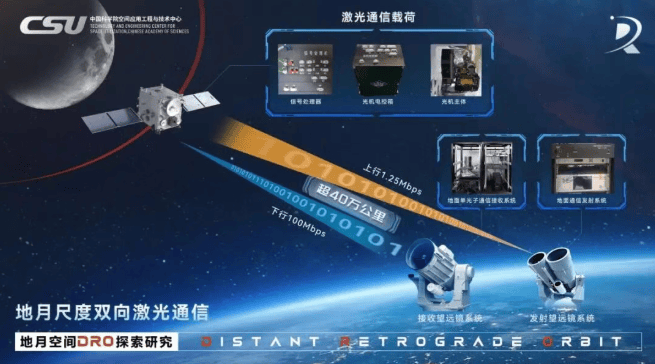
▲ Schematic diagram of two-way laser communication at the Earth-Moon scale.
Space laser communication is a communication method that uses lasers to transmit information, offering advantages such as large bandwidth, high speed, precise directionality, and strong security. However, the greater the distance, the greater the technical challenges. Yang Lei, a researcher at the Technology and Engineering Center for Space Utilization of the Chinese Academy of Sciences, said: "Deep-space laser communication has always been burdened by three major challenges: distances of hundreds of thousands of kilometers make precise beam alignment extremely difficult; the signal arriving at Earth is so weak it is almost undetectable; and transmission speeds have remained difficult to improve."
The first challenge lies in "aiming." Communication between Earth and the Moon is akin to threading an extremely fine beam of light through a high-speed moving "pinhole" from 400,000 kilometers away. Even the slightest angular deviation at the transmitting end can result in a positional error of several kilometers by the time the beam reaches its target. To address this, the research team devised a new approach: comprehensively accounting for factors such as satellite orbits, telescope installation errors, atmospheric refraction, and laser flight time, the satellite in orbit and the ground-based telescope remain precisely aligned during motion, ensuring the laser accurately illuminates the intended position.
Having solved the "aiming difficulty," a new problem emerged: by the time the laser travels 400,000 kilometers and reaches the ground, it has weakened to just a few photons. The signal that ground telescopes can receive is extremely scarce, while moonlight, starlight, and urban lights also interfere. To address this, the team employed a "ultra-sensitive detector" capable of detecting single photons and developed a complex signal recognition algorithm to extract the valid signal from massive noise. This is akin to accurately hearing the sound of a needle dropping in a bustling, noisy marketplace thousands of miles away.
With the signal now receivable, transmission speed also needed to keep pace. Through technical breakthroughs, the team significantly improved data processing efficiency. This test preliminarily achieved communication rates of 1.25 Mbps (megabits per second) on the uplink and 100 Mbps on the downlink. Yang Lei cited an example: "For a high-definition 8K image of the lunar surface, transmitting it via a traditional 5 Mbps microwave link would take about 4 to 5 minutes; with 100 Mbps laser communication, it takes only about 12 seconds."
"The 'information superhighway' between Earth and the Moon has now been established, and in the future, we will obtain more scientific data of greater original value," Yang Lei stated. The related technology will also provide new means of high-speed information transmission for China's crewed lunar landing, lunar research station construction, and deep-space exploration.
It is reported that this mission was led by the Technology and Engineering Center for Space Utilization of the Chinese Academy of Sciences, in collaboration with Zhejiang Lab, the Yunnan Observatories of the Chinese Academy of Sciences, the Shanghai Institute of Microsystem and Information Technology of the Chinese Academy of Sciences, and other institutions, carried out using a satellite (DRO-A) operating in a distant retrograde orbit.