
A research team led by Professor Xie Rongjun from the College of Materials at Xiamen University, in collaboration with Professor Wang Lixin's team from Fudan University, has for the first time elucidated the key mechanism by which electrochemical oxidation of tin-based perovskites under an electric field causes luminescence degradation in LEDs (light-emitting diodes). They proposed a synergistic strategy combining lattice doping and surface passivation, successfully fabricating tin-based perovskite LEDs with high efficiency and long working lifetime, providing important theoretical support and technical pathways for the development of high-performance lead-free perovskite optoelectronic devices. The related research findings were published in the international journal Science on the 27th.
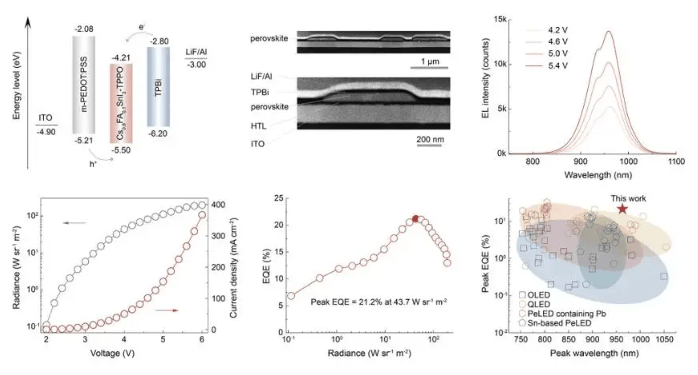
Near-infrared tin-based perovskite LEDs offer advantages such as low toxicity, solution processability, and low cost, holding broad application prospects in fields including optical communication, night-vision imaging, data storage, and biomedical detection. However, for a long time, material characteristics such as the high susceptibility of divalent tin ions to oxidation and the difficulty in controlling the crystallization process of tin-based perovskites have caused device luminescence efficiency and stability to lag behind lead-based perovskite LEDs and traditional quantum dot LEDs, hindering their practical application and development.
To address this challenge, the research team systematically analyzed the structural changes of tin-based perovskite films under an electric field, the valence state changes of tin ions, and the device luminescence degradation process, identifying the root cause of device failure as electrochemical oxidation triggered by carrier injection imbalance. When the device is powered on, an excessive accumulation of conductive carriers occurs internally, which, combined with the material's inherent conductive properties, jointly leads to irreversible oxidation of divalent tin, resulting in crystal structure changes, degradation of luminescence performance, and a sharp decline in device luminescence efficiency.
Based on this finding, the researchers adopted a synergistic strategy of lattice doping combined with surface passivation to stabilize the perovskite crystal structure, improve carrier transport, and suppress non-radiative transitions, successfully fabricating near-infrared tin-based perovskite LEDs with excellent performance. The device achieved a peak external quantum efficiency of 21.2% and a working lifetime surpassing 900 hours.
This result demonstrates that near-infrared tin-based perovskite LEDs, while maintaining their environmentally friendly advantages, have achieved substantial breakthroughs in optoelectronic performance, and can provide new near-infrared light sources for application fields such as optical communication and biomedical imaging.