
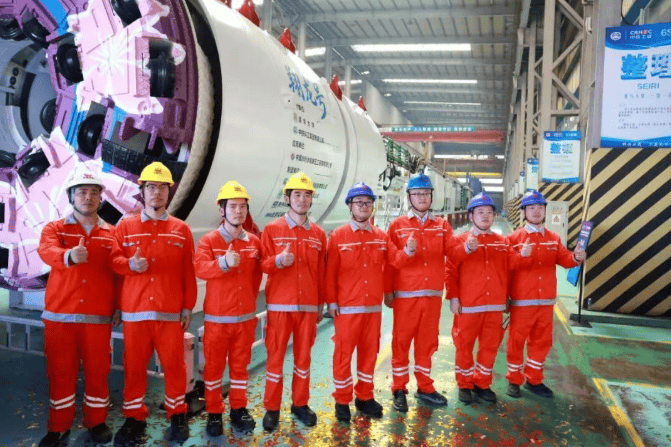
Recently, in Wuhan, Hubei Province, a giant piece of equipment resembling a "blueberry donut" slowly emerged from the manufacturing base, marking the official launch of the world's first Boring and Blasting Machine (BBM), jointly developed by Tsinghua University and China Railway Science & Industry (CREC) under China Railway Industrial. This marks the first time that the two mainstream construction methods—tunnel boring machine (TBM) method and drill-and-blast method—have been integrated into a single piece of equipment, providing a brand-new technical solution for the construction of long and large tunnels in complex geological conditions.
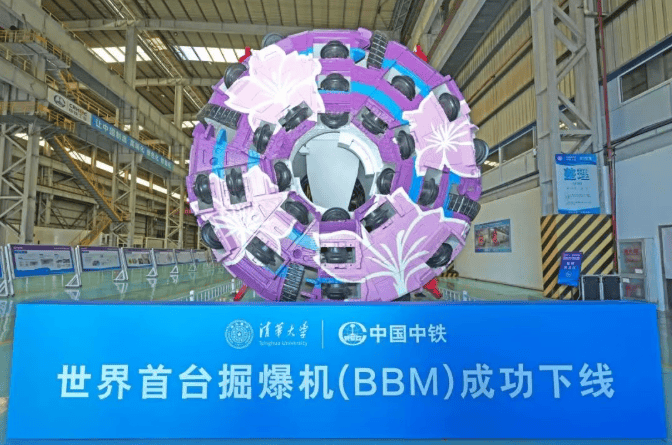
Two Methods Hard to Combine,Industry Calls for New Equipment
China boasts vast mountainous terrain, with numerous major infrastructure projects in highways, railways, and water conservancy extensively distributed in remote mountainous areas. Construction of long and large tunnels often encounters challenges such as rock bursts, mud and water inrushes, high ground temperatures, and large deformation of surrounding rock. Coupled with interwoven soft and hard strata and fault fracture zones, these conditions pose tremendous challenges to construction organization and safety management.
For a long time, the industry has predominantly adopted two mature technical routes: the tunnel boring machine (TBM) method and the drill-and-blast method, each with its own strengths yet clearly defined boundaries. TBMs offer continuous excavation and stable tunnel formation in homogeneous hard rock, but exhibit insufficient adaptability in soft rock with large deformation and fractured water-rich strata. The drill-and-blast method boasts a wide range of geological adaptability, covering various soft and hard rock layers, yet suffers from fragmented procedures and poor support integration, with overall efficiency significantly lagging behind mechanized continuous excavation.
In long and large tunnel projects with variable geological conditions, the alternating deployment of equipment for the two types of technologies has become the norm. However, each stage—equipment disassembly, assembly, and transport, crew rotation, and construction process conversion—incurs phased schedule losses, becoming an invisible bottleneck constraining project progress.
As China's infrastructure construction continues to expand into deep mountains and underground depths, an integrated piece of equipment that combines the advantages of both construction methods and adapts to all-stratum construction has become a critical innovation direction urgently awaiting breakthroughs in the industry.
Breaking the Deadlock,"Combining into One" to Forge a Heavyweight Machine
Targeting this industry pain point, Tsinghua University joined forces with China Railway Science & Industry (CREC), assembling multidisciplinary expertise in shield equipment, deep-earth drilling, and precision blasting for collaborative cross-disciplinary research. However, combining tunneling and blasting "into one" is not a simple "1+1"; it first requires overcoming two core technical challenges.
The first is the structural force balance challenge. Traditional TBMs employ a closed full-face cutterhead, ensuring uniform force distribution and stable operation. To enable drill-and-blast operations, the cutterhead must be "opened with a skylight"—designing a hollow annular cutterhead structure—which directly alters the entire machine's force system. Any imbalance in force distribution would exacerbate cutter wear and directly threaten equipment stability.
The second is the blasting safety protection challenge. Blasting-generated debris and shock waves can easily damage the precision electronic control and hydraulic components inside the machine. Establishing a reliable explosion-proof protection system within the enclosed body presents immense design difficulty.
Addressing these two major challenges, the R&D team repeatedly conducted structural simulation optimization and component performance testing, breaking through technical bottlenecks one by one, ultimately realizing the "center + annular" combined cutterhead design.
This donut-shaped hollow cutterhead is the most iconic original core structure of the BBM. Relying on the coordinated operation of the hollow cutterhead and the central cutterhead, the BBM can flexibly switch among three operating modes: "blasting in front, boring behind," "boring in front, blasting behind," and "full-face boring," possessing the dual advantages of advanced drill-and-blast pretreatment and mechanized continuous excavation, completely breaking the application boundaries of traditional construction methods.
"For example, in extreme strata such as high ground stress and soft rock with large deformation, the BBM can utilize the hollow channel in the middle of the 'donut' to allow personnel and equipment to enter and exit, conducting pretreatment operations such as grouting reinforcement, advanced pre-splitting, and emergency support ahead of the tunnel face, thereby mitigating safety risks such as surrounding rock collapse and machine jamming at the source," explained Wang Chenghai, Project Manager of the BBM at China Railway Science & Industry (CREC).
Hardcore Enhancements,Five Key Features Working in Concert
Beyond the iconic "donut" cutterhead, Wang Chenghai noted that the BBM is also equipped with multiple original technologies, enabling the coordinated operation of five core components to establish a complete integrated construction system, forming the technical advantages of "one integration, two adaptations, and three unifications."
The retractable gauge cutters act as the tunnel's "shape adjuster," relying on tangent-circle overcutting algorithms to precisely adjust the excavation cross-section dimensions—expandable for large cross-sections and retractable for small ones—effectively improving the equipment's transit efficiency within the tunnel. The self-adaptive retractable tail shield serves as a "dynamic armor" conforming to the surrounding rock, adaptable to multiple segment specifications, enabling variable-diameter lining assembly in rock burst and large-deformation tunnel sections to ensure continuous and stable support structures. The main machine explosion-proof device acts as the machine's "safety helmet," custom-designed for simultaneous boring and blasting operations, effectively cushioning blasting impacts and protecting the main machine and its precision internal components. The independent belt conveying system functions as a material "sorting line," separately transporting excavation muck and self-produced aggregates, effectively standardizing on-site material management and enhancing economic and environmental benefits.
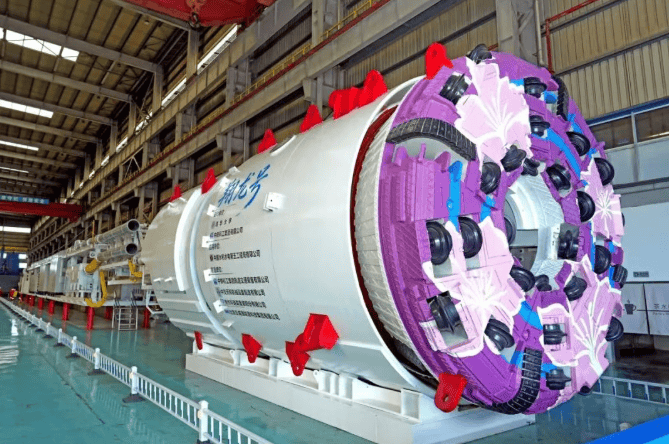
"One integration" refers to merging the continuous boring efficiency of TBMs with the wide-ranging geological adaptability of the drill-and-blast method, allowing construction mode switching without equipment replacement and eliminating schedule losses from equipment mobilization/demobilization and process conversion. "Two adaptations" signifies dual adaptability to both strata and cross-sections—handling soft and hard ground alike and accommodating various cross-section sizes, enabling a single machine to cover multiple tunnel working conditions. "Three unifications" achieves the standardized integration of construction methods, hardware equipment, and lining support forms, allowing the entire process—from pre-treatment, excavation, and muck removal to support and aggregate recycling—to be independently completed by a single machine, greatly simplifying on-site equipment configuration, personnel organization, and construction management.
Test data indicate that under ultra-hard rock geological conditions, after advanced pre-splitting treatment, the BBM's boring efficiency can be improved by 30%. For long and large tunnels spanning tens of kilometers, this translates to overall construction periods being shortened by months or even longer.
Venturing Deeper,From "Usable" to "Intelligent"
The launch of the world's first BBM breaks the conventional design pathways of similar equipment both domestically and internationally. With the entire machine and core components achieving full independent controllability, it fills the gap in the field of integrated construction equipment for tunnels in complex geology and perfects the industrial chain of China's high-end underground engineering equipment.
According to reports, this equipment will first be deployed in pumped-storage hydropower station projects for engineering demonstration applications. The R&D team will continuously iterate and optimize performance based on on-site measured data, while simultaneously advancing intelligent and refined upgrades, integrating systems such as intelligent surrounding rock identification, advanced construction forecasting, and autonomous intelligent boring, propelling the equipment to fully transition from "usable and workable" to "efficient and intelligent."
As a breakthrough innovation in the field of underground engineering equipment, this BBM will in the future be widely applied in key sectors such as transportation engineering, water conservancy hubs, and deep-earth resource development, continuously elevating China's independent R&D and manufacturing capabilities in underground engineering equipment, and empowering the new industrialization and the building of a transportation powerhouse through equipment technological innovation.