
Can a graphene nanoribbon change its twisting direction like a wringer? Researchers at Nagoya University in Japan have given a definitive answer. According to the latest issue of Nature Communications, researchers at the university have achieved on-demand switching of the twisting direction of graphene nanoribbons for the first time. This achievement is expected to provide new materials for the development of tunable optical switches, chemical sensors, and spintronic devices.
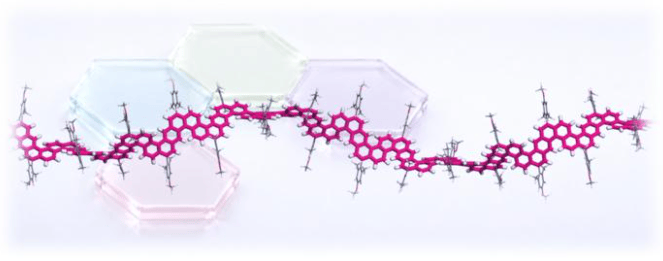
Helicene nanoribbons are long-chain structures composed of multiple fused carbon rings, a structure that gives the molecules a twisted morphology (schematic diagram). Image credit: Nagoya University, Japan.
Graphene nanoribbons are narrow, elongated nanostructures composed of carbon atoms. When a nanoribbon twists, it forms a helix-like morphology, and its optical and electronic properties differ depending on whether it twists to the left or to the right. Previously, although researchers could fabricate helical graphene nanoribbons, it was difficult to make them change their twisting direction as needed.
The key to this research is a four-ring helicene unit that was previously considered "difficult to control." These units rapidly interconvert between left-handed and right-handed states, making it difficult to maintain a fixed twisting direction. However, when multiple units are connected together, adjacent units influence one another and tend to twist in the same direction, ultimately forming a relatively uniform helical structure.
On this basis, they further used solvents to control the twisting direction of the nanoribbons. After testing six candidate solvents, they found that β-pinene, a natural compound derived from pine trees and citrus plants, was effective.
β-Pinene exists in two mirror-image molecular forms, and different molecular forms cause the nanoribbons to twist in different directions. In other words, simply changing the solvent can control whether the nanoribbons twist to the left or to the right.
When the twisting direction of the nanoribbons changes, the light they emit also changes accordingly, and the two twisting states produce circularly polarized luminescence in different directions. This means that by controlling the twisting direction of the nanoribbons, their optical properties can be tuned. This switching effect is most pronounced at -90°C and gradually weakens as the temperature rises to room temperature.
The researchers say this is the first time such switchable circularly polarized luminescence has been achieved in graphene nanoribbons. This material, which can change its twisting direction and optical properties in response to the external environment, is expected to be used in fields such as optical switches, chemical sensors, and electronic devices. Since the helical structure may also affect the transport of electrons in different spin states, it is also expected to be used in spintronic devices.