
Across the deep space spanning roughly 400,000 kilometers, a laser beam shuttles between Earth and lunar orbit, like an invisible, intangible fiber optic cable, establishing a bidirectional high-speed Earth-Moon communication link. Recently, a Chinese research team successfully completed a bidirectional high-speed Earth-Moon laser communication experiment, making China the second country in the world to master deep-space laser communication technology. This major breakthrough marks China's space laser communication officially advancing from low-Earth orbit into cislunar space.
A Beam of Light Builds an Invisible Broadband Link Between Earth and Moon
What is Earth-Moon laser communication? Simply put, it uses laser as a carrier to accomplish data exchange between Earth and satellites orbiting the Moon.
"This beam of light plays the same role as the network cable installed at home — both are carriers for information transmission. It's like stretching an invisible fiber-optic broadband cable between Earth and the Moon, enabling high-speed data transmission over a distance of about 400,000 kilometers. That's why people vividly compare it to a 'space network cable.'" said Yang Lei, a researcher at the Technology and Engineering Center for Space Utilization, Chinese Academy of Sciences, and head of the laser communication experiment research team.
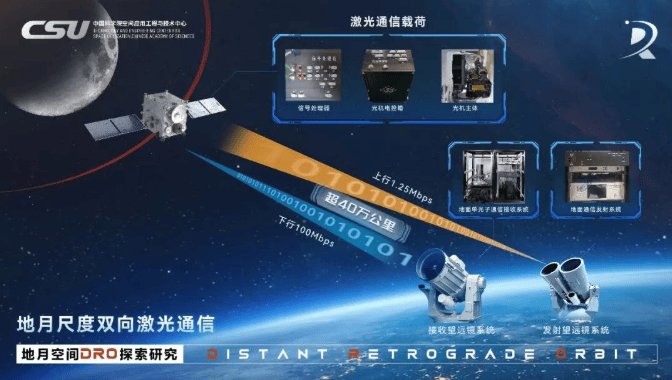
Schematic diagram of bidirectional laser communication at Earth-Moon scale.
For a long time, China's deep-space exploration has relied mainly on microwave communication for data return, but microwave communication has limited bandwidth — like an ordinary road with limited lanes. Once a probe generates large amounts of imagery and observational data, the channel is highly prone to congestion. "The probe can fly out there, but the precious data can't come back" has become a major practical bottleneck plaguing deep-space exploration.
Compared with traditional microwave, laser communication can increase rates by 10 to 100 times, and the concentrated beam is difficult to intercept, offering stronger confidentiality; meanwhile, onboard terminal equipment is small in size and light in weight, better suited to the stringent payload conditions of space missions.
In this regard, Yang Lei further explained: "Microwave communication is like an ordinary road — limited lanes, and traffic flow easily saturates; laser communication is like a multi-lane highway, capable of accommodating more information traveling side by side without interference."
A set of intuitive figures conveys the leap in speed: an uncompressed 8K panoramic photo of the lunar surface, with 33 million pixels, contains about 1.2 gigabits of raw data. Traditional Earth-Moon microwave communication rates are only a few megabits per second (Mbps), and fully transmitting this image would take 4 to 5 minutes. This experiment achieved a downlink communication rate of 100 Mbps, requiring only 12 seconds to transmit an equally high-definition image.
Building an invisible broadband link between Earth and Moon requires surmounting three major technological "mountains" — difficult aiming, weak signals, and slow transmission.
"Deep-space transmission distances routinely span hundreds of thousands of kilometers, imposing extremely demanding requirements on beam pointing accuracy; after traveling long distances to the ground, laser signals attenuate severely, becoming so faint that they are difficult to capture; high-speed transmission technology is constrained, and transmission speeds have remained difficult to raise." Yang Lei said.
Ultra-long-distance precise aiming was the primary challenge tackled in this experiment. Earth-Moon communication is like "threading a needle from ten thousand miles away": equivalent to precisely passing an extremely thin beam of light through a high-speed-moving "needle's eye" from about 400,000 kilometers away. Even an extremely tiny angular deviation at the transmitting end would produce a positional error of several kilometers upon reaching the target vicinity.
To this end, the research team innovatively proposed a bidirectional acquisition and tracking scheme suitable for ultra-long-distance, extremely weak signal conditions.
"Through calculation and systematic calibration of various factors including satellite orbits, telescope installation and deformation errors, atmospheric refraction, and laser time-of-flight, we keep the satellite in the sky and the telescope on the ground aligned throughout their motion, ensuring the laser can precisely hit the designated position." said Zhan Yueying, an associate researcher at the Technology and Engineering Center for Space Utilization, Chinese Academy of Sciences.
After overcoming the aiming challenge, the challenge of identifying extremely weak signals followed. When the laser reaches the ground after traveling about 400,000 kilometers, the signal has attenuated to only a few photons remaining, and the ground telescope can receive very little signal. At the same time, moonlight, starlight, city lights, and other signals also mix in, interfering with the laser signal, making it even harder to discriminate the effective signal — like accurately hearing a pin drop in a noisy, bustling market a thousand miles away.
To address this challenge, the research team employed an "ultra-sensitive detector" capable of detecting single photons and developed a complex signal identification algorithm to precisely filter through massive noise and extract effective signals, successfully breaking through the bottleneck.
On the basis of achieving stable signal reception, the team continued to tackle difficulties and significantly improved data processing efficiency. This experiment preliminarily achieved communication rates of 1.25 Mbps uplink and 100 Mbps downlink.
Harder Than the Experiment Itself Was Persevering Through the Low Period
Hardware delivery was merely the beginning of the challenge. The entire in-orbit testing lasted more than two years, and in Yang Lei's words, the team experienced almost "the eighty-one trials."
In December 2021, the team received the development task, leaving only two years for the development of the onboard payload. At that time, there was no mature domestic experience to draw upon. To catch the satellite launch window, the team operated in two shifts, continuously pushing forward integration and testing. In December 2023, the payload was delivered on schedule, and everyone breathed a sigh of relief, looking forward to it heading into space for the experiment.
However, no one anticipated that during the satellite launch phase, an unexpected incident occurred — the solar panel was damaged, and the satellite could only "go on duty wounded."
Yang Lei still clearly remembers that moment. When the news came, he had just gotten off a plane and into a taxi. "At that moment, I couldn't hold back my tears."
After more than two years of day-and-night efforts, it was as if a student who had studied hard for years was told the exam was canceled before even entering the examination hall. Immense despair enveloped the entire team.
A few days later, word came from the special project team that satellite rescue had been effective and there was still a possibility of conducting the experiment. But the cost of the damage was extremely heavy: the original experiment time was drastically reduced.
"The effective experiment windows were concentrated only in a few days around the beginning and middle of each lunar month. Sometimes, after finally waiting for a qualifying day, the ground would encounter rainy weather, and the experiment would be forced to cancel." Zhan Yueying said.
For every hard-won experiment opportunity, the team stood fully prepared. Half the personnel would head to the Yunnan ground station half a month in advance to prepare, while the other half stayed at the Beijing flight control center. After each experiment, they immediately reviewed all data, iteratively optimized software models and ground equipment, and quietly awaited the next window period.
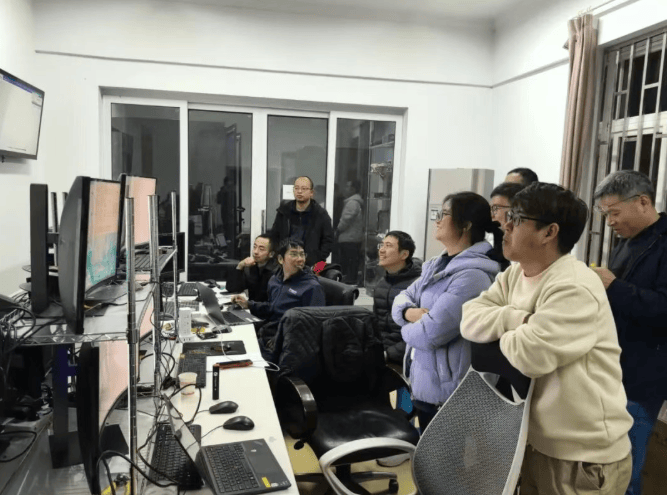
In December 2025, at the Earth-Moon laser communication experiment site at the Yunnan Observatories, researchers observe the real-time operating status of the ground station system.
The experiment itself was difficult, but harder than the experiment was persevering through the low period. As time slipped by, by the end of 2025, the in-orbit experiment still had not achieved breakthrough progress. The long wait and repeated failures left many team members disheartened, feeling that success was far beyond reach.
Yang Lei constantly encouraged the team: "We have previously completed two high-risk space missions. At the initial stage, everyone thought they were nearly impossible, yet ultimately both were completed successfully. Now, every experiment yields valid data, and the system continues to iterate and improve. As long as we persevere, our efforts will eventually be rewarded."
"Though the road is long, traveling will bring us there; though the task is hard, doing it will bring success." During those most difficult days, Yang Lei forwarded this saying to the team's work group chat, and it became the spiritual support for everyone. No one chose to give up; they persisted in cycles of analysis, verification, and optimization, enduring countless all-nighters, and finally welcomed the highlight moment when the link was successfully established. Afterwards, a colleague admitted that without this perseverance, the team would have found it very hard to hold on until the moment of success.
This experiment was the first internationally to complete bidirectional laser communication in the special strategic Earth-Moon orbit. Objectively speaking, compared with the mature deep-space laser communication of some countries, China still has gaps in communication rate and maximum communication distance.
"Currently, our primary goal is to verify the autonomous controllability and systemic integrity of the entire system, not to single-mindedly pursue extreme specifications." Yang Lei said. This breakthrough completed a "from 0 to 1" leap, officially bringing China's space laser communication from low-Earth orbit into cislunar space and into the global first tier.
Laying the Information Foundation for Future Deep-Space Exploration
Establishing the first Earth-Moon laser communication link is only the starting point for China's deep-space information infrastructure construction. Facing the practical needs of crewed lunar landing and lunar research station construction, Yang Lei stated that the team still has a series of clear objectives to tackle.
Continuing to increase the rate is the primary task. Currently, the onboard hardware already has the capability to reach internationally leading rate specifications, and the team plans to conduct rate upgrade experiments within the year. "However, ground experiments are greatly constrained by weather — clouds and atmospheric conditions all affect experiment conduct, and specific execution depends on the meteorological conditions at the ground station." Yang Lei acknowledged that beyond running faster, they also need to run more steadily.
In addition, current experiments are mostly limited to nighttime, as sunlight causes strong interference. The team is concentrating efforts on tackling new technologies, hoping to break the nighttime limitation and explore the possibility of conducting communication during daytime and under complex meteorological conditions, enhancing the system's ability to resist strong light and atmospheric turbulence, reducing the probability of disconnection, and striving toward long-duration continuous stable communication, making space communication as smooth as ground broadband with fewer stalls and dropouts.
More importantly, the Earth-Moon distance is only the starting point. Zhan Yueying stated that the technologies verified in this experiment — high-precision tracking, weak signal detection, and high-speed single-photon signal processing — can be further extended to Mars, asteroids, and even more distant deep-space missions, powerfully supporting China's deep-space exploration in achieving more original scientific results.
And the longer-term grand blueprint is to evolve from "one road" into "one network."
"Wherever our missions go, information pathways must be laid." Yang Lei said. This experiment is equivalent to completing the first step of network construction — first establishing a single link, then using laser communication as the core, with multiple links interwoven, to build a complete Earth-Moon information network. Currently, relevant departments are already demonstrating a normalized Earth-Moon backbone communication network.
Looking back on this major technological breakthrough, both Yang Lei and Zhan Yueying share the same reflection: core technologies are never waited for — they are built and forged through action. "Facing domestic technological gaps, we cannot shrink back because the road ahead is difficult. On the path of independent innovation, faith and hard work are both indispensable — we must dare to challenge world-class problems while also keeping our feet on the ground, tackling practical difficulties step by step." Yang Lei said.