
On September 30, the Solar wind-Magnetosphere-Ionosphere Link Explorer (SMILE), jointly developed by China and Europe, successfully passed the in-orbit test review and officially entered the scientific operation phase. On the same day, both China and Europe released the first batch of in-orbit observation images and detection data from the satellite's four scientific payloads. Among them, multiple results were achieved for the first time internationally.
The SMILE satellite aims to answer a seemingly simple yet actually complex question: What happens when the charged particle wind blown out by the Sun collides with Earth's magnetic field? This process can trigger auroras and magnetic storms, and may also affect satellites, communications, navigation, and power grids. In the past, scientists could mostly only conduct localized "point measurements"; now, the SMILE satellite attempts to shoot a "panoramic movie" of the interaction between the solar wind and Earth's magnetosphere.
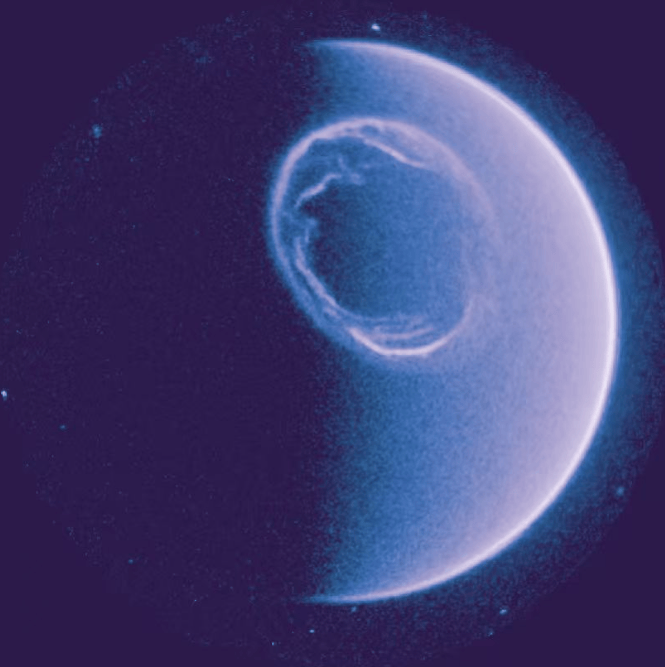
Auroral oval image obtained by UVI, captured on August 4, 2026
Among the first batch of results, the most notable is the auroral observation. The Ultraviolet Auroral Imager (UVI) aboard the satellite obtained uninterrupted panoramic and fine-structure images of the Northern Hemisphere aurora for the first time internationally. It is like an "auroral panoramic camera" placed in space, with a maximum continuous observation of 44 hours and a maximum frame rate of one image every 5 seconds. Auroras are a "visualization window" of the interaction between the solar wind and Earth's magnetosphere; these images can help scientists clearly see how energy is deposited and how space plasma moves.
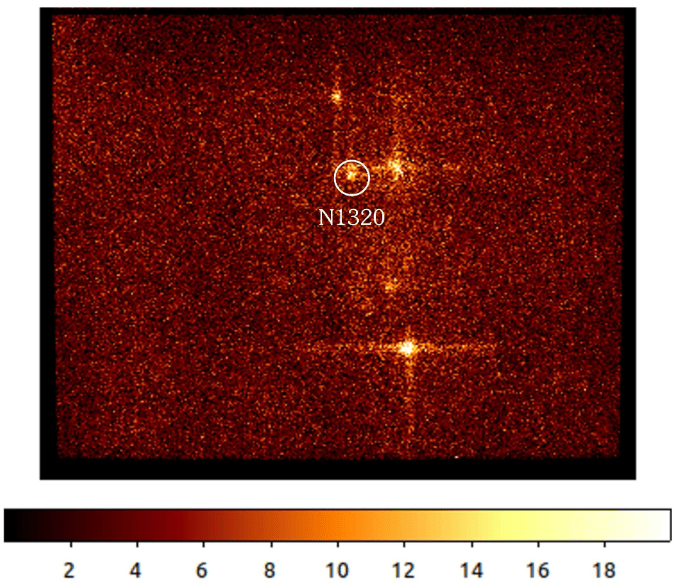
First X-ray image from the SMILE satellite — a supernova remnant in the Large Magellanic Cloud
The Soft X-ray Imager (SXI) captured its first image. It is the world's first spaceborne soft X-ray imager for Earth observation, and the first image shows a supernova remnant in the Large Magellanic Cloud, about 160,000 light-years away. After entering the scientific operation phase, it will turn to its true main battlefield: observing the soft X-rays released when charged solar particles strike the edge of Earth's magnetosphere. With its help, the SMILE satellite becomes the first spacecraft to conduct detailed and long-duration X-ray observations of Earth's magnetic field.
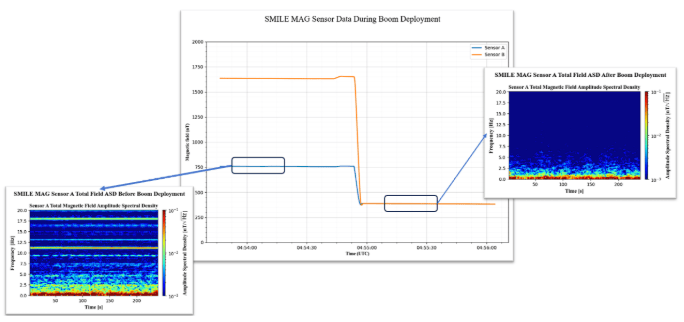
Comparison of magnetic field data before and after MAG boom deployment
Unlike the two imagers, the other two payloads are responsible for in-situ detection, equivalent to "collecting evidence" on site. The Magnetometer (MAG) obtained high-resolution magnetic field data in Earth's very high orbit for the first time internationally, with a resolution better than 0.1 nanotesla, capable of capturing weak changes in the solar wind. It has already crossed the bow shock and measured the process in which the solar wind magnetic field is compressed and the magnetic field in the magnetosheath fluctuates strongly; the data are consistent with the multi-source OMNIweb solar wind dataset. The Low-energy Ion Analyzer (LIA) obtained high-resolution ion data in Earth's very high orbit for the first time internationally, capable of clearly seeing changes over time in ion energy, direction, and flux distribution.
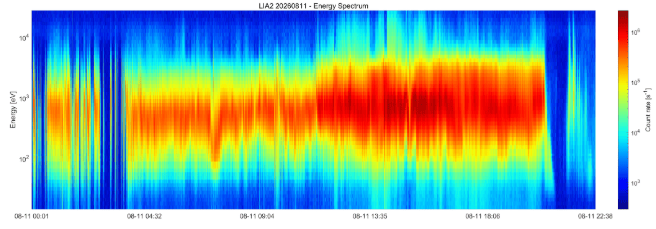
LIA ion energy spectrum detection data
Academician Wang Chi, Chinese chief scientist of the SMILE satellite and director of the National Space Science Center of the Chinese Academy of Sciences, said that these images and data will provide a completely new perspective for studying solar wind-magnetosphere interaction. In the past, space weather research was often limited by "not seeing the whole picture" or "not measuring in enough detail"; the SMILE satellite uses its unique highly elliptical orbit to combine imaging observations with in-situ detection, conducting synchronized observations of the magnetopause, cusp region, and auroral oval for the first time, which is expected to improve humanity's ability to forecast space weather.
Behind these results is deep cooperation between China and Europe. The SMILE satellite was jointly developed by the Chinese Academy of Sciences and the European Space Agency. It is the concluding project of the Chinese Academy of Sciences' Strategic Priority Program on Space Science (Phase II), and also another major China-Europe space science cooperation project after the Double Star Program. As scientific operation begins, this satellite will continue to "gaze" in space at every collision between the solar wind and Earth's magnetosphere, writing new footnotes for humanity's understanding of space weather.