
On October 16, Tan Dian's team of researchers at the Shenzhen International Quantum Academy, in collaboration with researchers from the University of Stuttgart in Germany and other institutions, made a major advance in the field of phononic quantum information by achieving, for the first time, the preparation and cross-node transmission of multipartite genuine entangled phonon states on a scalable two-dimensional hybrid quantum chip experimental platform. The related research results were published on the same day in the international journal Science.
The research team built a hybrid quantum system based on high-overtone bulk acoustic wave resonators (hereinafter referred to as "HBARs") and superconducting qubits, achieving the preparation of multipartite genuine entangled phonon states from two modes and four modes to six modes.
It is reported that HBAR mechanical resonators have advantages such as multiple modes, long lifetimes, and on-chip integrability, and are becoming key devices for building next-generation quantum information processing platforms. Leveraging this natural multimode property, the research team precisely designed the frequency distribution of the acoustic modes and the coupling between qubits and phonons, enabling a single superconducting qubit to strongly couple and interact with multiple mechanical modes.
Tan Dian introduced, "Genuine entanglement means that the entanglement of this quantum state cannot be reduced to several mutually independent lower-order entanglements, but is a quantum correlation shared collectively by the entire multimode system. This is an important resource for building multi-node quantum networks and distributed quantum information processing."
In the transmission step, the team integrated two HBAR mechanical resonators with superconducting qubits and a tunable quantum coupler in the same hybrid chip architecture, completing the transmission of multipartite genuine entangled states across two independent HBAR mechanical resonators.
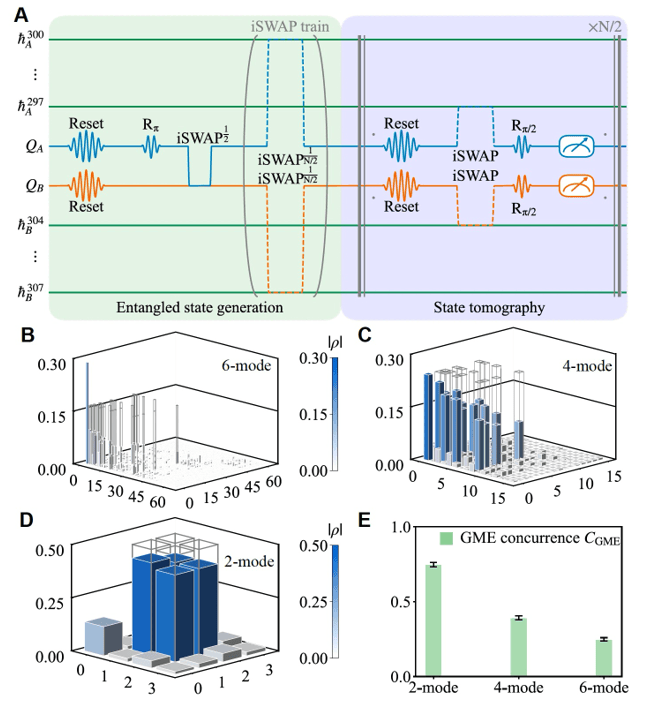
Preparation and characterization of multimode phonon entangled states.
Tan Dian said that, unlike traditional architectures relying on three-dimensional microwave cavities, the two-dimensional chip architecture features modularity, integrability, and ease of scaling, and can avoid the spatial and engineering limitations of three-dimensional cavities in scale expansion and multi-node interconnection.
As the number of phonon modes increases, how to precisely characterize multimode quantum states has become another challenge. The research team developed a multimode phonon state tomography method based on qubit multiplexing. By reusing limited superconducting qubit measurement resources among different phonon modes, they broke through the bottleneck in the characterization scale of phonon modes.
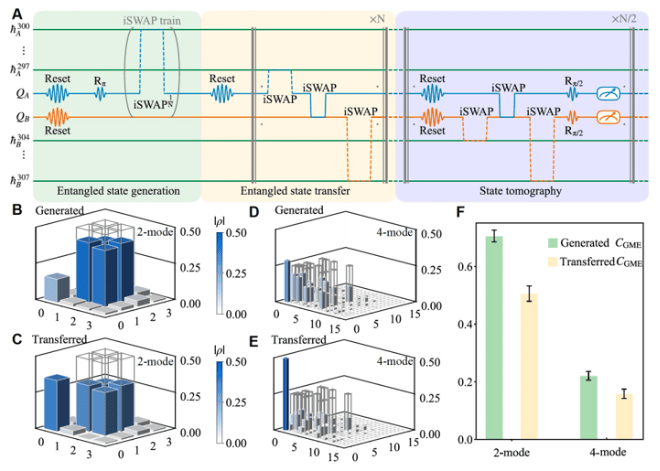
Transmission and characterization of multimode phonon entangled states.
Tan Dian introduced, "Using only two superconducting qubits, we completed quantum state tomography of multimode phonon entangled states. This is currently the largest-scale experimental characterization of multimode phonon states in quantum acoustic platforms."
It is also learned that the research team additionally proposed in this work a scalable multi-HBAR hybrid phononic quantum processing architecture. Tan Dian stated that as more HBAR mechanical resonators and superconducting qubits are connected, multimode entanglement resources are expected to be scaled to a larger size.