Wedonay.com Report on Mar 7th, Nilav Patel of Fairbanks Morse introduced the application of collaborative welding robots in the ship repair industry. Traditional repairs required welders to perform high-precision welding in confined spaces, taking approximately three weeks, while collaborative robots have reduced this time to one week.
The Australian welding robot manufacturer Orbimax pointed out that collaborative robots differ from standard industrial robots; they operate at lower speeds and are equipped with more safety features, allowing users to work alongside them as a workshop tool. Currently, collaborative robots are being assigned to undertake shipbuilding and ship repair tasks. China's Xin Neng Shipbuilding is trialing a robotic welding system to collect data on welding qualification rates. Italy's Fincantieri is collaborating with Generative Bionics to develop a humanoid welding robot that integrates artificial intelligence, advanced manipulation, and perception capabilities, with initial trials expected this year.
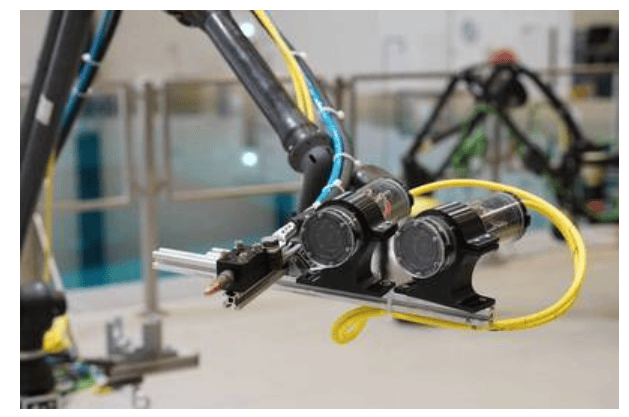
The MARIOW project, led by the German Research Center for Artificial Intelligence (DFKI), has developed a robotic system capable of autonomously performing underwater welding tasks on port or offshore structures. Its underwater manipulator can operate at depths of up to 6000 meters. The system utilizes a stereo camera system to provide high-resolution images, and an AI model autonomously identifies welds along with their start and end points. The fully integrated MARIOW system has been demonstrated at the DFKI underwater test basin in Bremen, Germany, confirming the feasibility and commercial prospects of automated underwater flux-cored arc welding.