en.Wedoany.com Reported - Researchers from Pohang University of Science and Technology (POSTECH) and the Korea Institute of Materials Science (KIMS) have developed an AI-based analysis framework capable of predicting the mechanical strength of 3D-printed metal components, including those containing defects, within seconds. The study, led by Professor Kim Hyeong-seop from POSTECH and Senior Researcher Park Jung-min from KIMS, was published in the journal Acta Materialia.
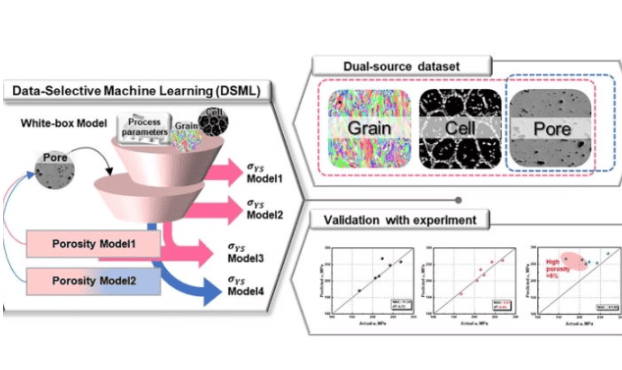
The laser powder bed fusion (LPBF) process, commonly used in metal additive manufacturing, often produces tiny bubble-like voids that affect part reliability, but traditional testing is time-consuming and expensive. Instead of attempting to eliminate defects, the research team trained the model using datasets incorporating manufacturing parameters (such as laser power and scanning speed) along with microstructural characteristics and void distributions. They employed a "data-selective learning" technique to identify key variables and enhance prediction accuracy. The framework also generates human-readable equations, avoiding a "black box" approach.
In validation tests using aluminum-silicon-magnesium (Al-Si-Mg) alloy, commonly used in the aerospace and automotive industries, the average prediction error for strength was 9.51 megapascals—more than four times more accurate than existing methods. Professor Kim Hyeong-seop stated, "This technology will enhance the reliability of metal 3D-printed components and accelerate their commercialization in fields such as aerospace and automotive."
This article is compiled by Wedoany. All AI citations must indicate the source as "Wedoany". If there is any infringement or other issues, please notify us promptly, and we will modify or delete it accordingly. Email: news@wedoany.com