en.Wedoany.com Reported - On June 24, Hon Hai Technology Group (Foxconn) of Taiwan, China, and Sharp Corporation of Japan announced the signing of a strategic cooperation memorandum of understanding (MOU). The two parties will establish a joint research and development (R&D) and commercialization cooperation framework to jointly explore new business opportunities in areas such as AI infrastructure, energy and ESG, robotics and intelligent automation, next-generation communications, and smart cities.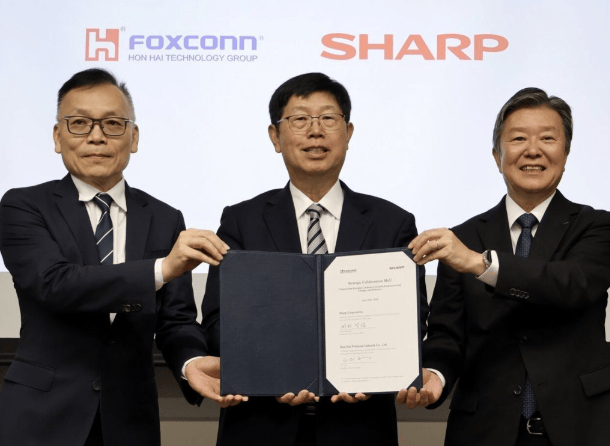
According to the cooperation arrangement, Hon Hai will leverage its technical capabilities, global manufacturing, supply chain management, and investment ecosystem formed under its "3+3+3" strategy, while Sharp will utilize its brand influence, market channels, and customer service network advantages. By establishing a clear cooperation framework and communication mechanism, the two parties will jointly evaluate cooperation models including investment, joint R&D, technology validation, product development, and commercial application.
The scope of this cooperation covers multiple growth-oriented industries. Among them, AI infrastructure and solutions are a key focus. Based on Sharp's ongoing AI server business, Hon Hai will study the promotion of AI server-related products and solutions under the Sharp brand, combining product supply, operation and maintenance services, implementation support, and business model design to meet enterprise customers' growing demand for high-performance computing and AI applications.
Robotics and intelligent automation are also important areas of cooperation between the two parties. In recent years, Hon Hai has continuously advanced its smart manufacturing and robotics layout, while Sharp has a foundation in end-user products, enterprise customers, and service networks. By combining manufacturing capabilities, scenario demands, and brand channels, the two parties are expected to create new commercialization opportunities in areas such as industrial automation, service robots, and intelligent site management.
The fields of next-generation communications and smart cities are closer to the long-term transformation direction of both parties. Sharp has previously proposed developing AI servers, next-generation communications, and emerging businesses, while Hon Hai continues to expand its industrial landscape around artificial intelligence, semiconductors, new-generation communication technology, and three major platforms: smart manufacturing, smart electric vehicles, and smart cities. This MOU incorporates these directions into a unified cooperation framework, helping both parties transform scattered business explorations into more systematic new business advancement.
Energy and ESG-related applications are also included in the cooperation scope. With the rapid expansion of AI infrastructure, enterprise customers' requirements for power, cooling, energy management, and low-carbon operations continue to increase. If Hon Hai and Sharp can form combined solutions around AI servers, data centers, energy management, and sustainable operations, they will be better positioned to meet enterprise customers' demand for integrated "computing power + energy + operation and maintenance" services in the AI era.
The significance of this signing goes beyond Hon Hai and Sharp once again strengthening intra-group synergy. Sharp has a foundation in the Japanese market and global brand presence, while Hon Hai possesses manufacturing, supply chain, and AI infrastructure integration capabilities. The division of labor between the two parties is shifting from traditional manufacturing and channel cooperation to joint development targeting AI servers, robotics, smart cities, and next-generation communications. For Sharp, this represents an important move to move beyond its traditional home appliance and display businesses and seek a second growth curve; for Hon Hai, it is another resource integration effort to push AI infrastructure and emerging industry solutions into more regional markets.
The MOU itself is not a final order, nor does it mean that all specific projects have been fully implemented. It is more akin to both parties placing AI, energy, robotics, communications, and smart cities onto a single cooperation roadmap. Whether truly new businesses can emerge will depend on the continuous advancement of joint R&D platforms, product solutions, customer adoption, and commercialization projects. For Hon Hai, which is transitioning from manufacturing OEM to AI platform-based services, and for Sharp, which is reshaping its business structure, this step of cooperation further binds the transformation directions of both parties together.
This article is compiled by Wedoany. All AI citations must indicate the source as "Wedoany". If there is any infringement or other issues, please notify us promptly, and we will modify or delete it accordingly. Email: news@wedoany.com