South Korea's Naver Unveils Core AI Tab Technology, Service Capability Scores 108 Points
en.Wedoany.com Reported - Naver Cloud Director Lee Ki-chang stated at the Tech Deep Talk session held in Gangnam-gu, Seoul on the 2nd that its AI Tab conversational search service has applied a Product Native LLM developed based on HyperCLOVA X. He noted that Naver's goal is to secure a clear advantage in service capability, maintaining basic capabilities at a level surpassing competitors while narrowing the gap with the world's top-tier professional capabilities.
AI Tab is a conversational search service officially launched by Naver on the 26th of last month. It understands users' search intent and context to provide answers, and connects to practical actions such as shopping and location searches. This Product Native LLM fully reflects Naver's data, service scenarios, and user feedback in the model design.
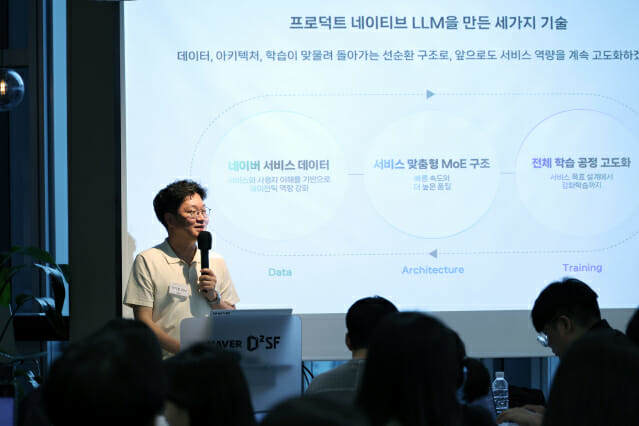
The model is developed around three pillars: data, architecture, and training. A document quality filter improves the quality of training data, and a "non-structured data collection pipeline" (비스형 데이터 수집 파이프라인) is built to reflect data from domains such as search, shopping, places, and lifestyle information during the pre-training phase. In terms of architecture, the MoE (Mixture of Experts) structure is introduced to ensure faster response speed and higher throughput compared to the original HCX (HyperCLOVA X), thereby shortening end-to-end latency. The model improves computational efficiency to be linearly proportional to input length, maintaining stable response speed and high throughput in long contexts.
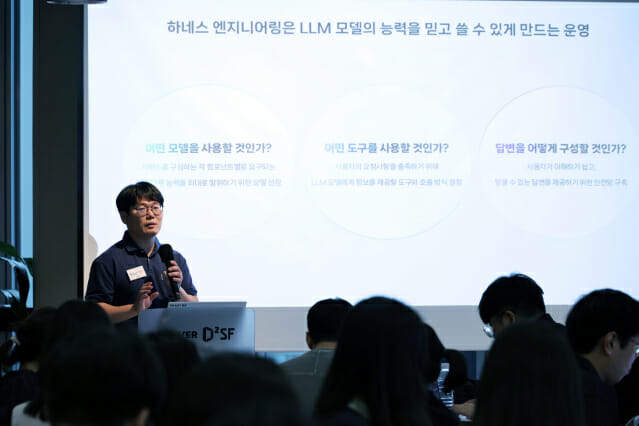
During the training phase, the computational resources allocated to reinforcement learning were expanded to more than double those of the original HCX. A newly applied Clarify Reinforcement Learning (Clarify RL) technique rewards the model for asking follow-up questions when it cannot answer, thereby reducing hallucination. On-Policy Distillation (OPD) technology is also applied, where responses generated by the model being trained are modified at the token level by a high-performance model, effectively supplementing weak specialized domain capabilities. This structure allows for continuous improvement: as the high-performance model's capabilities improve, the model being trained also strengthens accordingly.
In Naver's comprehensive evaluation of the model applied to AI Tab using its own benchmark measuring execution quality in areas such as "search, purchase, and booking," the service capability score was 108 points, higher than the competitor average of 100 points and the highest competitor score of 106 points. Basic capabilities such as instruction execution and Japanese tool invocation scored 104 points, exceeding the competitor average of 100 points. Professional capability in solving doctoral-level scientific problems scored 97 points, slightly below the competitor average of 100 points. Director Lee Ki-chang explained that while basic and professional capabilities can be improved with effort, the strategic decision was made to invest more heavily in service-related capabilities.
At the event, Naver also unveiled the core technology "Harness Engineering" for stably driving AI Tab, which operates in four steps: understanding user intent and managing long conversational context, reasoning related to services such as search, shopping, and places, providing sources, and executing connections.
Naver presented a vision of evolving into a multimodal agent centered on Smart Lens applied to the search bar. Since launching Smart Lens for image search services in 2017, through composite search combining images and text in 2022, and last year's introduction of Smart Lens X AI Briefing for image understanding and summarization, the company has continuously upgraded its technology.
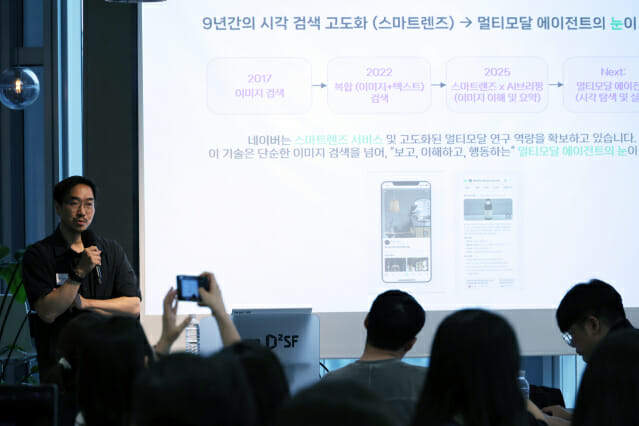
Naver's Team Leader Yoon Sang-doo stated that while Naver's AI agent currently primarily relies on text input, it will evolve in the future toward a multimodal agent that understands intent through images and connects to practical actions.
Related Products


Conveyor Belt Intelligent Monitoring System
LUO YANG WIRE ROPE INSPECTION TECHNOLOGY CO., LTD.
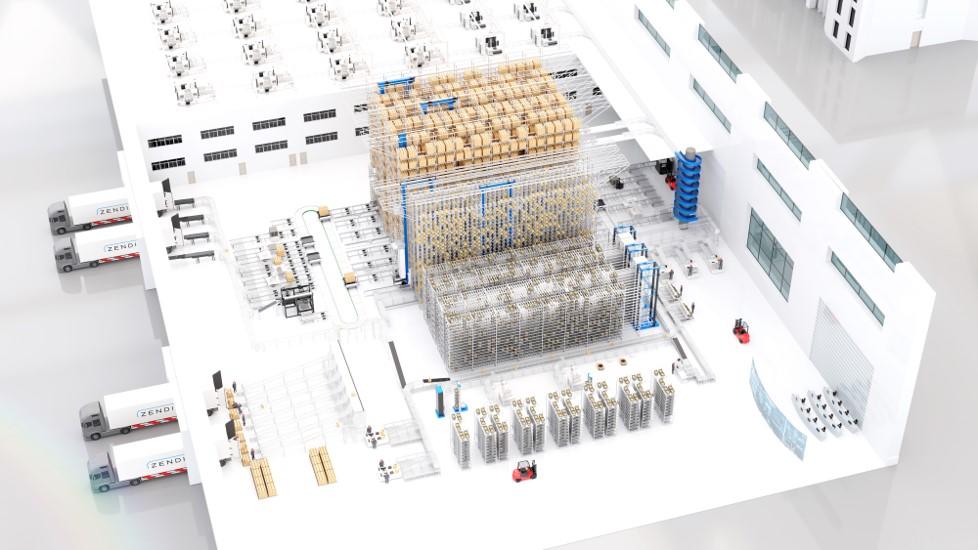
One-Stop Steward Service for the Entire Logistics System Integration Chain
Zhongding Intelligent (Wuxi) Technology Co., Ltd.

Multi-function Marine Monitoring Low-altitude Detection Radar Sea-air Boundary Ocean Dynamic Environment Measurement
Chengdu Dixin Technology Co., Ltd.
G.652.D Wavelength-extended Non-dispersion Shifted Single-mode Optical Fiber
HONGAN GROUP CO., LTD.