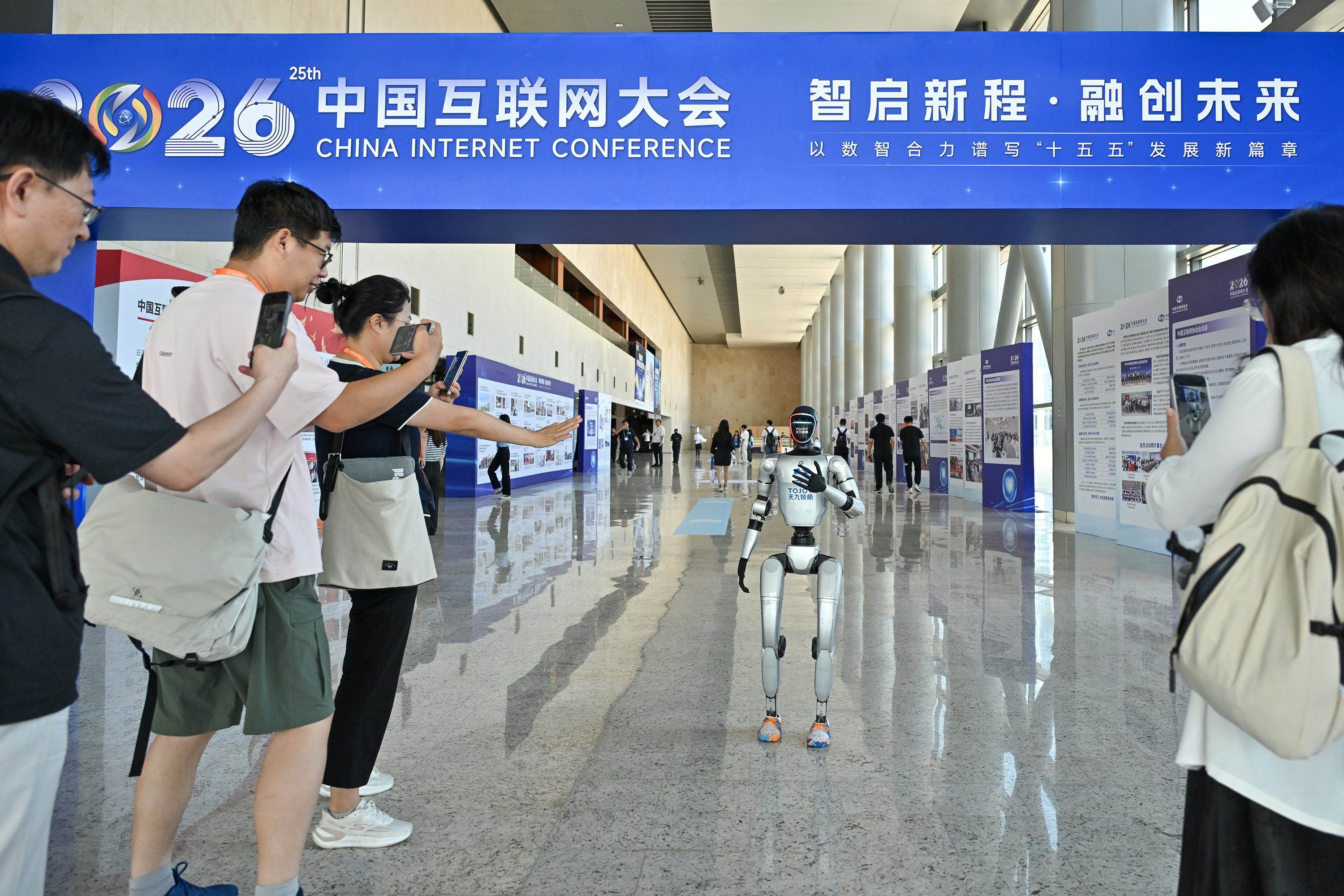
en.Wedoany.com Reported - The 2026 (25th) China Internet Conference opened in Beijing on July 8. Focusing on the underlying transformation driven by AI, the conference proposed localized solutions to industry issues such as computing power fragmentation, Token commercialization, and multi-agent collaboration.
During the opening ceremony, Wu Hequan, an academician of the Chinese Academy of Engineering, stated in a video keynote report that by 2030, global AI traffic will account for over 60% of total traffic, the domestic Token structure will be completely reshaped, and agent service traffic will rise to 75%. He pointed out that the industry has moved beyond the stages of prompt engineering and context engineering, and that agent collaborative control suites will become the core focus of the next phase, with the restructuring of computing power network architecture being an urgent priority.
At the conference site, the "Zhongzhi FlagOS Prairie Fire Plan" was launched. Huang Tiejun, Chairman of the Beijing Academy of Artificial Intelligence (BAAI), introduced that the plan will unite the three major telecom operators, cloud vendors, and research institutes. Through scenario-based pilots, talent co-development, and standard setting, it aims to connect the entire chain from core components and models to industry applications, with the goal of addressing China's shortcomings in AI foundational software and laying the groundwork for large-scale deployment of heterogeneous computing power.
Representatives from participating telecom operators highlighted the trend of shifting from "traffic management" to "Token management." China Telecom, China Mobile, and China Unicom jointly called for deep collaboration between computing and electricity, computing and networks, and data and computing, to resolve challenges related to computing power energy consumption and data circulation.
Wang Lei, Vice President of Huawei Technologies Co., Ltd. and President of Huawei's Data Communication Product Line, proposed the concept of "accessing the network means accessing computing power," aiming to build a computing power network for lossless Token transmission. Ma Hongbin, Senior Vice President of Kuaishou Technology, suggested leveraging multimodal large models to empower county-level industries and using AI to reduce marketing costs for small and medium-sized merchants.
Experts at the conference believe that the value of the internet is being upgraded, shifting from connecting people and information in the past to enabling comprehensive collaboration across computing power, models, and agents. Unlocking synergy across the entire photoelectric, computing power, and data industry chain, and relying on three pathways—independent infrastructure, deep scenario cultivation, and green computing power—are key to continuously unleashing new digital and intelligent productive forces and solidifying the foundation of Digital China Construction.