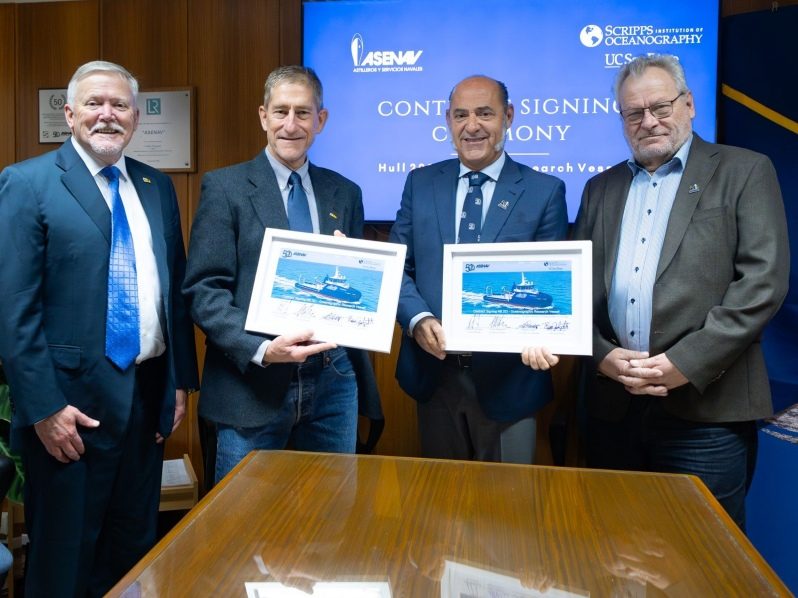
en.Wedoany.com Reported - Chilean shipyard ASENAV has signed a construction contract with the University of California San Diego to deliver a hybrid-powered oceanographic research vessel that will join the U.S. Academic Research Fleet, which provides research vessels to U.S. universities and scientific institutions.
Designated as Project NB 201 and designed by U.S. firm Glosten, the vessel will replace the near-coastal research vessel Robert Gordon Sproul, which has been in service for nearly four decades. The construction, systems integration, sea trials, and certification process are expected to take 24 months, with delivery scheduled for July 2028. The new vessel will be homeported in San Diego, California, and will operate more than 200 days per year conducting scientific surveys in the Eastern Pacific Ocean, supporting research at the Scripps Institution of Oceanography.
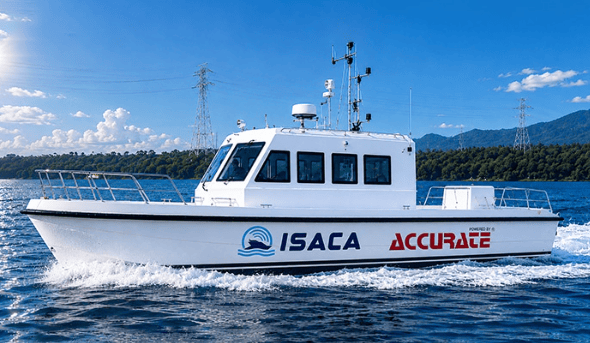
The new vessel belongs to the "Coastal" class of the U.S. Academic Fleet, with an overall length of 38 meters, a beam of 10.2 meters, and a draft of 3 meters. It has a maximum capacity of 20 people (crew, scientists, and students) and can carry out research missions of up to 11 days; for single-day teaching missions, it can accommodate 40 students, with a planned operational capacity of up to 55 missions per year. The vessel is equipped with a hybrid propulsion system consisting of two stern L-Drive azimuth thrusters and a bow thruster, enabling precise maneuvering and station-keeping during scientific operations. The operating profile specifies speeds by mission type: 10 knots for transit, 8 knots for scientific surveying, 2 knots for towing equipment, and dynamic positioning for station-keeping operations.
The design integrates multiple oceanographic systems to support research in physical oceanography, marine biology, geology, geophysics, and marine chemistry. Key equipment includes: a multibeam echosounder system and sub-bottom profiler for seafloor mapping; acoustic Doppler current profilers for measuring ocean currents; multi-frequency sonar for detecting biomass and fish in the water column; and an ultra-short baseline (USBL) acoustic positioning system for tracking and controlling autonomous underwater vehicles (AUVs). Deck cranes, winches, and an A-frame are used to deploy scientific instruments and remotely operated vehicles (ROVs) to a maximum operating depth of 4,000 meters. The vessel also features an integrated computer network and satellite links for real-time transmission of scientific data.
The most demanding aspect of the project lies in meeting strict acoustic and environmental performance parameters. The vessel must ensure low airborne and underwater noise during survey operations at speeds of 1 to 10 knots, to avoid interfering with oceanographic measurements and to minimize impacts on marine ecosystems. The analysis and verification of these parameters are handled by Noise Control Engineering, a specialized subsidiary of Glosten, which will verify that the vessel complies with established noise standards. The design also includes battery-hybrid propulsion, low-emission systems, an uninterruptible power supply (UPS), and redundant systems, the latter ensuring continuous operation of research missions.
To join the U.S. Academic Fleet, the vessel must meet the technical and regulatory requirements of the American Bureau of Shipping (ABS), the U.S. Coast Guard (USCG), and applicable federal, state, and local regulations. This project represents a new export of Chilean shipbuilding engineering to the scientific sector, integrating hybrid propulsion, dynamic positioning, and advanced oceanographic systems for highly complex near-coastal research operations.