Norwegian Study: Moisture Content in Ground-Mounted PV Modules Up to 37% Higher Than Floating PV
en.Wedoany.com Reported - An international study led by Norwegian scientists compared the humidity-induced stress levels experienced by floating photovoltaic (FPV) and ground-mounted photovoltaic (GPV) modules under different climatic conditions. Using multi-year meteorological data from seven inland water bodies and adjacent land areas, the research team simulated module temperature, relative humidity, and moisture ingress. The results show that humidity-induced stress over water is not necessarily more severe than on land, and that climatic region and system design parameters may have a greater influence.

The study covered Sweden's Stortjärn, Erssjön, and Lake Erken, Norway's Lake Almbergasjön, Washington Lake in the United States, Harp Lake in Canada, and Lake Taupō in New Zealand. The researchers analyzed on-site data on air temperature, relative humidity, wind speed, and water temperature at each measurement point, combined with ERA5 irradiance data. They used the Faiman photovoltaic temperature model to simulate module temperature and humidity conditions, and then employed a three-dimensional finite element diffusion model to simulate moisture ingress over 25 years in both glass-glass and glass-backsheet modules. The study also examined the influence of design parameters such as module installation height above the water surface and system heat transfer efficiency on humidity-induced stress.
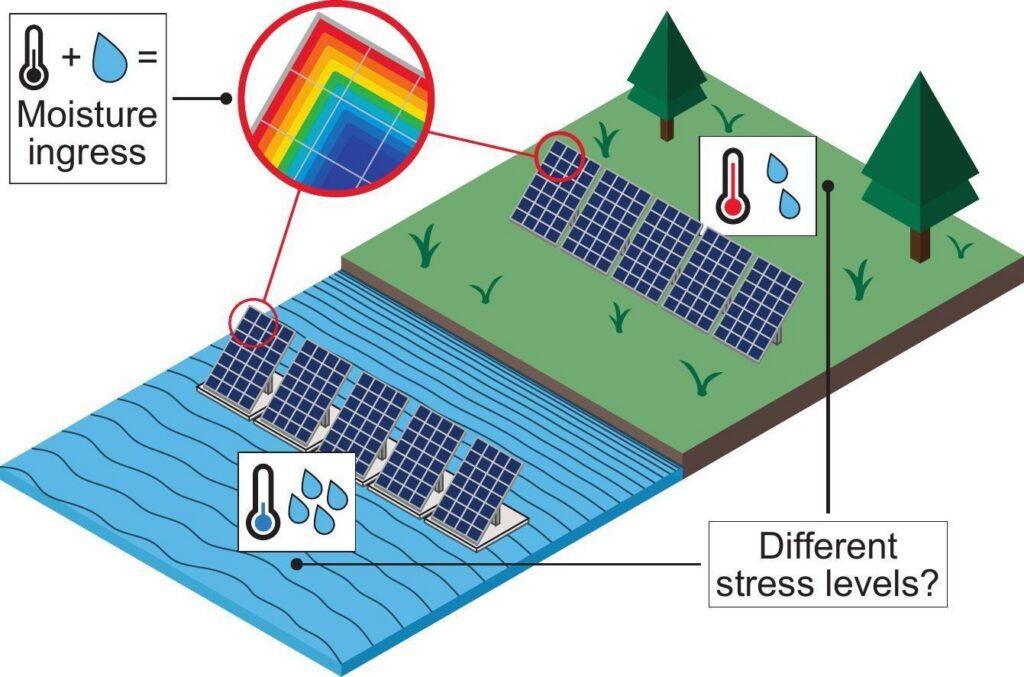
Author Nathan Roosloot stated that this is the first study to systematically compare humidity-induced stress levels between over-water and land-based installations under different climatic conditions, filling a knowledge gap regarding humidity-induced degradation in floating PV modules and their comparison with ground-mounted PV. He added that such research helps in understanding the reliability of floating PV modules and provides a scientific basis for developing dedicated testing protocols and material selection standards for floating PV.
The simulation results show that ambient and module temperatures over water and on land are similar, with absolute mean differences of less than 2 degrees Celsius. Relative humidity over water can be either higher or lower than on land, with absolute mean differences of up to 9 percentage points depending on location. Daily temperature and relative humidity fluctuations on land are greater than over water, which the researchers attribute to the stabilizing effect of water bodies. In terms of internal moisture content, ground-mounted PV modules were higher than floating PV modules in most cases, with average concentrations up to 37% higher. The design of the floating PV system had a more significant impact on moisture ingress: variations in module height above the water surface could alter average moisture concentration by up to 47%, while differences in system heat transfer efficiency could result in changes of up to 42%.
The researchers noted that floating PV modules may not always require special design or testing protocols for enhanced humidity-induced degradation. The study also demonstrates that reliability findings for floating PV depend heavily on climatic region and system design, making it difficult to transfer results between different floating PV systems and challenging to define the "floating environment" as a single concept.
The research findings were published in the journal Solar Energy under the title "Comparison of humidity-induced stress levels between floating and ground-mounted photovoltaics." Participating institutions include Norway's Institute for Energy Technology, University of Oslo, Norwegian Institute for Water Research, King County (United States), University of Wisconsin-Madison, Macalester College, State University of New York at Oneonta, University at Albany, Swedish University of Agricultural Sciences, Victoria University of Wellington (New Zealand), Ministry of the Environment, Conservation and Parks (Canada), Queen's University, University of Saskatchewan, and Italy's Edmund Mach Foundation.
Related Products


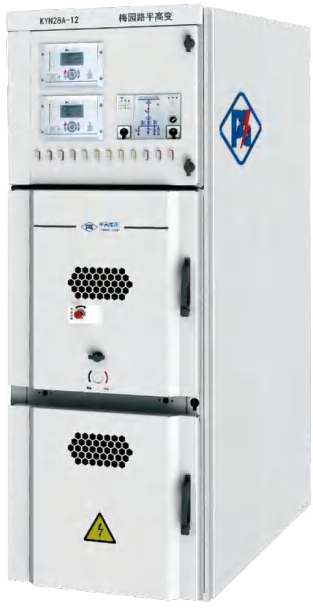
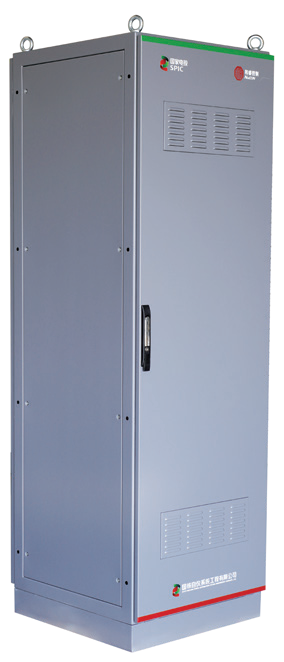
KYN28A-12 Metal Armored Removable Switchgear
Tianjin Ping Gao Intelligent Electric Co., Ltd.
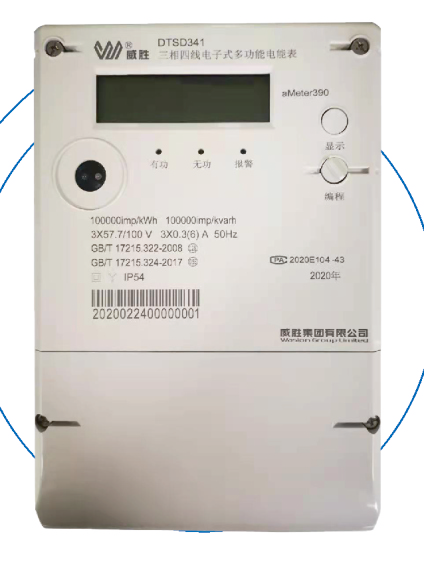
Overseas IEC Gateway Energy Meter - DTSD341/DSSD331-aMeter390
Wasion Group Limited Co., Ltd.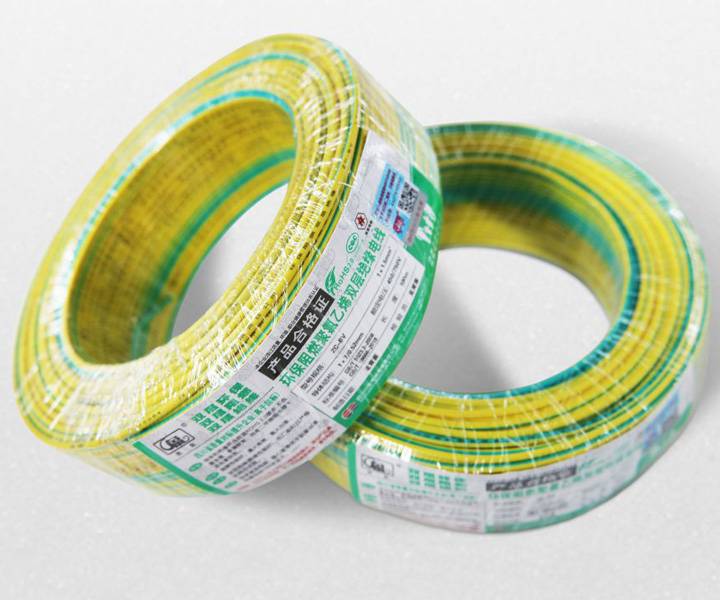
Environmentally Friendly Flame-retardant PVC Double-layer Insulated Wire
Sichuan Chndo Cable Co., Ltd.
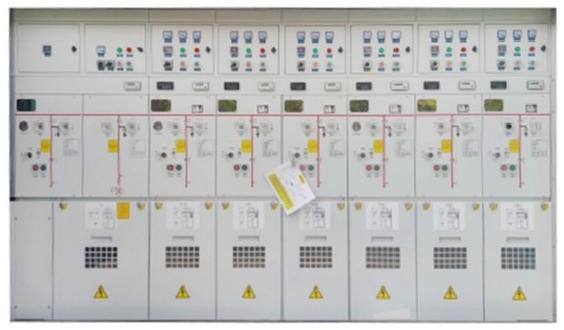
NISELA Series Environmentally Friendly Gas-Insulated Ring Main Unit
XJ DELISHIER ELECTRIC CO., LTD.
TAI Slew-drive Single-axis Independent 1P Tracking Bracket System
ANTAI TECHNOLOGY CO., LTD.
KYN28-12/24 Indoor High-Voltage Metal-Clad Removable Switchgear
Shenzhen Zhaoyang Hui Technology Co., Ltd.