Cornell Receives $7.5 Million to Develop Orchard Robots
en.Wedoany.com Reported - On September 3, Cornell University launched a 4-year orchard robotics research project, funded by a $7.5 million grant from the U.S. Department of Agriculture's Specialty Crop Research Initiative, and will establish an Orchard Robotics Center of Excellence within the Department of Biological and Environmental Engineering at Cornell. Led by Cornell University, the project brings together multiple U.S. universities, orchard operators, and robotics companies to develop autonomous robots capable of performing tasks such as pollination, fruit thinning, apple harvesting, and inter-row weeding in orchards.
The project is led by Professor Manoj Karkee of Cornell University, with Matthew Whiting, Professor of Tree Fruit Horticulture at Washington State University, serving as co-lead. Participating institutions include Washington State University, Oregon State University, Penn State University, Michigan State University, Carnegie Mellon University, Stanford University, and Israel's Fresh Fruit Robotics, with Washington Fruit and Produce of Washington State also involved in the project. The research is additionally supported by Federal Capacity Funds administered by the Cornell University Agricultural Experiment Station.
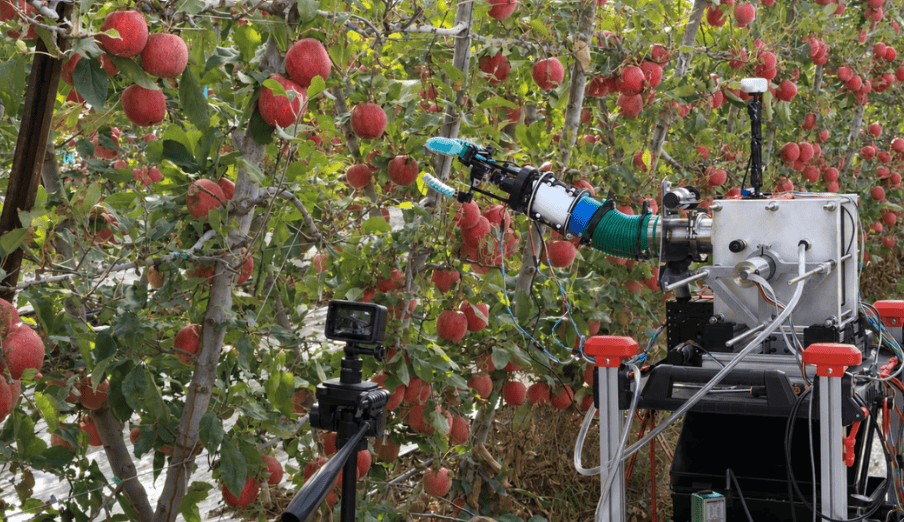
The robotics development will simultaneously cover autonomous mobility, environmental perception, and fruit manipulation. The research team plans to equip the robots with autonomous navigation capabilities, using artificial intelligence to identify leaves, branches, trellis wires, and fruit, determine the positional relationships between fruit and surrounding branches and structures, and plan the robot's movement and operational paths within the orchard accordingly. For fruit grasping, the Karkee team has been continuously developing flexible robotic hand mechanisms capable of reducing fruit damage.
The project will also establish digital twin models of real orchards for tree crop cultivation analysis and robot development testing, as well as to train artificial intelligence to recognize tree canopies and young fruit. For example, in fruit thinning operations, the system needs to determine which young fruit should be removed in the early spring so that the remaining fruit can continue to grow. The research team is also designing the robot as a multi-task platform, studying its sequential application across different stages, including winter pruning, spring pollination and fruit thinning, in-season weeding, and autumn harvesting.
This project integrates teams from agricultural engineering, computer science, and horticulture into a unified research framework, and will collect feedback from New York State apple growers on equipment functionality and operating conditions through Cornell Cooperative Extension. Fresh Fruit Robotics will participate in robot commercialization and orchard application validation, and the project will continue to advance over the 4-year research cycle, focusing on robot autonomy, multi-operation capabilities, digital orchard modeling, and adaptation to real-world production.
Related Products



Industrial and Commercial Point-Type Gas Detector
Jinan Benan Technology Development Co., Ltd.
4HS-8 High-efficiency Peanut Inverted-laying Harvester
Hebei Yongfa Hongtian Agricultural Machinery Manufacturing Co., Ltd.
714CD Series C-Band Weather Radar
Chengdu Zhongdian Jinjiang Information Industry Co., Ltd.