
China has achieved another landmark breakthrough in the field of intelligent equipment, as the country's first embodied intelligent special robot has been officially deployed for high-risk scenarios. This robot integrates a humanoid dual-arm system, magnetic climbing capability, and large-model intelligence, enabling it to replace human labor in high-risk tasks such as welding, flaw detection, and rust removal in chemical storage tanks, ships, energy facilities, and other settings.
The upper body of the robot resembles a humanoid robot. With 15 degrees of freedom in total, it features highly dexterous arms capable of performing operations at any angle.
Its lower body is a stable wheeled-plus-magnetic chassis. The robot weighs approximately 90 kilograms. With such weight, will it fall off vertical walls? Its powerful electromagnetic performance ensures stable movement on metal tanks, and even when carrying an adult, it can effortlessly scale walls and operate flexibly, akin to a martial arts master with extraordinary lightness skills.
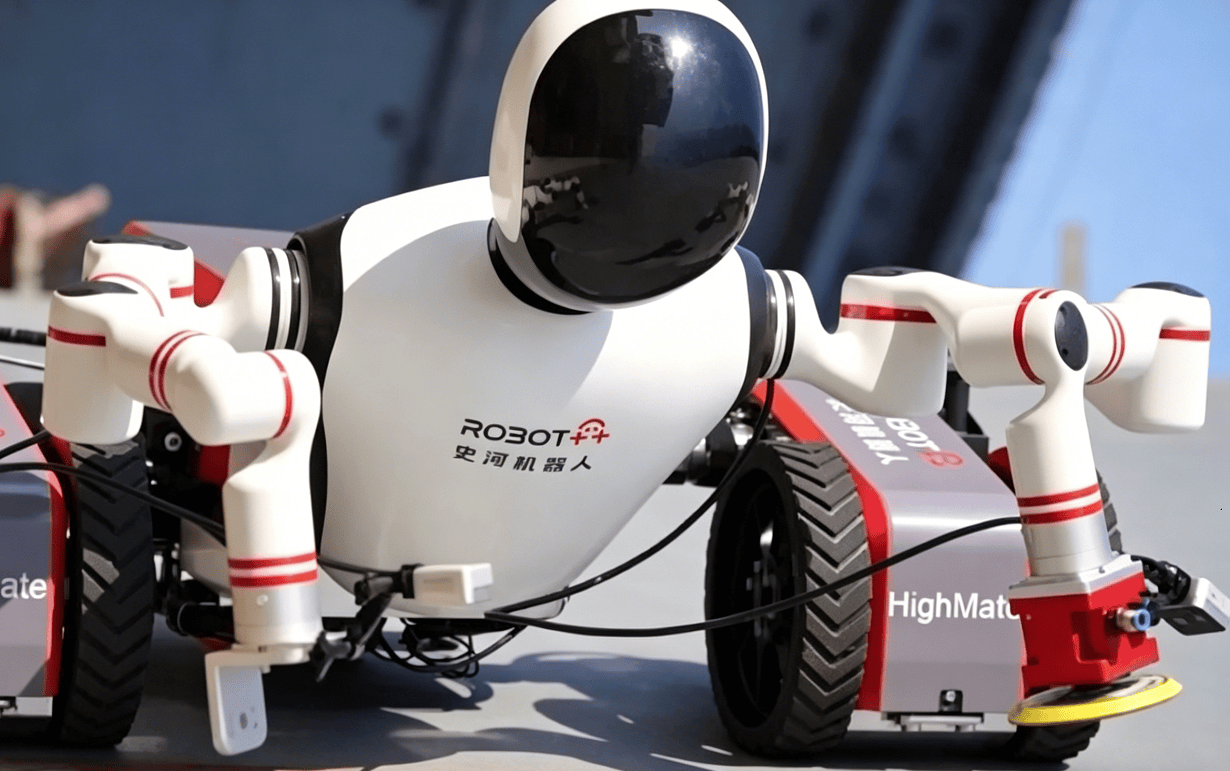
Compared to traditional single-function climbing robots, this robot is a true multi-tool. By simply changing different hand attachments, it can quickly switch between tasks, performing flaw detection, rust removal, spraying, and more—it masters a variety of skills. This significantly shortens construction timelines and improves operational efficiency, while also delivering more consistent quality than manual work. Additionally, it uses cable power, allowing for continuous, long-duration operation without range anxiety. With this intelligent coworker, construction safety has been greatly enhanced.
Equipped with a remote control device paired with VR goggles, its two robotic arms feature 12 movable joints that move smoothly in all directions. Its response time is measured in milliseconds, and the robot’s dual-arm movements are fully synchronized 1:1 with the operator's arms. With this remote control system, operators can safely sit in an office and remotely control the robot hundreds of meters in the air, immersing themselves in performing various high-risk tasks alongside it.
The biggest difference from traditional climbing robots is that it bridges the gap between AI and the physical world, allowing AI intelligence to be truly applied in specialized high-risk scenarios such as chemical, maritime, energy, and manufacturing industries. This marks the first time China has integrated embodied intelligence into specialized industrial robots.
Pu Xiao, head of the embodied special robot R&D team, stated: "Behind this robot is China's largest specialized robotic large model. To train the model, our robots have accumulated over 100,000 hours of operation, covering an operational distance of 22,500 kilometers—equivalent to more than half of Earth's equator—and a cumulative operational area exceeding 5,000 square kilometers, which is roughly two and a half times the size of Shenzhen. The vast and rich set of cases has allowed this robot to fully learn and become increasingly intelligent."
With this large model, not only aerial robots but also a ground-based counterpart—the land patrol robot—plays a key role. It features a robust robotic arm with six axes, providing high flexibility to replace humans in dangerous scenarios such as fires or toxic gas leaks, enabling tasks like shutting down switches or rotating valves. It also has a "far-seeing eye," capable of detecting fires or malfunctions within a 2,000-meter range and issuing timely warnings to minimize risks.