
Long-distance entanglement between quantum memories is the technological foundation for building a quantum internet, with potential applications in relay-based long-distance quantum communication, distributed quantum computing, and distributed quantum sensing. The key to extending the entanglement distance between quantum memories lies in improving the entanglement success rate. To this end, the team has continuously conducted research on entanglement connection based on single-photon interference over the years, overcoming technical challenges such as phase locking over long optical fibers, remote phase synchronization of independent lasers, and high-efficiency low-noise quantum frequency conversion. To further extend the entanglement distance to several hundred kilometers, it is also necessary to further reduce channel transmission loss and improve the long-term stability of single-photon phase locking.
The research team shifted the wavelength of the quantum memories from 795 nanometers to 780 nanometers and replaced the quantum frequency conversion scheme, enabling signal photons to match the ultra-low-loss transmission window of optical fibers. In terms of single-photon phase locking, the team developed a dual-wavelength, three-frequency phase locking technique combining full-time and time-division methods, significantly improving the long-term stability of photon phase locking over ultra-long optical fibers. Combining these two new technologies, the researchers conducted two-node entanglement experiments over optical fiber links of varying lengths. The experiments found that up to 420 kilometers, the outgoing photons from two cold-atom quantum memories maintained stable single-photon interference, and quantum entanglement between the memories was directly verified.
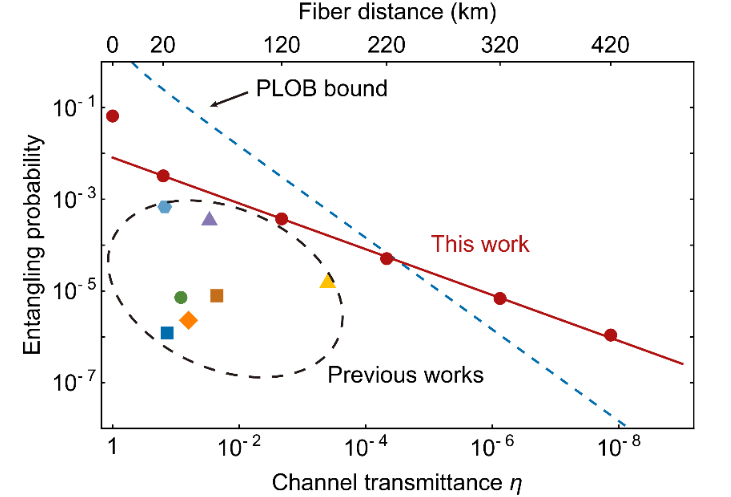
The researchers stated that this work not only achieves a significant increase in the entanglement distance between memories but also makes an important breakthrough in the entanglement distribution success rate, surpassing the theoretical limit of direct quantum entanglement distribution at long distances (over 230 kilometers). The related technologies make it possible to construct intercity-scale quantum networks and conduct related application research.